WESTERN PACIFIC ODYSSEY
19th April 19th May 2011
SYSTEMATIC LIST
The taxonomy and English names used in this checklist generally follow The Clements Checklist of the Birds of the World by James Clements with revisions made where an alternative name/taxonomy is considered more appropriate.
This systematic list was compiled by Chris Collins (based on the figures agreed at the nightly logs) and includes all species recorded between departing Tauranga and arriving in Yokohama.
Accurately counting seabirds at sea is extremely difficult (eg as one can never be sure which birds are following or revisiting the ship), so the system outlined below was adopted, with this also used for the more numerous land birds:
1-10 = actual number seen
11-100 = A
101-1,000 = B
1,001-10,000 = C
10,001-100,000 = D
Non-native introductions are shown in brackets.
____________________________________
BIRDS
Australasian Grebe Tachybaptus novaehollandiae
A single bird seen at Riviere Bleue National Park, New Caledonia (26 April) was the first record for the WPO.
Gibson’s Albatross Diomedea gibsoni
A number of birds showing characteristics of this form/species were seen in the Hauraki Gulf (20 April) with a further ten individuals seen over the following two days.
Short-tailed Albatross Phoebastria albatrus
After a seven hour chumming session close to Torishima Island, a single sub-adult bird was attracted in and then spent well over an hour close to the ship with everyone onboard enjoying great looks at this extremely rare species.
Laysan Albatross Phoebastria immutabilis
This species can be tricky along the WPO route, however, a single bird was seen shortly before the ship entered Tokyo Bay on the afternoon of 18 April.
Black-footed Albatross Phoebastria nigripes
The first sightings of this species were on 15 May (east of the Bonin Islands) where A was logged. Similar numbers were seen on the subsequent two days, with the final birds being as the ship sailed north from Miyake-jima to Tokyo Bay on 18 May (4 individuals).
Campbell Albatross Thalassarche impavida
Three were seen in the Hauraki Gulf on 20 April with eight individuals the following day. The characteristic honey-coloured eyes of this form/species were well seen on some of the closer birds.
White-capped Albatross Thalassarche steadi
Seven birds were seen in the Hauraki Gulf (20 April) with a singleton the following day.
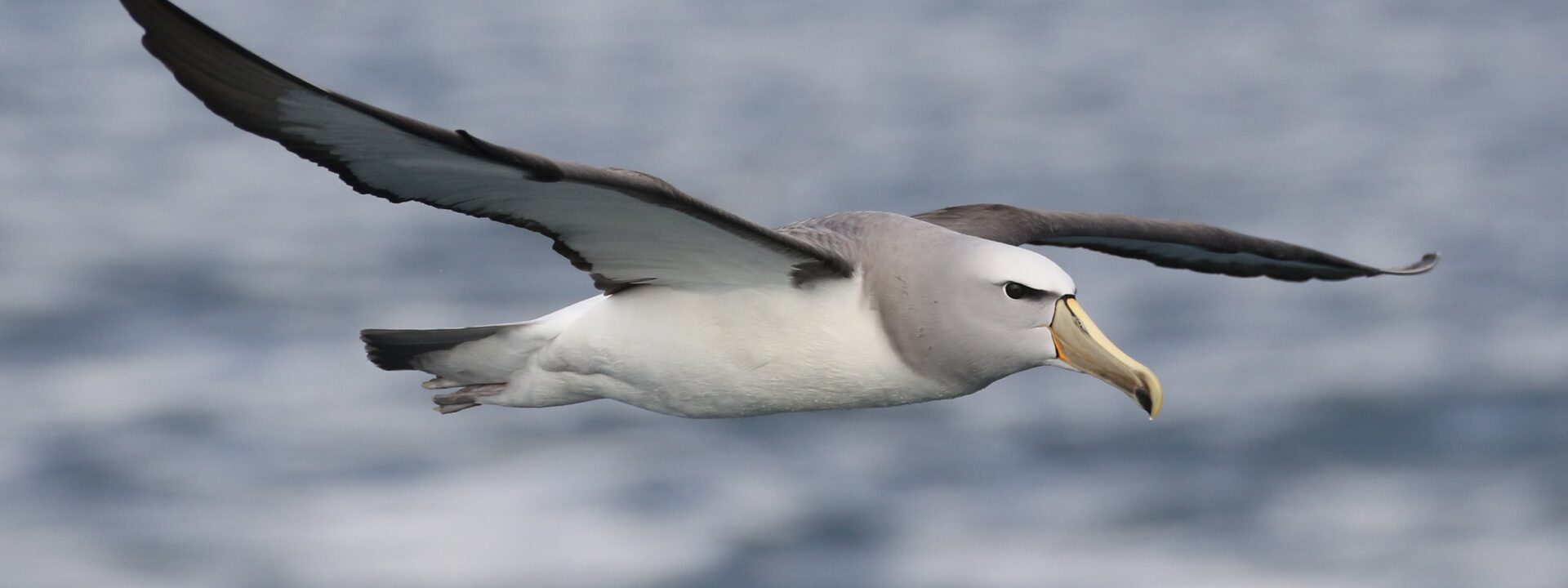
Salvin’s Albatross Thalassarche salvini
One bird in the Hauraki Gulf on 20 April was the only sighting of the expedition and the first confirmed record for the WPO.
Pacific Albatross Thalassarche platei
At least three individuals were seen in the Hauraki Gulf (20 April) with a single bird the following day.
Based on photos, it appeared that the birds were ‘Pacific Albatrosses’ which is split by some authorities from Buller’s Albatross.
Beck’s Petrel Pseudobulweria becki
One of the major specialities of the voyage, with at least four individuals of this extremely poorly known species seen over a chum slick off New Ireland on 5 May. These birds were flying with Tahiti Petrels and the size difference and different flight action were very apparent.
A single bird was also seen the previous evening off NW Bougainville although the prolonged views were much better the following day.
Tahiti Petrel Pseudobulweria rostrata
This species was seen on a regular basis from 22-29 April inclusive (close to Norfolk Island day south of Rennell Island) with A logged on four dates and single figure counts on the other days.
The only other sightings were around Bougainville and New Ireland (4-5 May) with a lone bird off Bougainville and six recorded the following day.
Grey-faced Petrel Pterodroma gouldi
Good numbers were seen on a daily basis between the Hauraki Gulf and a day north of Norfolk Island with B logged on 20-22 April. Smaller numbers were then seen after leaving Norfolk Island (23 April) and the following sea day, with a low A logged on both occasions.
Providence Petrel Pterodroma solandri
This species is not recorded annually on the WPO, however, two individuals were seen in the late afternoon after leaving Norfolk Island (23 April).
Kermadec Petrel Pterodroma neglecta
A total of nine birds were seen, with three logged on the sea day south of Norfolk Island (22 April) and four individuals on the day north of Norfolk Island (24 April). The final two birds were in the latter stages of the expedition, with one individual three days south of the Bonin Islands (12 May) and one a day north of these islands (16 May).
White-necked Petrel Pterodroma cervicalis
Seen in smaller numbers than on some previous WPO expeditions with sightings on only three dates. Three birds were recorded a day north of the Hauraki Gulf (21 April), a lone individual was noted shortly after leaving Norfolk Island (23 April), with the final sightings being four individuals the following day.
Cook’s Petrel Pterodroma cookii
Only seen in small numbers with four individuals in the Hauraki Gulf (20 April) being the only sightings.
Gould’s Petrel Pterodroma leucoptera
Seen on a daily basis between 21-27 April (day 1 to Norfolk Island day 1 to Rennell) with the highest count being around the southern end of New Caledonia (25 April) when a low B was logged. At least 44 individuals were seen on 21 April when the ship was off the northern end of New Zealand which is the furthest south that reasonable numbers of this species have ever been seen on a WPO voyage.
Collared Petrel Pterodroma brevipes
At least seventeen individuals were recorded between Norfolk Island and the sea day north of Noumea (23-27 April) with this total being significantly higher than on most WPO expeditions.
This total included seven individuals which were seen within Australian territorial waters (ie north of Norfolk Island) where this species is regarded as an extreme rarity.
Bonin Petrel Pterodroma hypoleuca
The most northerly of the Pterodromas which are regularly seen on the WPO, with the first sightings being a day south of the Bonin Islands (14 May: A). The largest numbers were recorded in the vicinity of the Bonin Islands with B logged the following day, with smaller numbers over the final three days of the expedition.
Black-winged Petrel Pterodroma nigripennis
Encountered on a daily basis from a day north of the Hauraki Gulf (21 April) until we arrived at New Caledonia (25 April), with A logged on 22 and 23 April and smaller numbers on the other dates.
Fairy Prion Pachyptila turtur
A was logged in the Hauraki Gulf on 20 April with four birds then seen the following day.
Bulwer’s Petrel Bulweria bulweria
Seen in far higher numbers than on any previous WPO expedition, with sightings on nine dates and a total of over sixty individuals recorded. The first bird was on 29 April (a day south of Rennell), however, between 6-15 May (a day north of New Ireland Bonin Islands), birds were seen on eight days, with the highest count being 21 individuals two days south of the Bonin Islands.
Black Petrel Procellaria parkinsoni
A low A was recorded in the Hauraki Gulf (20 April) with a further four birds noted the following day.
Streaked Shearwater Calonectris leucomelas
This species is sometimes recorded off New Ireland but there were no sightings there on this occasion, however, on the last three days of the expedition, there were daily sightings with C logged (ie well over 1,000 individuals) between Miyake-jima and Tokyo Bay (18 May).
Flesh-footed Shearwater Puffinus carneipes
This species was recorded at both ends of the voyage, with a high A in the Hauraki Gulf and four birds the following day. A total of twelve birds were also seen between 14-18 May (day south of the Bonin Islands Tokyo Bay) with the only other sightings being two birds off New Ireland on 5 May.
Great Shearwater Puffinus gravis
The lone Great Shearwater which was with a small flock of Buller’s Shearwaters off the Poor Knights Islands in the outer Hauraki Gulf (20 April) was undoubtedly one of the biggest surprises of the expedition.
Prior to 2011, there were only a handful of records of this species from New Zealand waters and the record (plus photos) will be submitted to the NZ rarities committee.
It is worth noting that irrespective of which way this individual had come round Antarctica, it was at least 12,000 kilometres from the Tristan da Cunha archipelago, ie the only place where this species breeds.
Wedge-tailed Shearwater Puffinus pacificus
Along with Short-tailed Shearwater, this was the joint most frequently encountered species on the voyage with sightings on 25 dates. The first records were a day south of Norfolk Island (22 April: B) and birds were then seen on an almost daily basis until a day north of Torishima, with the only days when birds were not recorded being on the day we landed on Kolombangara and the sea day off New Ireland. On most dates, A or B was logged with the highest count being on the morning before reaching New Caledonia when a low C (ie in excess of 1,000 birds) was recorded.
During the first half of the trip, dark phase birds predominated, however, during the latter stages of the trip almost all the birds were pale.
Buller’s Shearwater Puffinus bulleri
Only seen in the Hauraki Gulf on 20 April where B was recorded.
Sooty Shearwater Puffinus griseus
Only recorded in the early stages of the voyage with a total of eleven birds recorded in the Hauraki Gulf and over the next couple of days (20-22 April).
Short-tailed Shearwater Puffinus tenuirostris
This species was recorded on 25 dates with almost daily sightings from a day north of the Hauraki Gulf (20 April) until reaching Tokyo Bay (18 May).
The highest numbers were as the ship approached Noumea on 25 April when, at times, there was an almost constant stream of migrating birds. These were heading south-east along the coastline and were presumably rounding the southern end of New Caledonia before continuing north. It was difficult to accurately assess numbers but a high C (ie approaching 10,000 individuals) was logged.
Fluttering Shearwater Puffinus gavial
A low A was logged in the Hauraki Gulf (20 April).
Little Shearwater Puffinus assimilis
Six birds were seen in the Hauraki Gulf on 20 April, however, quite exceptional numbers were seen around Norfolk Island with almost two hundred individuals logged as the ship sailed north away from the island (23 April). A few birds were also seen the previous evening (with a low A logged) as we approached Norfolk Island.
The birds seen around Norfolk Island were presumably of the race assimilis which breeds on Norfolk Island. It is interesting to note, however, that according to Margaret Christian who wrote the field guide to the birds of the island, there are summer and winter breeding populations which vary so markedly in size that they require different size leg rings !!
Atoll (“Tropical”) Shearwater Puffinus (bailloni) dichrous
The first sighting was near Noumea on 26 April with a single bird then also seen offshore from Guadalcanal on 2 May. Birds were then seen again close to the reef entrance at Chuuk (8 May: 6; 9 May: A) with the only other sighting being a single bird whilst passing the North Mariana Islands on 12 May.
Although the Audubon’s/Little/Tropical Shearwater complex has recently been split by several authorities, it seems unlikely that the situation has been fully resolved with the name ‘Atoll shearwater’ used to describe the birds seen on this voyage, ie to differentiate them from those in the Indian Ocean. Even this is probably a simplification of the situation, however, as there do seem to be some visual differences between some of the populations seen on the expedition.
Bannerman’s Shearwater Puffinus bannermani
The identification criteria for this poorly known bird remain somewhat confused, especially as Tropical Shearwaters also seemingly occurs in the waters between the North Marianas and the Bonin Islands. Birds which were considered to be Bannerman’s Shearwaters were, however, seen east of the Bonin Islands and the sea day south of this archipelago (14-15 May).
Heinroth’s Shearwater Puffinus heinrothi
One of the star seabirds of the WPO with at least fifteen seen off western Bougainville on 4 May. A lone bird was also noted close inshore to Kolombangara the previous afternoon.
Wilson’s Storm-petrel Oceanites oceanicus
This species was seen periodically throughout the voyage being recorded on twelve dates. The first sightings were four birds in the Hauraki Gulf (20 April) with the final sightings being two birds east of the Bonin Islands on 15 May. The typical number seen on any one day was between 1-4 birds although a low A (ie 10+ individuals) was logged on the day the ship arrived at New Caledonia (25 April) and on the two sea days after leaving Noumea (27-28 April).
New Zealand Storm-petrel Oceanites maorianus
Oiling in the outer Hauraki Gulf for this species proved highly successful with a low A (ie 10+ individuals) logged for the day and the maximum number seen at any one time being four birds.
“New Caledonia Storm-petrel”
Following the sighting of a bird resembling a New Zealand Storm-petrel approximately 20 miles off the coast of New Caledonia on WPO 2008, a similar looking bird was seen on the 2010 expedition. Oiling in the same area on the 2011 voyage proved successful and at least one individual was seen flying in close association with several Wilson’s Storm-petrels.
When a short article about the 2008 sighting was published in the British magazine Birding World (by Steve Howell and Chris Collins) reference was made to the fact that a number of observers felt the bird was too large for New Zealand Storm-petrel and the more recent sightings have reconfirmed this belief.
Although freshly fledged storm-petrels can have a greater bulk than adults, this would not explain what was seen in the field or the underwing pattern which seems too dark for New Zealand Storm-petrel.
The identity of this bird, therefore, remains unresolved and whilst some have suggested it is a juvenile New Zealand Storm-petrel (which would itself be a highly significant record), there are a number of compelling reasons for believing this suggestion is not correct. It is also worth noting that on all three occasions the birds have been very similar in appearance (ie none have looked like ‘classic’ NZSPs) which would also seem to count against this possibility.
White-faced Storm-petrel Pelagodroma marina
The first sightings were of two birds in the Hauraki Gulf on 20 April. A low A (ie 10+ individuals) was logged on the two following sea days, with three individuals also seen on the sea day north of Norfolk Island (ie 24 April).
The final sighting (which was the furthest north this species has ever been seen on a WPO expedition) was on 28 April (Day 2 to Rennell).
White-bellied Storm-petrel Fregetta grallaria
Three individuals were seen on 21 April as we cruised north towards Norfolk Island (day 1 to Norfolk Island). It is interesting to note that this species was not recorded on the first two WPO expeditions but 2011 was the third year in succession it has been seen.
Polynesian Storm-petrel Nesofregetta fuliginosa
A single individual was seen on 24 April (day 1 to New Caledonia) with a further three birds off northern New Caledonia on 28 April. Whilst the first sighting was only seen by a few of those on the ‘Spirit of Enderby’, two of the birds on 28 April performed well off the bows of the ship giving everyone some nice looks at this poorly known and rarely seen species.
Band-rumped Storm-petrel Oceanodroma castro
A total of seven Oceanodroma storm-petrels were seen and well photographed on 28-29 April (days 2-3 to Rennell). The birds appeared to be Band-rumped Storm-petrels, although according to Onley and Scofield, this species has never been recorded in the south-west Pacific south of the Equator.
Subsequent research has, however, established that others have seen this species a couple of hundred miles north of the Solomon Islands (2008) although it is clearly very poorly known in this part of the world.
Leach’s Storm-petrel Oceanodroma leucorhoa
This species was only seen in the late stages of the expedition with two birds east of the Bonin Islands (15 May) and four the following day (ie near to Torishima).
Tristram’s Storm-petrel Oceanodroma tristrami
The first sightings of this species were on the day the ship passed the Bonin Islands (15 May) with B logged. The following day A was recorded (ie up to 100 individuals) as the ship cruised towards Torishima but only five individuals were definitely identified the following day.
Matsudaira’s Storm-petrel Oceanodroma matsudairae
This species was seen on six dates with the first sightings being three days south of the Bonin Islands (12 May: 5 birds). For the following four days A was logged, with the final records being 2 birds on the sea day north of Torishima.
Common Diving-petrel Pelecanoides urinatrix
Good numbers were seen in the Hauraki Gulf on 20 April with B logged.
Red-tailed Tropicbird Phaethon rubricauda
The first sightings were a day north of the Hauraki Gulf (21 April: 2), with birds then seen on the subsequent three days including excellent views of this species on Norfolk Island.
Two individuals were then seen on the sea day south of Rennell, however, after this it was two weeks until the next records with a total of nine birds recorded east of the Bonin Islands and the two sea days south of there (13-15 May).
White-tailed Tropicbird Phaethon lepturus
Recorded on fourteen dates including daily sightings from New Ireland (5 May) until two days south of the Bonin Islands (13 May). There was only one occasion during the trip when more than 10 birds were logged (9 May: Chuuk) but otherwise all counts were in single figures.
Australian Gannet Morus serrator
The only records were in the Hauraki Gulf on 20 April when B was logged and the following day when a lone individual was recorded.
Masked Booby Sula dactylatra
This species was recorded on ten widely spread dates during the voyage with the largest numbers (A) recorded close to Norfolk Island (22 and 23 April). Smaller numbers (one individual/day) were then seen during the journey from New Caledonia to Rennell with the final sightings being off the North Mariana Islands (13 May).
Red-footed Booby Sula sula
Seen on fourteen dates between 25 April-15 May (the sea day south of New Caledonia Bonin Islands) although on most dates only a single figure count was recorded.
One sub-adult white morph bird roosted on the ship on the night of 13 May (two sea days south of the Bonin Islands) had a dark tail and thus showed the main characteristic of the Eastern Pacific subspecies websteri. The bird was well photographed and at the time of writing, investigations are ongoing to establish if there are other field marks which would help to confirm that this individual was indeed from the East Pacific.
Brown Booby Sula leucogaster
This species was first encountered near Norfolk Island on 23 April (when a single bird was logged) and was then seen on fifteen subsequent dates with the final birds being near Tokyo Bay on 18 May. On ten days, the numbers recorded was in single figures with A logged on all other dates.
Pied Cormorant Phalacrocorax varius
A lone individual on the Maori Rocks in the Hauraki Gulf (20 April) was the only sighting of the expedition.
Little Pied Cormorant Phalacrocorax melanoleucos
The only sightings of the voyage were on the trip to Riviere Bleue on New Caledonia (26 April) when five birds were observed.
Great Frigatebird Fregata minor
Although many of the more distant frigatebirds seen during the voyage were not identified to species, there were confirmed sightings of Great Frigatebird on seven dates with the first sightings (2 birds) being on Norfolk Island on 23 April and the final record off Bougainville on 4 May.
Lesser Frigatebird Fregata ariel
This species was only recorded during the second quarter of the trip, with the first confirmed sighting being a single bird on the sea day south of Rennell Island. Over the next week, Lesser Frigatebirds were then seen on six days (ie through the Solomon Islands to Bougainville) with the highest count being off Bougainville on 4 May when A was logged.
Grey Heron Ardea cinerea
As the ship cruised into Tokyo Bay on 18 May, A were logged.
White-faced Heron Egretta novaehollandiae
Recorded on Norfolk Island (23 April: 9 birds) and New Caledonia (26 April: 2 birds) with the only other sighting being over the Maori Rocks in the Hauraki Gulf where a presumably somewhat lost individual was recorded on 20 April.
Pacific Reef Heron Egretta sacra
Seen on four dates with one bird on Makira (1 May), three on Kolombangara (3 May) and five individuals on both days on Chuuk (8-9 May).
Striated Heron Butorides striatus
The three birds seen on the shore excursion on Makira (1 May) were the only sightings of the voyage.
Rufous Night-Heron Nycticorax caledonicus
This species was only recorded on Chuuk with two seen from the ship in the early evening of 8 May (as we awaited clearance from Immigration and Customs) and three the following day.
Yellow Bittern Ixobrychus sinensis
Six birds were observed during the shore excursions on Chuuk with sightings on both Weno and Tol South (9 May).
Australian Ibis Threskiornis molucca
This species is reasonably common on Rennell with A logged on 30 April.
Pacific Black Duck Anas superciliosa
Three were seen on Kolombangara on 3 May and the same number were then noted on Chuuk on 9 May.
Osprey Pandion haliaetus
This species was seen in small numbers (three birds/island) on three of the islands visited in the Solomons, namely Rennell (30 April), Makira (1 May) and Kolombangara (3 May). The only other records were on New Caledonia where there were a total of five sightings.
Pacific Baza Aviceda subcristata
Two birds were seen on Makira on 1 May, with the same number logged the following day at Mount Austin on Guadalcanal.
Whistling Kite Haliastur sphenurus
This species was only seen during the shore excursion to Riviere Bleue on New Caledonia with six logged on 26 April.
Brahminy Kite Haliastur Indus
This species was seen on three of the four landings in the Solomons (none on Rennell) with a total of ten individuals logged.
Solomon Islands Sea-Eagle Haliaeetus sanfordi
This impressive Solomon Islands endemic was seen on three islands with three birds on Makira (1 May) and a lone individual the following day at Mount Austin on Guadalcanal. The final sightings were three birds during the shore excursion on Kolombangara (3 May).
Swamp Harrier Circus approximans
The only record was of a single bird during the excursion to Riviere Bleue on New Caledonia on 26 April.
Variable Goshawk Accipiter hiogaster
A single bird was seen in a coconut plantation on Kolombangara on 3 May.
Brown Goshawk Accipiter fasciatus
There were seven sightings of this species on Rennell on 30 April.
Pied Goshawk Accipiter albogularis
This species is endemic to the Solomon Islands and birds were seen on Makira (1 May: 4) and at Mount Austin, Guadalcanal (2 May: 2).
New Caledonia Goshawk Accipiter haplochrous
Four birds were seen during the excursion to Riviere Bleue on New Caledonia (26 April) with prolonged views of two perched individuals giving us the best views on any of the five WPO expeditions.
Australian Kestrel Falco cenchroides
Three were seen during the shore excursion on Norfolk Island (23 April).
Melanesian Scrubfowl Megapodius eremita
A single bird was seen by some participants during the shore excursion on Kolombangara on 3 May.
[California Quail Callipepla californica]
A reasonably common introduction on Norfolk Island where A was logged on 23 April.
[Red Junglefowl Gallus gallus]
Another well established introduced species on Norfolk Island with B recorded (23 April).
Purple Swamphen Porphyrio porphyrio
Seen in small numbers on five islands, with single birds on Norfolk Island (23 April), New Caledonia (26 April), Rennell (30 April) and Guadalcanal (2 May). Three birds were also seen on 3 May whilst ashore on Kolombangara.
Common Moorhen Gallinula chloropus
An adult, with chicks, was seen on Chuuk on 9 May.
Kagu Rhynochetos jubatus
This species is always one of the major landbird highlights of the expedition and we enjoyed great looks at eight birds at Riviere Bleue, New Caledonia on 26 April.
Variable Oystercatcher Haematopus unicolor
Several birds were seen on the wharf as the ship sailed from Tauranga on 19 April.
Whimbrel Numenius phaeopus
The only sighting was a lone bird on Norfolk Island on 23 April.
Grey-tailed Tattler Heterosceles brevipes
The only land-based sighting of the expedition was a lone bird on Kolombangara on 3 May. There were also two “at sea” records with one seen migrating north (approximately 50 miles south of Chuuk) with a Wandering Tattler on 8 May, with another recorded near Torishima on 17 May.
Wandering Tattler Heterosceles incanus
Three were seen on Norfolk Island on 23 April, a single bird was photographed migrating with a Grey-tailed Tattler (8 May) and two were noted on Chuuk (9 May).
Ruddy Turnstone Arenaria interpres
Seen on the same islands as the previous species, with three on Norfolk Island (23 April) and three on the second day on Chuuk (9 May). Several birds were observed flying passed the ship on the sea day north of Torishima (17 May) with a lone bird also recorded a day south of the Bonin Islands (14 May).
Red-necked Phalarope Phalaropus lobatus
A number of small flocks were seen between Miyake-jima and Tokyo Bay (18 May) with A logged.
Grey Phalarope Phalaropus fulicarius
The only sighting of the voyage was a single bird east of the Bonin Islands on 15 May.
Pomarine Skua Stercorarius pomarinus
There were significantly fewer sightings of this species on WPO 2011 compared with previous voyages, with the only sightings being two birds east of the Bonin Islands on 15 May and four individuals between Miyake-jima and Tokyo Bay (18 May). This contrasts, for example, with WPO 2010 when twenty eight birds were seen across fifteen widely spaced dates with sightings from Noumea northwards.
Presumably the difference in the number of birds seen was due to the 2011 expedition being three weeks later and most individuals had, therefore, already migrated north to their Arctic breeding grounds.
Arctic Skua Stercorarius parasiticus
Single individuals were seen on seven dates with the first sighting being a day south of Rennell Island (29 April) and the final record a little south of Torishima (16 May).
Long-tailed Skua Stercorarius longicaudus
This species was only recorded during the second half of the expedition with a total of seven birds seen across five dates. Apart from a lone individual off New Ireland on 5 May, all sightings were spread across the last six days of the voyage, ie from a couple of days south of the Bonin Islands until the ship reached Tokyo Bay.
Silver Gull Chroicocephalus novaehollandiae
This species was reasonably numerous (A) around the harbour in Noumea, New Caledonia on both 25 and 26 April.
Red-billed Gull Chroicocephalus scopulinus
This New Zealand endemic was only seen around the Maori Rocks in the Hauraki Gulf, where there was a substantial flock of over 1,000 birds.
Laughing Gull Leucophaeus atricilla
Probably the biggest surprise of WPO 2011 was finding a 1st summer Laughing Gull flying around the wharf at Chuuk on 8 May. The bird was then seen the following afternoon as the ‘Spirit of Enderby’ sailed away from the archipelago.
It is interesting to note that it is 9,000 kms from Chuuk to the west coast of the USA and thus even further to where this species is normally found.
Kelp Gull Larus dominicanus
The only record of this species was as the ship left the wharf at Tauranga on 19 April where one juvenile was seen.
Black-tailed Gull Larus crassirostris
A single individual seen as the ship approached Tokyo Bay (18 May) was the only sighting of the voyage.
Great Crested Tern Sterna bergi
This species was seen close to the majority of islands between New Caledonia and Chuuk (with sightings on eight dates) with the highest count being as the ship left Noumea (26 April) when a low A was logged. On all other days when this species was recorded, all counts were in single figures.
Black-naped Tern Sterna sumatrana
The largest numbers were in the waters around Rennell where a high A (up to 100 individuals) was recorded on 30 April. Birds were also seen during the two days the ship was at Chuuk (8-9 May: A logged on both days) with the only other sightings being five birds as the ship approached Noumea on 25 April.
Whiskered Tern Chlidonias hybrida
A single bird was seen flying around the ship shortly after dawn on the morning of 17 May when the ship was approximately 25 nautical miles north of Torishima. Somewhat surprisingly, this was the first record of this species on any WPO expedition.
White-fronted Tern Sterna striata
Only seen as the ship left Tauranga on 19 April where a low A was logged.
Common Tern Sterna hirundo
This species was only recorded as the ship cruised between Miyake-jima and Tokyo Bay (18 May) with five individuals seen.
Fairy Tern Sterna nereis
Good numbers were seen just inside the reef entrance shortly before arriving at Noumea on 25 April.
Grey-backed Tern Sterna lunata
This species rarely seems to approach ships although birds were seen on 4 dates with the highest count being off Bougainville when a low A was logged. Four birds were also seen as the ship cruised towards Guadalcanal after leaving Makira on 1 May and single birds were seen off Kolombangara (1 May) and New Ireland (5 May).
Bridled Tern Onychoprion anaethetus
This species was only encountered between Makira and Bougainville (1-4 May) with A logged on each day.
Sooty Tern Onychoprion fuscata
Generally this species is one of the most frequently encountered seabirds on the voyage, however, on WPO 2011 there were sightings on only thirteen dates which was markedly lower than, for example, in 2010 when birds were recorded on twenty days.
There were only two dates when more than one hundred individuals (ie B) were seen, with these sightings being on day 2 from New Caledonia to Rennell (28 April) and three days south of the Bonin Islands (12 May). The number recorded on all other days was typically a low A or a single figure count.
Most sightings were between New Ireland and the Bonin Islands when this species was recorded daily except on 9 May, ie the day of shore excursions on Chuuk.
Black Noddy Anous minutes
This Noddy was encountered on sixteen days between a day south of Norfolk Island (22 April) and two days south of the Bonin Islands (13 May). The highest counts were around Norfolk Island and Chuuk, where a high B was logged (ie approaching 1,000 individuals).
Brown Noddy Anous stolidus
This species was first seen around Norfolk Island on 23 April and last recorded off the Bonin Islands on 15 May. Sightings were spread across fifteen dates, with the highest numbers being around Chuuk (8-9 May) and off the Bonin Islands (15 May) where B was logged.
Grey Ternlet Procelsterna albivitta
This species breeds in the Hauraki Gulf and on islets just offshore from Norfolk Island and was seen on a daily basis between these two locations (20 April-23 April) with A logged on most dates.
White Tern Gygis alba
Sightings of this species were almost exclusively divided into two discrete blocks with birds seen on a daily basis from the sea day south of Norfolk Island until arriving at New Caledonia island (22-25 April) and from 6-14 May (day north of New Ireland - day south of the Bonin Islands). The only record outside these periods was a lone bird a day south of Rennell on 29 April.
The highest counts were at Norfolk Island and Chuuk where this species breeds, with B logged at both locations.
Ancient Murrelet Synthliboramphus antiquus
Three birds were seen distantly in Tokyo Bay on 18 May.
Japanese Murrelet Synthliboramphus wumizusume
Japanese Murrelet is an early breeder and most young had seemingly fledged by the time of our visit (18 May) as only one adult bird was seen as the ship passed Miyake-jima, compared with 75+ individuals which had been seen in the same area the year before.
With the lone individual off Miyake-jima having been seen by only a handful, some expressed concerns that we might miss this key seabird, however, as the ship continued towards Tokyo Bay, there were multiple sightings of 30+ individuals. These included a party of 12+ birds and two adults and two chicks which stayed on the surface as the ship passed within 10m of them, giving the best ever WPO views of this species.
Metallic Pigeon Columba vitiensis
The only sighting of the expedition was a lone bird on Makira on 1 May. Although this was the fourth time the ‘Spirit of Enderby’ had visited this island/location, this was the first sighting of this species on this island.
[Spotted Dove Streptopelia chinensis]
This Asian introduction was seen on New Caledonia on both days, with a low A recorded on 25 April and two further individuals noted the following day on the drive back to Noumea from Riviere Bleue.
Mackinlay’s Cuckoo-dove Macropygia mackinlayi
This species was somewhat inconspicuous compared with some previous visits to the Solomon Islands, with a total of fourteen birds seen Rennell: three (30 April); Guadalcanal: eight (2 May) and Kolombangara: three (3 May).
Emerald Dove Chalcophaps indica
Seven birds were seen in the Botanical Gardens on Norfolk Island on 23 April were the only sightings of the voyage.
Stephan’s Dove Chalcophaps stephani
Two birds were seen on the shore excursion to Mount Austin (2 May), with a single individual seen on Kolombangara the following day.
Caroline Islands Ground-dove Gallicolumba kubaryi
This species is endemic to the Caroline Islands and was seen on the excursion to Tol South and by those who explored Japanese Gun on Weno (9 May), with a total of three individuals recorded.
Superb Fruit-dove Ptilinopus superbus
A single bird on Kolombangara (3 May) was the sole record of the expedition.
Crimson-crowned Fruit-dove Ptilinopus porphyraceus
Reasonably numerous on Chuuk, with A logged on 9 May and a few seen from the ship as we awaited clearance on the late afternoon of the previous day.
Silver-capped Fruit-dove Ptilinopus richardsii
This species is endemic to Rennell and a few nearby islets, however, it is fairly common with A recorded on 30 April.
Claret-breasted Fruit-Dove Ptilinopus viridis
Another range-restricted fruit-dove which was seen on Guadalcanal (A) on 2 May and Kolombangara (5 birds) on 3 May.
White-headed Fruit-dove Ptilinopus eugeniae
A Makira Island endemic which was well seen during the shore excursion on 1 May with six individuals logged.
Cloven-feathered Dove Drepanoptila holosericea
This New Caledonian endemic can be tricky to find and unfortunately was only heard during the excursion to Riviere Bleue National Park on 26 April.
Pacific Imperial-pigeon Ducula pacifica
This species was only seen on Rennell (30 April) with six individuals logged.
Red-knobbed Imperial-pigeon Ducula rubricera
This impressive looking pigeon was seen in reasonable numbers on Makira, Guadalcanal and Kolombangara (1-3 May) with A logged on all three islands.
Chestnut-bellied Imperial-pigeon Ducula brenchleyi
This poorly-known species is endemic to just three islands in the Solomons (plus a few islets) but seems to be reasonably common around Anuta, with six birds seen during the shore excursion on Makira on 1 May.
Island Imperial-pigeon Ducula pistrinaria
A flock of this nomadic species was seen on Makira (1 May) with two birds also noted on Kolombangara on 3 May.
New Caledonian Imperial-pigeon Ducula goliath
Four individuals were logged at Riviere Bleue on 26 April, with several of these seen exceptionally well.
Ducorps’ Cockatoo Cacatua ducorpsii
This species was seen at Mount Austin, Guadalcanal on 2 May and the following day on Kolombangara with A logged on both landings.
Cardinal Lory Chalcopsitta cardinalis
This brilliantly coloured parrot was seen on Rennell (30 April: 2), Guadalcanal (2 May: A) and Kolombangara (3 May: A).
Rainbow Lorikeet Trichoglossus haematodus
This species was common in downtown Noumea, New Caledonia (25-26 April), with a few birds also seen on the excursion to Riviere Bleue. It was also seen on Makira (A), Guadalcanal (2) and Kolombangara (A).
Yellow-bibbed Lory Lorius chlorocercus
A Solomon Islands endemic which was seen on Makira, Guadalcanal and Kolombangara (1-3 May) with the highest count being at Mount Austin where a low A was logged.
Duchess Lorikeet Charmosyna margarethae
The only records of this handsome parrot were on Kolombangara where four were seen on 3 May.
Finsch’s Pygmy-parrot Micropsitta finschii
Although this species is reasonably numerous in the Solomons, its tiny size can make it difficult to spot, however, it was seen on all four of the islands we visited in the archipelago with the highest count being on Rennell where a low A was recorded (30 April).
Horned Parakeet Eunymphicus cornutus
This New Caledonia endemic showed exceptionally well at Riviere Bleue (where it can be tricky) with eleven birds recorded undoubtedly the best showing by this species on any WPO visit.
New Caledonian Parakeet Cyanoramphus saissetti
Another species which is not seen on every WPO but everyone had excellent looks during the visit to Riviere Bleue, New Caledonia on 26 April with a low A being logged overall.
Norfolk Island Parakeet Cyanoramphus cookii
This species has apparently declined markedly in recent years and the closure of the captive breeding programme at the Botanical Gardens has also decreased the chances of finding it, as wild individuals used to regularly come to ‘talk’ with the captive birds. Although none were seen during our visit to the Botanical Gardens, a visit was made to Palm Glen where four birds were recorded.
[Crimson Rosella Platycercus elegans]
A reasonably common introduced species on Norfolk Island with a low A logged on 23 April.
Singing Parrot Geoffroyus heteroclitus
Seen in small numbers (single figure counts) on Rennell, Makira and Guadalcanal with birds also heard on Kolombangara.
Eclectus Parrot Eclectus roratus
Another stunningly beautiful bird which was recorded on Makira, Guadalcanal and Kolombangara (1- 3 May) with the highest count being on Kolombangara where a low A was logged.
Brush Cuckoo Cacomantis variolosus
The only sighting of the voyage was a single bird at Mount Austin, Guadalacanal on 2 May.
Shining Bronze-cuckoo Chrysococcyx lucidus
A single bird was seen at Mount Austin, Guadalacanal (2 May) was the only sighting for the expedition, although this species was also heard on Rennell (30 April).
Channel-billed Cuckoo Scythrops novaehollandiae
One of the more unexpected records on WPO 2011 was the Channel-billed Cuckoo which flew passed the ship as we cruised up the west coast of Bougainville (4 May). The bird was seemingly coming from the west so was presumably a migrant which, for some reason, was moving from New Britain to Bougainville.
Buff-headed Coucal Centropus milo
This raucous Coucal, which is endemic to the Solomon Islands, makes an almost mammalian-like call and was seen at Mount Austin, Guadalcanal (2 May) with three logged during the morning. The following day, three were also seen on Kolombangara.
Glossy Swiftlet Collocalia esculenta
This species was seen in reasonable numbers on the two days ashore on New Caledonia (25-26 April) and then on all the islands visited in the Solomons with A logged on all islands except Guadalcanal.
White-rumped Swiftlet Aerodramus spodiopygius
Reasonably numerous on Kolombangara (3 May) with A recorded.
Uniform Swiftlet Aerodramus vanikorensis
Seen on all the islands visited in the Solomon, with the highest count being on Makira where a low B (ie 100+ individuals) was logged.
Caroline Islands Swiftlet Aerodramus inquietus
This extremely common Swiftlet is endemic to the Caroline Islands and was seen on Chuuk on both 8 and 9 May.
Moustached Treeswift Hemiprocne mystacea
This impressive bird was seen on Rennell (30 April: 3), Guadalcanal (1 May: 1) and Kolombangara (3 May : 4).
Common Kingfisher Alcedo atthis
Two birds of the race salomonensis were seen on Kolombangara on 3 May. These birds differ markedly from the birds in Europe having blue ear-coverts and richer purple-blue upperparts and surely warrant further taxonomic study.
Ultramarine Kingfisher Todirhamphus leucopygius
Undoubtedly the best views of any WPO expedition with many of the group getting excellent looks at a pair of this tricky Solomon Islands endemic at Mount Austin, Guadalcanal on 2 May. The birds were seen displaying to each other, behaviour that has probably been rarely seen before.
During the morning landing, an additional three birds were seen elsewhere along the trail.
Collared Kingfisher Todirhamphus chloris
At least six birds were seen on Rennell on 30 April.
Beach Kingfisher Todirhamphus saurophaga
A single bird was seen on a small island just offshore from Makira on 1 May.
Sacred Kingfisher Todirhamphus sanctus
This species was seen on six dates with the most surprising sighting being a lone bird which landed on the ship approximately twenty miles offshore from Bougainville on 4 May. Birds were also seen on Norfolk Island (23 April: A), New Caledonia (26 April: 3) and in small numbers on all shore excursions in the Solomon Islands except Guadalcanal.
Rainbow Bee-eater Merops ornatus
A flock of eight birds were seen flying east towards the Fenni Islands off NE New Ireland on 6 May.
Dollarbird Eurystomus orientalis
Only seen in the Solomons with nine on Makira (1 May), five at Mount Austin on Guadalcanal (2 May) and four on Kolombangara (3 May).
Blyth’s Hornbill Aceros plicatus
The numbers seen at Mount Austin, Guadalcanal on 2 May were undoubtedly the highest of any WPO visit to this site with at least thirty birds observed. A further two individuals were also noted the following day on Kolombangara.
Barn Swallow Hirundo rustica
A total of five birds were seen migrating passed the ship over the last four sea days of the expedition.
Pacific Swallow Hirundo tahitica
Seen on Makira, Guadalcanal and Kolombangara with A logged on each island.
Welcome Swallow Hirundo neoxena
This species is reasonably common on Norfolk Island (A logged on 23 April), however, birds were also seen migrating north on the two previous sea days with approximately 20 individuals recorded on 21 April and a lone individual the following day. It is interesting to speculate where these birds were migrating to, given the species has apparently not been recorded on New Caledonia and it seems unlikely that Norfolk Island was their intended destination.
Melanesian Cuckoo-shrike Coracina caledonica
Four birds were seen at Riviere Bleue, New Caledonia on 26 April with a further two noted on Kolombangara (3 May).
Yellow-eyed Cuckoo-shrike Coracina lineate
This cuckoo-shrike was the most frequently encountered during our shore excursions in the Solomon Islands and was seen on all the islands which were visited. A was logged on Rennell, Guadalcanal and Kolombangara (30 April and 2-3 May), with five birds seen on Makira (1 May).
White-bellied Cuckoo-shrike Coracina papuensis
As with the above species, this cuckoo-shrike was only seen in the Solomons with six birds at Mount Austin, Guadalcanal and A logged the following day on Kolombangara.
New Caledonian Cuckoo-shrike Coracina analis
This New Caledonian endemic was seen at Riviere Bleue on 26 April where six birds were found.
Cicadabird Coracina tenuirostris
Only seen on Guadalcanal (2 May) where four individuals were seen at Mount Austin and the following day on Kolombangara where three were recorded.
Solomon Islands Cuckoo-shrike Coracina holopolia
As its name suggests, this species is endemic to the Solomon Islands. It was, however, only seen during the shore excursion to Mount Austin on Guadalcanal (2 May) where five birds were found and the following day on Kolombangara where a presumed pair were seen.
Long-tailed Triller Lalage leucopyga
Four individuals were seen at Riviere Bleue, New Caledonia on 26 April, with a low A (ie 10+ individuals) logged on Makira (1 May).
[Red-vented Bulbul Pycnonotus cafer]
Four individuals of this Asian introduction were seen around Noumea, New Caledonia on 25 April.
[Blackbird Turdus merula]
A reasonably common introduced species on Norfolk Island where A was logged on 23 April.
Island Thrush Turdus poliocephalus
The only island on the WPO itinerary where this highly variable species can be found is Rennell with the birds resembling ‘mini Blackbirds’. During our shore excursion (30 April), at least six individuals were seen along the forest road north of the landing site.
[Song Thrush Turdus philomelos]
Two were seen on Norfolk Island (23 April).
Caroline Reed Warbler Acrocephalus syrinx
This species is endemic to the Caroline Islands and was seen in reasonable numbers on both Weno and Tol South, Chuuk on 9 May.
Willie-wagtail Rhipidura leucophrys
Seen on Makira (1 May) and Kolombangara (3 May) with a low A recorded on both islands.
Rennell Fantail Rhipidura rennelliana
This species is endemic to Rennell and was seen well with a low A logged during the shore excursion on 30 April.
Grey Fantail Rhipidura fuliginosa
This species was seen on Norfolk Island (23 April: A) and on the shore excursion to Riviere Bleue on New Caledonia (26 April) where five were recorded.
Streaked Fantail Rhipidura spilodera
This New Caledonian endemic was seen well at Riviere Bleue (26 April: A).
Rufous Fantail Rhipidura rufifrons
This species was only found on Makira where six were seen on 1 May.
Southern Shrikebill Clytorhynchus pachycephaloides
Three individuals of this regional endemic (which is only found on New Caledonia and Vanuatu) were seen at Riviere Bleue National Park on 26 April with others heard calling.
Rennell Shrikebill Clytorhynchus hamlini
This Rennell endemic is common (A) and was seen well during our shore excursion on 30 April.
Chuuk Monarch Metabolus rugensis
Those who visited Tol South had some great looks at this highly range-restricted and endangered species with two males, one female and a juvenile seen on 9 May.
Chestnut-bellied Monarch Monarcha castaneiventris
A Solomon Islands endemic which was seen on both Makira (1 May: low A) and at Mount Austin, Guadalcanal (2 May: 4).
White-capped Monarch Monarcha richardsii
This monarch is only found in the New Georgia group of islands (within the Solomons) and nine individuals were seen on 3 May during our afternoon shore excursion on Kolombangara.
White-collared Monarch Monarcha viduus
Another very range restricted monarch (which in this case is endemic to Makira) with two seen on 1 May.
Oceanic Flycatcher Myiagra oceanica
This Micronesian endemic is relatively common on Chuuk and A was logged on Weno and Tol South on 9 May.
Steel-blue Flycatcher Myiagra ferrocyanea
This Solomon Islands endemic was seen on Guadalcanal and Kolombangara with A recorded on both days.
Ochre-headed (Makira) Flycatcher Myiagra cervinicauda
This species is endemic to Makira and five birds were seen during the shore excursion on 1 May.
Melanesian (New Caledonian) Flycatcher Myiagra caledonica
This species was seen at Riviere Bleue, New Caledonia (26 April: A). It is also found on Rennell and during the shore excursion there, four birds were seen 30 April.
The calls of the birds on the two islands are different and there are also some plumage differences, so this is another instance where further taxonomic work is certainly required.
Pacific Robin Petroica multicolor
Seven of these brightly coloured birds were seen on Norfolk Island on 23 April.
Yellow-bellied Robin Eopsaltria flaviventris
This New Caledonian endemic is reasonably numerous at Riviere Bleue National Park with A logged (26 April).
Golden Whistler Pachycephala pectoralis
At least six individuals of the highly distinctive (but very drab) subspecies xanthoprocta were seen on Norfolk Island on 23 April. The only other island where this species was seen was Makira (1 May: 5) where the males are more typical having a vivid black-and-yellow plumage. Golden Whistlers were also heard on Guadalcanal and Kolombangara.
New Caledonian Whistler Pachycephala caledonica
This endemic is generally found in more forested areas than the next species (ie Rufous Whistler) and a low A was logged at Riviere Bleue, New Caledonia on 26 April.
Rufous Whistler Pachycephala rufiventris
The only records were during the shore excursion to Riviere Bleue, New Caledonia where four individuals were seen (26 April).
Norfolk Gerygone Gerygone modesta
This Norfolk Island endemic is reasonably common with A logged on 23 April.
Fan-tailed Gerygone Gerygone flavolateralis
Seen in reasonable numbers on New Caledonia with a low A during the excursion to Riviere Bleue on 26 April.
Rennell (Fan-tailed) Gerygone Gerygone (flavolateralis) citrina
A reasonably numerous bird on Rennell with A logged during the shore excursion on 30 April.
Although this bird is generally lumped with the Gerygones on New Caledonia (and not treated as a sixth Rennell endemic), visually it is quite different, eg pale eyes and a mainly yellow breast compared with the birds on New Caledonia which have dark eyes and less yellow on the underparts. Playback experiments on both New Caledonia and Rennell also suggest that the birds do not recognise the songs of the birds from the other island, providing further evidence that the two forms should indeed be split.
Olive-backed Sunbird Cinnyris jugularis
Only seen on Guadalcanal and Kolombangara with six at Mount Austin on 2 May and a low A on Kolombangara the following day.
Midget Flowerpecker Dicaeum aeneum
This Solomon Islands endemic is not uncommon at Mount Austin on Guadalcanal and A was recorded on 2 May, although its tiny size means getting good views can often be challenging.
Mottled Flowerpecker Dicaeum tristrami
Reasonable numbers of this Makira Island endemic were seen on the shore excursion on 1 May with a low A recorded.
Caroline Islands White-eye Zosterops semperi
This Micronesian endemic is reasonably numerous on Chuuk and A was logged on 9 May with birds recorded on both Weno and Tol South.
Rennell White-eye Zosterops rennellianus
Despite its name, this Rennell endemic does not have a white eye-ring (it is dark !!) and somewhat uncharacteristically for a white-eye, it also has a bright orange bill. Nevertheless, it was well seen during the landing with a low A recorded (30 April).
Solomon Islands White-eye Zosterops rendovae
This slightly confusingly named white-eye is only found on the New Georgia group of islands (including Kolombangara) within the Solomon archipelago. During our shore excursion, it was less numerous than some of the other white-eye species on the voyage with a very low A logged (ie just over 10 individuals seen) on 3 May.
Green-backed White-eye Zosterops xanthochrous
This New Caledonian endemic is reasonably common and A was recorded following the visit to Riviere Bleue on 26 April.
Slender-billed White-eye Zosterops tenuirostris
This Norfolk Island endemic was well seen with a low A logged on 23 April.
Silver-eye Zosterops lateralis
This species was only seen on Norfolk Island (23 April: A).
Faichuuk (Great Truk) White-eye Rukia ruki
This species is only found on a few of the islands within the Chuuk lagoon and is treated as critically endangered by Birdlife International. After a long zodiac ride and a tough climb, at least eight birds were seen on Tol South on 9 May.
Bare-eyed White-eye Woodfordia superciliosa
This species is probably the commonest of the single-island endemics on Rennell and good numbers (A) were seen during the shore excursion on 30 April.
Dark-brown Honeyeater Lichmera incana
This species is more readily found in scrubby/urban habitats than in the forest at Riviere Bleue and several birds were seen on 25-26 April around Noumea.
New Caledonia Myzomela Myzomela caledonica
The first of six species of Myzomela recorded on the voyage with a low A logged at Riviere Bleue on 26 April.
Micronesian Myzomela Myzomela rubratra
This species is common on Chuuk and A was logged on 9 May with a few birds also seen from the ship in the late afternoon of the previous afternoon as we awaited clearance.
Cardinal Myzomela Myzomela cardinalis
This species was only seen on Rennell where it is common (30 April: A).
Yellow-vented Myzomela Myzomela eichhorni
A relatively scarce and range-restricted Solomon Island endemic, with a low A recorded on Kolombangara on 3 May.
Black-headed Myzomela Myzomela melanocephala
Endemic to some of the islands in the Central Solomons, six individuals were seen at Mount Austin, Guadalcanal on 2 May.
Sooty Myzomela Myzomela tristrami
Restricted to Makira and a few nearby islands, this species was reasonably numerous (A) during our shore landing on 1 May.
New Caledonian Friarbird Philemon diemenensis
This endemic was seen on the excursion to Riviere Bleue on New Caledonia (26 April) with six individuals observed.
San Cristobal Melidectes Melidectes sclateri
This bizarre-looking honeyeater is restricted to Makira with a low A recorded on 1 May.
Barred Honeyeater Phylidonyris undulata
This endemic is not uncommon in suitable habitat on New Caledonia, with a low A at Riviere Bleue on 26 April.
White-breasted Woodswallow Artamus leucorynchus
This species is generally only encountered in more ‘open country’ habitats on New Caledonia with four birds seen on 26 April.
New Caledonia Crow Corvus moneduloides
This New Caledonian endemic is one of the few birds known to use tools (sticks in the case of this species). It can be difficult to locate at Riviere Bleue, however, five were found in the forest at Riviere Bleue on 26 April.
White-billed (Guadalcanal) Crow Corvus woodfordi
This is another corvid which can be extremely elusive, with the only sighting of the expedition being a lone bird at Mount Austin, Guadalcanal on 2 May.
Metallic Starling Aplonis metallica
Seen on Makira (1 May: A), Guadalcanal (2 May: 1) and Kolombangara (3 May: A).
Singing Starling Aplonis cantoroides
This species was only recorded on Guadalcanal and Kolombangara (2-3 May) with A logged on both islands.
Rennell Starling Aplonis insularis
This Rennell endemic seems to be somewhat nomadic as the numbers seen can vary from year to year. On this visit, however, it was reasonably numerous with A recorded during the shore excursion on 30 April.
Brown-winged Starling Aplonis grandis
This Solomon Islands endemic species is reasonably reliable at Mount Austin, Guadalcanal with A logged on 12 April. Despite its name, the diagnostic pale brown primaries can, on occasions, be moderately difficult to see when birds are perched.
San Cristobal Starling Aplonis dichroa
This Makira Island endemic can be moderately tough to find with only six birds seen during the shore excursion on 1 May.
Striated Starling Aplonis striata
This New Caledonian endemic is not particularly common at Riviere Bleue and only four individuals were recorded there on 26 April.
Micronesian Starling Aplonis opaca
A common bird on Chuuk with A recorded on both 8 and 9 May.
Long-tailed Myna Mino kreffti
This myna (which has recently been split into two species Long-tailed and Yellow-faced with the latter now regarded as a Papua New Guinea endemic) was seen in reasonable numbers (A) at both Mount Austin, Guadalcanal (2 May) and the following day on Kolombangara.
[Common Myna Acridotheres tristis]
This Asian introduction was reasonably numerous on New Caledonia (25-26 April) and in Honiara, Guadalcanal (2 May) with A recorded on all three dates.
[European Starling Sturnus vulgaris]
This introduced species is common on Norfolk Island (23 April: A).
[Common Waxbill Estrilda astrild]
Seen in small numbers (a low A) in Noumea on 25 April.
[House Sparrow Passer domesticus]
Another common introduction which was seen on both Norfolk Island and New Caledonia.
[Tree Sparrow Passer montanus]
This species was recorded in small numbers on both days on Chuuk (8-9 May) where it is believed to be a recent, and presumably ship-assisted, arrival.
Blue-faced Parrotfinch Erythrura trichroa
This species was seen on both Weno and Tol South Islands, Chuuk with a low A recorded on 9 May.
Red-throated Parrotfinch Erythrura psittacea
This New Caledonia endemic was recorded at Riviere Bleue (26 April: 2).
European Greenfinch Chloris chloris
A small flock of Greenfinches were seen flying passed the ship north of the Hauraki Gulf (20 April).
European Goldfinch Carduelis carduelis
The only sighting of this common introduction to New Zealand was a lone bird at sea one day north of the Hauraki Gulf (21 April).
CETACEANS
Sperm Whale Physter macrocephalus
Approximately forty animals were encountered across six widely spread dates, with the seas off Bougainville and New Ireland once again being an excellent area for this species with eight individuals off Bougainville (4 May) and A logged the following day off New Ireland.
Northern Minke Whale Balaenoptera acutorostrata
A single animal on the sea day between Torishima and Miyake-jima (17 May) was the only sighting of the expedition.
Orca Orcinus orca
A single animal was recorded off New Ireland on 5 May.
Long-finned Pilot Whale Globicephala melas
It is nigh on impossible to separate the two species of pilot whale at sea, however, research has indicated that the most commonly encountered species in the Hauraki Gulf is the Long-finned and a pod of animals seen there on 20 April was, therefore, presumed to be this species.
Approximately twenty animals were also seen the following day, however, given New Zealand is in the overlap zone between the two species, it is better if these are left unidentified.
Short-finned Pilot Whale Globicephala macrorhynchus
A good-sized pod, probably number about 100 animals, were found off Makira on the afternoon of 1 May, with a smaller number seen a few days later off Bougainville (4 May: A).
Pygmy Killer Whale Feresa attenuata
The only sightings of this small and rarely encountered species were off New Ireland where three animals were seen (5 May).
Melon-headed Whale Peponocephala electra
A pod, which probably comprised at least a couple of hundred animals, was seen and photographed off New Ireland on 5 May.
Baird’s Beaked Whale Berardius bairdii
At least six of these large beaked whales were seen between Miyake-jima and Tokyo Bay (18 May) and were the first records of this species for the WPO.
Beaked Whale sp
A small pod of beaked whales were seen and photographed close to Torishima (16 May). At the time of writing, research is ongoing in an attempt to establish the identity of these animals, however, it is thought they were probably either Hubb’s, Gingko-toothed or Stejneger’s Beaked Whales, all of which are poorly known.
Dwarf Sperm Whale Kogia breviceps
This species was seen on three occasions during the voyage with the first sighting being two individuals off New Caledonia (25 April). A single animal was then seen off Bougainville on 4 May, with a further two recorded off New Ireland the following day.
.
Bottlenose Dolphin Tursiops truncates
There were confirmed sightings of this widespread species on only three occasions, with five animals bow-riding north of Norfolk Island on 23 April. Two days later, two individuals were recorded as the ship approached Noumea, with the only other confirmed sightings being five near Makira on 1 May.
Short-beaked Common Dolphin Delphinus delphis
A large pod (B) were seen in the outer Hauraki Gulf on 20 April.
Spinner Dolphin Stenella longirostris
The most frequently encountered dolphin on the expedition with pods seen daily between Guadalcanal and New Ireland (2-5 May.
Pantropical Spotted Dolphin Stenella attenuate
A pod of several dozen animals was seen close to Torishima on 16 May.
© Chris Collins/Wildwings
May 2011