|
WildWings, 577 Fishponds Road, Fishponds, Bristol. BS16 3AF.UK
|
|
By Chris Collins, Tour Leader
Introduction
This was only the third Western Pacific Odyssey (“WPO”) and as on the previous two voyages, the trip was a great success with many very special species seen.
During the trip, we saw a good number of poorly known seabirds including New Zealand Storm-petrel, Heinroth’s Shearwater, Beck’s Petrel, Short-tailed Albatross and Japanese Murrelet, with the speciality land birds surely headed by the unique Kagu.
The expedition was also a great success for cetaceans with at least sixteen species seen, with the undoubted highlight being two breaching Ginkgo-toothed Beaked Whales, a species which is very poorly known with most of our knowledge of it largely based on just twenty or so stranded animals. Seeing and photographing this species was thus highly significant.
These notes describe some of the trip highlights of the voyage, however, for a detailed species list please see our systematic list.
At sea: Auckland Norfolk Island 18th21st March 2009
Having departed Auckland harbour during the night of 17-18 April, we began WPO 2009 by heading for the Mokohinau Islands in the Hauraki Gulf to look for Grey Ternlet. Although this species is only rarely seen from the New Zealand coastline, these small islands regularly hold a small population and as we passed their favoured islet, at least 25 birds could be seen, with some passing close to the ‘Spirit of Enderby’.
With everyone having got good views of this tropical seabird, we cruised on into deeper waters to look for our next target, the New Zealand Storm-petrel. Many of the Wildwings group had come on the pre-WPO ‘extra pelagic’ when we had enjoyed excellent looks at this recently rediscovered species, however, today the Storm-petrels were less obliging and our first oil slick failed to attract any real interest.
Moving out towards the 200 metre contour, we eventually located two “NZSPs” with one feeding on the same slick as a Wilson’s Storm-petrel. Unfortunately, however, all the stormies were a little distant today confirming the advantage of coming on the extra pelagic.
With our other sightings including Black-browed and Campbell Albatrosses, as well as Grey-faced and Black Petrels, White-faced Storm-petrel and Flesh-footed, Fluttering and Buller’s Shearwaters, Short-beaked Common Dolphin and a pod of twenty or so False Killer Whales, the first day of the trip had certainly been a success.
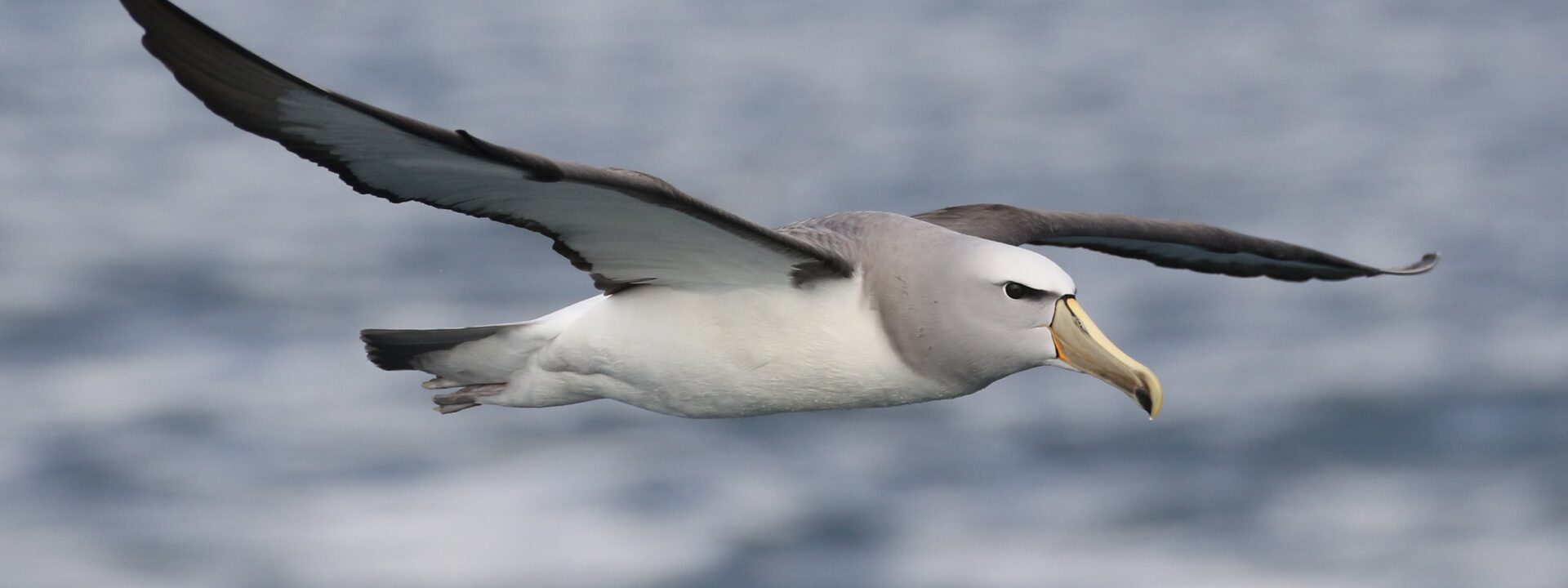
Over the next couple of days as we headed on towards Norfolk Island, we continued to add new seabirds, with our first sightings of a number of tropical species including Black-winged, Tahiti, Kermadec and White-necked Petrels. There was, however, confirmation that we were still not too far from more cooler climes with at least two Gibson’s Albatrosses seen.
Somewhat surprisingly two ‘land birds’ were added to the trip list as we cruised north, with a New Zealand Fantail landing briefly on the ship (on 19th March) when we were over 50 nautical miles from the nearest point of land. The following day, a White-faced Heron then flew past the ship confirming that ‘anything is possible at sea’.
Norfolk Island - New Caledonia 21st23rd March 2009
We arrived off Norfolk Island in the early hours of 21 March to a heavy swell with the wind blowing from the worst possible direction for a landing. Expedition Leader, Nathan Russ, spoke by radio to our contacts on the island and they confirmed that due to the heavy swells, zodiac-landings would not be possible at either Kingston or Anson Bay. As a result, we cruised round to the rarely-used west coast of Norfolk Island to see if a landing might be possible, however, with the waves also crashing onto the beach there, it was clear that getting ashore would not be possible.
As a result, Nathan took the difficult decision to head north. We were all very disappointed but with the conditions forecast to worsen, it seemed senseless to do anything else and by leaving immediately, we hoped to get some additional time ashore on New Caledonia.
Cruising around and away from Norfolk Island, there were plenty of birds with large numbers of Black Noddies and Wedge-tailed Shearwaters, as well as White Terns, Masked Boobies and Black-winged Petrels. As we entered deeper waters, we added both Providence and Collared Petrels (the former being a species we had inexplicably missed on the 2008 expedition) and then the birding surprise of the day with great looks at a very obliging White-bellied Storm-petrel, a new species for the ever growing WPO list.
The undoubted cetacean highlight of the entire voyage, however, came later that afternoon when a pair of beaked whales were seen breaching repeatedly a few hundred metres in front of the ship. Several of the photographers managed to get photos and these confirmed that the animals were Ginkgo-toothed Beaked Whales, a species which is rarely seen and known from only a couple of dozen strandings and possibly even fewer live/at sea sightings.
As we continued onwards towards New Caledonia, the Pterodromas included White-necked, Providence and Black-winged, however, it was the “pale Collared/Gould’s” Petrels which caused the greatest controversy, with a number of birds which did not seem to readily fit either species.
New Caledonia 23rd 24th March 2009
At dawn (on 23rd March), it was possible to make out the southern end of New Caledonia and as we waited for our allotted time slot to take on the Pilot, there were hundreds of Wedge-tailed Shearwaters around the ship. Also present were good numbers of ‘classic’ Gould’s Petrels, with many of these appearing to differ from the birds we had seen further south a curious scenario that surely requires further study.
Once we arrived at the wharf, the ship was soon cleared, however, the original plan to offer an extra excursion to Mount Koghi (a birding site approximately 30 minutes from downtown Noumea) was frustrated when our ground agent informed us that although they could find three buses to take us there, no drivers were available !!!
As a result, the majority elected to spend the afternoon exploring the environs of Noumea on foot, however, some of the Wildwings group took a taxi to Mount Koghi and were successful in seeing a range of endemics including New Caledonian Imperial-Pigeon, Horned Parakeet, Streaked Fantail and New Caledonian Whistler. Their greatest stroke of luck, however, was finding a family party of four Crow Honeyeaters a species which is now extremely threatened on New Caledonia and rarely seen outside of its main stronghold at the Riviere Bleue National Park.
The following day our trip to the Riviere Bleue National Park began well before dawn with a general wakeup call at 03:00.
Jean Marc Meriot (the Park’s Head Ranger) had generously agreed to allow us to enter the Park an hour earlier than the normal permitted time and a few minutes before 06:00, he was at the entrance with our second guide, Yves Letocart, who has now retired but is widely credited with saving the Kagu from extinction.
After a brief stop to allow Nathan and Robyn (our Cruise Director) to pay the Park entrance fees, we re-boarded our bus for the journey to Pont Perignon (the closest our bus could go to the forest), with Jean Marc and Yves leading the way in a Park 4WD. Part way there, however, we saw that our two guides rapidly exiting their vehicle. Doing likewise, we saw what had attracted their attention, a New Caledonian Goshawk, a bird which can be tricky to find at the Park and a fantastic start to our time at Riviere Bleue.
With everyone getting excellent views of the goshawk, we then continued to the bridge and then transferred to the edge of the forest in two specially chartered minibuses. Once everyone had arrived, we set off on foot along the forest road to begin our search for our principle target, the extraordinarily looking Kagu. Jean Marc had, however, had gone ahead in one of the Park vehicles and as we rounded a corner, there he was with a family party of Kagus only a matter of metres away !!!
We approached in silence but there was no real need for this as the birds were totally unconcerned by the presence of over fifty people and we were privileged to see the birds calling, displaying and mating at point blank range a truly unforgettable experience.
With our main target bird seen, we tried unsuccessfully to tape in a Crow Honeyeater and then split into several smaller groups to explore the Park. Despite almost constant heavy rain, over the next few hours the group saw most of the Park’s specialities including Southern Shrikebill, Yellow-bellied Robin, New Caledonian Pigeon, Horned Parakeet and Streaked Fantail with the fortunate ones also seeing both Crow Honeyeater and Cloven-feathered Dove during a brief lull in the deluge.
After a traditional French baguette for lunch at one of the Park’s shelters (an opportunity to get out of the rain !!) and a final hour in the forest, we transferred to an area near the Park entrance where we caught up with our final endemic of the day, the Red-faced Parrotfinch.
It had been a highly memorable day and whilst the Kagus had surely been “the stars of the show”, our bird list for the day also included New Caledonian Cuckoo-shrike, Long-tailed Triller, Melanesian Flycatcher, New Caledonian Whistler, Green-backed White-eye, New Caledonian Myzomela and New Caledonian Friarbird.
Arriving back at Noumea, we re-boarded the ‘Spirit of Enderby’ and headed out to sea once again. Before dinner, however, Nathan informed us that a Tropical Cyclone (“Jasper”) was predicted to be off the north-west corner of New Caledonia at almost exactly the same time as we were due to pass through this area. He explained that as all shipping has been advised to avoid the area, we would be taking a different course (around the southern end of New Caledonia) and as this would add over 125 nautical miles to our journey, the Expedition Team were currently assessing the implications for our schedule in the Solomon Islands.
What had been an excellent day thus ended on a slightly unfortunate note with everyone hoping that the cyclone followed its predicted course and thus did not cause us any further problems.
At sea: New Caledonia Rennell Island, Solomon Islands 25th28th March 2009
By dawn of the following day (25th March) we were rounding the southern end of New Caledonia and heading into waters not previously explored on any of the previous WPO voyages. The weather was not exactly ideal with some heavy squalls passing through, however, despite the conditions there were good numbers of birds about with the undoubted highlight of the day being a Black-bellied Storm-petrel. Although this species can be numerous much further south (eg when crossing the Drake Passage to Antarctica), this was the first time it had been recorded on a WPO expedition.
Other birds seen during the day included a further nine Providence Petrels and over the next few days other species seen included Tahiti, Kermadec and Collared Petrels. For many, however, the best news on this leg was when Nathan announced that despite the delay caused by Cyclone Jasper (which fortunately was following its predicted cause and would not cause us any further problems), we would still be visiting all the islands on the itinerary in the Solomons. We would be a day late on Rennell, Makira and Guadalcanal and there would be less time ashore at Mount Austin and on Kolombangara but otherwise we hoped to still visit all the locations.
Rennell, Solomon Islands 29th March 2009
Arriving off Rennell 24 hours later than we had originally expected, we were pleased to hear that the message had nevertheless reached the village that we were behind schedule and as soon as the officials (from Immigration, Customs, Quarantine and Agricultural Control) had cleared the ship, we began the Zodiac shuttle to the beach.
Before too long, everyone was ashore and having split into a series of smaller groups we began exploring the island. It did not take long before we started finding the five species which are endemic to Rennell, ie Rennell Starling, Rennell Shrikebill, Rennell Fantail, Rennell White-eye and Bare-eyed White-eye, and before too much time had passed, everyone had ‘cleaned up’ with good looks at all five.
Despite the fact that it quickly gets very hot on Rennell, there was still good bird activity and over the next few hours, other species seen included the near-endemic Silver-capped Fruit-dove, both Pacific and Island Imperial-pigeons, Cardinal Myzomela and Finsch’s Pygmy-parrot. Many of the group also got excellent views of Island Thrush (which on Rennell resemble and sound like mini-Blackbirds) as a couple of birds fed along the edge of one of the forest trails.
Makira, Solomon Islands 30th March 2009
As this was only the second time the ‘Spirit of Enderby’ had been to Makira and the charts of the area are not at all detailed, at dawn we were a couple of miles offshore from our planned anchorage and as the light improved, we slowly cruised closer inshore.
It was clear, however, that news of our delay had again preceded us (despite the isolation of our destination) as a small boat came out to greet us. This was filled with our local guides and shortly afterwards, everyone boarded the Zodiacs and we set off for the shore.
In 2008, the trail we used had been steep and muddy, so we had asked permission to walk a logging road instead and the change was a great success with some excellent birds seen over the course of the morning. These included Mottled Flowerpecker, San Cristobal Melidectes, White-headed Fruit-dove, Ochre-headed Flycatcher, Chestnut-bellied Imperial-pigeon, San Cristobal Starling, White-collared Monarch and Sooty Myzomela, all of which are either endemic to Makira or are only found there plus a few nearby islands. Indeed some of these birds are so poorly known that details will be sent to Birdlife International.
Other species seen included a pair of Solomon Islands Sea-eagles, Yellow-bibbed Fruit-dove, Red-knobbed Imperial-pigeon, Cardinal and Yellow-bibbed Lories and Chestnut-bellied Monarch.
In the late morning, we transferred to the nearby village on Yanuta Island where we received a fantastic welcome from the local community. The “Spirit of Enderby” had been the first expedition ship to ever visit Yanuta when we had been there the previous year and the reception we received this year was equally amazing. As we got off the Zodiacs, we were met by half a dozen warriors in their war paint and everyone was then presented with orchid garlands. After a series of speeches and displays of singing and dancing we were free to wander. It was truly humbling to visit such a welcoming community where some families had rowed for many hours just to be there to meet us.
All too soon, however, it was time to return to the ship and as we headed on towards our next destination, the ship’s horn was sounded to thank the villagers for their fantastic reception.
Guadalcanal, Solomon Islands 31st March 2009
With the ship arriving off Honiara in the middle of the night, there was another early wakeup call (03:45) and before dawn we were ashore and on our way to Mt Austin.
Although the track to the summit had deteriorated markedly over the previous twelve months, nevertheless, by dawn we were at our intended destination and splitting into a series of smaller groups began birding along the main trail.
With the assistance of our local guides, Jerry and Samson, we began to find a range of Solomon endemics including Claret-breasted Fruit-dove, Red-knobbed Imperial-pigeon, Ducorps’ Cockatoo, Yellow-bibbed Lory, Black-faced Myzomela, Midget Flowerpecker, Brown-winged Starling and the bird with surely the most amazing call of the entire expedition, the Buff-headed Coucal. The majority of the group were also fortunate to get good looks at an Ultramarine Kingfisher, a species which can be moderately tricky to find at Mount Austin.
By late morning it was time to return to the ship and as we sailed onwards towards Kolombangara, the most noteworthy sightings were a single Tropical Shearwater (which proved to be the only one on this leg of the voyage) and 4+ Sperm Whales.
Kolombangara, Solomon Islands 1st April 2009
The fourth successive day of landings saw us ashore near the village of Kukudu in the early afternoon. For many of the Wildwings group, the Roviana Rail was the main target and we set off for the short walk to a location where this species is reasonably reliable. Despite being there during the heat of the day, we eventually got satisfactory looks at this species which had only been described in the early 1990s.
Dividing up into a series of smaller groups, we then explored various forest trails close to the village. For the lucky few, the undoubted highlight was a Kolombangara Monarch (a new species for the WPO list), however, the majority saw many of the other specialities including Solomon Islands Sea-eagle, Pied Goshawk, Moustached Treeswift, White-winged Fantail, White-capped Monarch, Steel-blue Flycatcher, Solomon Islands White-eye, Yellow-vented Myzomela, Singing Starling and Yellow-faced Myna.
Earlier concerns that Cyclone Jasper would have a major impact on our schedule in the Solomons had thankfully proved largely incorrect and as we sailed away from Kolombangara, it was agreed that our four days in the Solomon Islands had been a spectacular success with some fantastic birds seen.
At sea: Kolombangara, Solomon Islands Chuuk, Micronesia 2nd6th April 2009
We awoke off the south-west corner of Bougainville the following morning (2th April) to a sense of anticipation and excitement, as we knew the waters we would be traversing over the next two days would be our only chance for two of the least known seabirds in the world, ie Heinroth’s Shearwater and Beck’s Petrel.
As we cruised up the west coast of Bougainville, several species of cetaceans were sighted and then there were frustratingly brief views of a distant Heinroth’s Shearwater. Shortly before lunch, we were fortunate enough to see one sat on the sea and initially there was some dismay as we continued passed. After some rapid discussions with Nathan and Captain Dmitry, however, the ship was turned round and we headed back to look for the bird. Fortunately, it was still where we had left it just a few minutes before and as we approached, we enjoyed fantastic looks at this rarely seen seabird, with the views certainly being the best on any of the three WPO voyages.
After successfully nailing the shearwater, we had hoped to find Beck’s Petrel off north-west Bougainville, however, a late afternoon chumming session proved unsuccessful with very still conditions and few birds coming to our oil slick. As a result, the decision was taken to sail overnight to New Ireland which was where we felt we had the best chance of finding the petrel.
The following morning (3rd April) conditions were still far from ideal with almost no wind and a flat sea. As we laid a vast slick of oil and fish guts, three petrels appeared and whilst the first two were judged to be Tahitis, those who saw the final bird were happy that it was indeed a Beck’s Petrel. Unfortunately, however, the birds did not hang around and with no further sign of any other Pseudobulwerias, we started the engines once again and headed over to a distant feeding flock. Although there were no petrels here either, we saw our first Streaked Shearwaters of the voyage, as well as Wedge-tailed Shearwater, Bridled Terns and somewhat unexpected, a group of half a dozen Little Terns.
A return visit to our original chum slick drew a further blank so the decision was made to head north and try our luck later in the day.
As we cruised onwards, there were unexpectedly high numbers of Heinroth’s Shearwaters with at least thirty individuals logged during the day far more than had been seen on previous WPOs. Numerous roving feeding flocks were also noted and during the morning and early afternoon we saw Wedge-tailed Shearwaters, three booby species (ie Red-footed, Masked and Brown), Wilson’s Storm-petrel, three Skuas (Long-tailed, Pomarine and Arctic) as well as Sooty Tern and Brown Noddy.
Some excellent cetaceans were also seen with great looks at a Dwarf Sperm Whale and 4+ Pygmy Killer Whales, however, it was Beck’s Petrel that everyone wanted to see, so in the late afternoon we laid another substantial oil slick. The conditions were even stiller than in the morning, however, eventually a distant Pseudobulweria was spotted. As this got a little closer, it was clear that this was indeed a Beck’s Petrel, although disappointingly the bird did not pass particularly close to the ship.
Nevertheless, everyone had seen both our principle targets over the last couple of days and as we headed on towards Chuuk, even new species like Bulwer’s Petrel or a fantastically close pale phase South Polar Skua somehow did not hold the allure of the two special birds we had been fortunate to see off Bougainville and New Ireland.
Chuuk, Micronesia 7th8th April 2009
At dawn on 7th April, we were a few miles south of the Chuuk Lagoon and as we cruised towards the reef entrance, there were plenty of birds to see with good numbers of Black and Brown Noddies, however, our main target was to see the “Tropical” Shearwaters that can be found not too far out from the reef. Although these birds may indeed be the same as some of the other populations, there have been suggestions they could potentially be a separate species, so we were all on the lookout despite some rather inclement weather.
Eventually most people saw at least one individual (with a total of three seen by the group) and having picked up the Pilot, we headed for the wharf at Weno Island.
Arriving in Chuuk is often a rather slow and bureaucratic process, however, on this occasion the officials excelled themselves and within little more than an hour we were free to go ashore. Whilst some elected to explore on foot, others joined a snorkelling excursion to some of the Second World War wrecks that litter the Chuuk Lagoon, with the most adventurous chartering a speedboat and heading for Tol South (another island within the Lagoon) to look for Truk Monarch and Faichuuk White-eye.
Despite some torrential rain, we all had a successful time, however, many of us were somewhat envious when those who had been to Tol returned, reporting that they had had great looks at both the Monarch and White-eye as well as Caroline Islands Ground-dove.
The following morning (8th April) the weather had greatly improved and shortly after dawn we assembled for our excursion and the serious business of looking for endemics. The commoner specialities, ie Caroline Islands Swiftlet, Caroline Reed-warbler, Caroline Islands White-eye, Micronesian Myzomela, Oceanic Flycatcher and Micronesian Starling were quickly found, however, the bird we were keenest to try and locate was the Caroline Islands Ground-dove.
This species is sometimes far from easy to find on the island but for the second year in succession we enjoyed great looks at a couple of birds as they fed in some hillside scrub. After enjoying lunch ashore at the Truk Stop Hotel, we returned to the ship and began the long sea journey to Japan.
At sea: Chuuk, Micronesia Chichi-jima, Bonin Islands, Japan 9th 13th April 2009
The journey from Chuuk to Chichi-jima can be somewhat birdless at times (indeed it is often described as the “Dead Zone” by the expedition staff !!), however, as the ship continued to head northwards, we began to pick up a number of new species with our first Matsudaira’s Storm-petrel sighted on 11th April. A couple of days later, we also added Tristram’s Storm-petrel, with this species being seen significantly further south than on either of the two previous voyages.
Also new on this leg of the expedition was Bannerman’s Shearwater with two birds seen on 12th April and half a dozen the following day. The 13th April was also when we had our first sightings of Bonin Petrel, with over 100 of these birds logged by the end of the day.
This section is, however, also where we see our last sightings of various species and 12th April was the last occasion when we encountered Masked and Red-footed Boobies and the following day we saw the last Red-tailed Tropicbird of the voyage.
Chichi-jima and Haha-jima, Bonin Islands, Japan 14th April 2009
The main town on Chichi-jima is located within a fantastic natural harbour and as the ship was being tied up at the wharf, we were astonished to see a large flock of Waxwings flying around a distant hillside. A few minutes later, some closer birds were spotted and through telescopes it could be seen that these were Japanese Waxwings. A real surprise this far south and a new species for the WPO. Indeed when Dick and Chris subsequently discussed these sightings with some Japanese birders, it was suggested that the records were so significant, they should be published !!!
Once landing formalities were completed, most of the group headed to the town park which was conveniently located on the opposite side of the road from the wharf. Over the next couple of hours, new birds for the trip included Brown-eared Bulbul, Japanese Bush-warbler, Japanese White-eye and Blue Rock-thrush with a lucky few also catching up with a White’s Thrush. Also seen from one of the watch points were a couple of Humpback Whales which were regularly breaching just offshore.
By late morning, we were all returning to the ship and as we cruised out of the harbour on Chichi-jima, we had great looks at a pod of Spinner Dolphins and more Humpbacks and then we did something never previously done on a WPO voyage and headed south !!
As we cruised towards Haha-jima (which is approximately 30 nautical miles south of Chichi-jima) we saw our first Black-footed Albatrosses of the expedition, however, everyone was anxiously watching the weather and swell would the conditions be good enough to allow us to land and look for Bonin Island Honeyeater ??
Three hours later, we were off the small harbour on Haha-jima and were greeted by another breaching Humpback Whale which gave a spectacular show a few hundred metres in front of the ship. The conditions were, however, suitable for going ashore and by 4pm we were all on dry land and looking for the island’s endemic.
Although some initially struggled to see the Honeyeater, eventually all the Wildwings group got good looks at this extremely range-restricted species and whilst we only had an hour and a half ashore, the extra excursion was deemed a great success. Indeed at times the excursion resembled a twitch on the Isles of Scilly, with 50+ birders running around much to the amusement (or was it bemusement ??) of the islanders who usually see less than twenty Westerners a year !!!
At sea: Haha-jima Torishima, Japan 15th April 2009
As we cruised towards Torishima, we had several decent sized flocks of Short-tailed Shearwaters fly passed the ship. A number of Matsudaira’s Storm-petrels were also seen (typically in the wake) along with a couple of Tristram’s Storm-petrels, however, the bird of the day was unquestionably a Short-tailed Albatross which was spotted simultaneously by Wildwings clients Angus Hogg and Doug Gill. This flew up from the south and gave some great views before heading onwards. Although we fully expected to see this species the following day, it was great to get one ‘at sea’ and Doug and Angus shared a bottle of champagne that evening courtesy of Wildwings.
Also seen during the day was a pod of Blackfish which were initially assumed to be Pilot Whales, however, when photos were reviewed that evening, it was realised these were Melon-headed Whales a new cetacean for the WPO list and a tick for many !!
Torishima, Japan 16th April 2009
One of the main reasons for stopping at Chichi-jima had been to clear into Japan and thus allow us to get close to Torishima and we were inshore to the island by the middle of the night. Even before dawn, Short-tailed Albatrosses could be seen flying around the ship and as soon as there was enough light for the photographers, we began our “STA chumming extravaganza”. Roughly 100kgs of fish guts had been loaded in New Zealand for the specific purpose of attracting the albatrosses and before too long, they began appearing in ever increasing numbers giving us unbelievable views of just about every plumage of this fantastic bird.
Thousands of photos were taken and there was no need for large lenses or fancy cameras as the birds came to within a matter of metres of the back of the ship to sample the delicacies (!!) we had available.
Also present were good numbers of Black-footed Albatrosses and a full adult Pomarine Skua (complete with ‘spoons’) which joined the feeding throng, giving many of us some of our best ever views of this species.
It was, however, undoubtedly the “STAs” which stole the show with what must have been several dozen different birds coming to the chum.
After a couple of hours our supplies of chum were exhausted, so we cruised around the southern and western coasts of Torishima and were able to see the main Albatross breeding colony distantly on the island. Although initial estimates suggested that about one hundred birds were probably present, subsequent examination of photos showed that there were at least twice this number, including decent numbers of chocolate brown youngsters 2008/9 had clearly been a satisfactory breeding season.
By late morning, we were back in the open ocean with Wedge-tailed Shearwaters once again being the most numerous species, however, in the middle of the afternoon there was a shout as a passerine was seen flying passed the ship. Initially it was thought this had landed, but it could not be found anywhere around the outer decks and after some discussions about its identity, photos proved conclusively that it was another new bird for the WPO list, a Red-flanked Bluetail !!!
Later in the day, a couple of Barn Swallows were sighted and these were then followed by a Red-rumped Swallow that somehow managed to end up inside the Bridge. This was quickly caught and given the late hour and that the bird was clearly exhausted, it was decided that the best thing would be to roost it overnight and release it nearer to land the following day.
Once birding for the day was over, we gathered in the Bar for the main charity fundraising event of the expedition an auction in aid of the “Save the Albatross” campaign. Doug Gill, had kindly agreed to be the auctioneer and the various lots raised a total of US$750. Special thanks to Doug for his role as MC and to Andrew Stevenson (both Wildwings clients) who had generously donated a number of fantastic bird paintings he had done during the cruise which greatly complemented the other lots which had been supplied by Wildwings and Heritage Expeditions.
Miyake-jima, Izu Islands, Japan 17th April 2009
With an unexpectedly strong current running against us overnight, progress towards the final island of our expedition was somewhat slower than expected, however, as we passed Mikura-jima (the island to the south of Miyake-jima), Japanese Murrelets began to be spotted.
Initially views were distant with the birds only seen in flight, however, as we got closer to Miyake-jima, more and more were seen and eventually everyone got great views as a number of birds remained floating on the sea until the “Spirit of Enderby” was a matter of metres from them.
With the murrelet safely ‘ticked off’, we landed on Miyake-jima in a fairly heavy swell and then set off for the Miyake Nature Centre. This was only a few kilometres away and we soon split up into a number of smaller groups to explore the area which consisted of mature woodland surrounding a reasonable sized crater lake.
Over the course of the next few hours, we saw Ijima’s leaf-warbler and Izu thrush (both of which are endemic to the Izu Islands), as well as a range of other species including the distinctive Izu race of the Varied Tit, the rather smart Japanese Pygmy Woodpecker, with some also seeing the rather elusive Japanese Robin.
All too soon, however, it was time to return to the ship and ready ourselves for disembarkation the following morning in Yokohama.
The last few days had been a fantastic end to a stunning voyage, during which we had been privileged to see and share with you all an amazing range of rarely seen and poorly known species. Whilst the weather had made the early stages of the expedition somewhat challenging, we had certainly had some fabulous experiences over the course of 33 days and 5,249 nautical miles.
A full systematic species list is also available for this voyage, as are the 2007 and 2008 voyage trip reports and species list.