![]() |
|||
|
WILDWINGS TRIP REPORT
|
|||
![]() |
BIRDING DOWNUNDER - THE SUBANTARCTIC ISLANDS OF NEW ZEALAND & AUSTRALIA - 12th 30th December 2005 | ||
|
Trip Report by Tour Leader Tony Marr
Summary
WildWings booked a number of passengers on the Spirit of Enderby, a former Polar Research vessel for this legendary voyage, led by Nathan Russ. WildWings clients on previous trips had described it as a seabird spectacular to these rarely-visited islands lying between New Zealand and Antarctica, and so it turned out to be. Thousands upon thousands of albatrosses and penguins dominated the wildlife spectacle, with huge numbers of petrels, shearwaters, prions, storm petrels, diving petrels and shags around all the islands we visited. Each island group was also home to a variety of extraordinary shorebirds and landbirds, several of them endemic. We enjoyed good weather for most of the trip, with just a few rough days and some foggy ones. The birds and marine mammals were in their element, the remarkable plants and megaherbs were flowering in profusion, and we were privileged to be there to experience these exceptional islands at their best. With a rugged and comfortable ship and an experienced Expedition Team, including Shane Hunniford, Vicky Shilvock and Nathan’s father Rodney Russ, we were in very safe hands to enjoy a hugely successful voyage.
Dunedin to Snares Islands 12-13 December
The 46 passengers gathered in the Southern Cross Hotel in the centre of Dunedin on the evening of 12 December to have dinner with the Expedition Team and to stay there overnight. Many had been travelling around New Zealand immediately before this, and all had been impressed by the country and its friendly, helpful people - not to mention its very special birds and mammals.
Next day, on a cool and windy morning, everyone came aboard after breakfasting at the hotel, and the Spirit of Enderby sailed at 10.00. Leaving Otago Harbour we enjoyed an hour and a half watching Spotted and Stewart Island Shags, Black Swans, South Island Pied and Variable Oystercatchers, Dominican and Red-billed Gulls and lovely White-fronted Terns as we journeyed towards the open sea. Passing close to Tairaroa Head we had our first albatrosses, the famous mainland-breeding Northern Royals, which we could see on their nests on the grassy slopes of the headland.
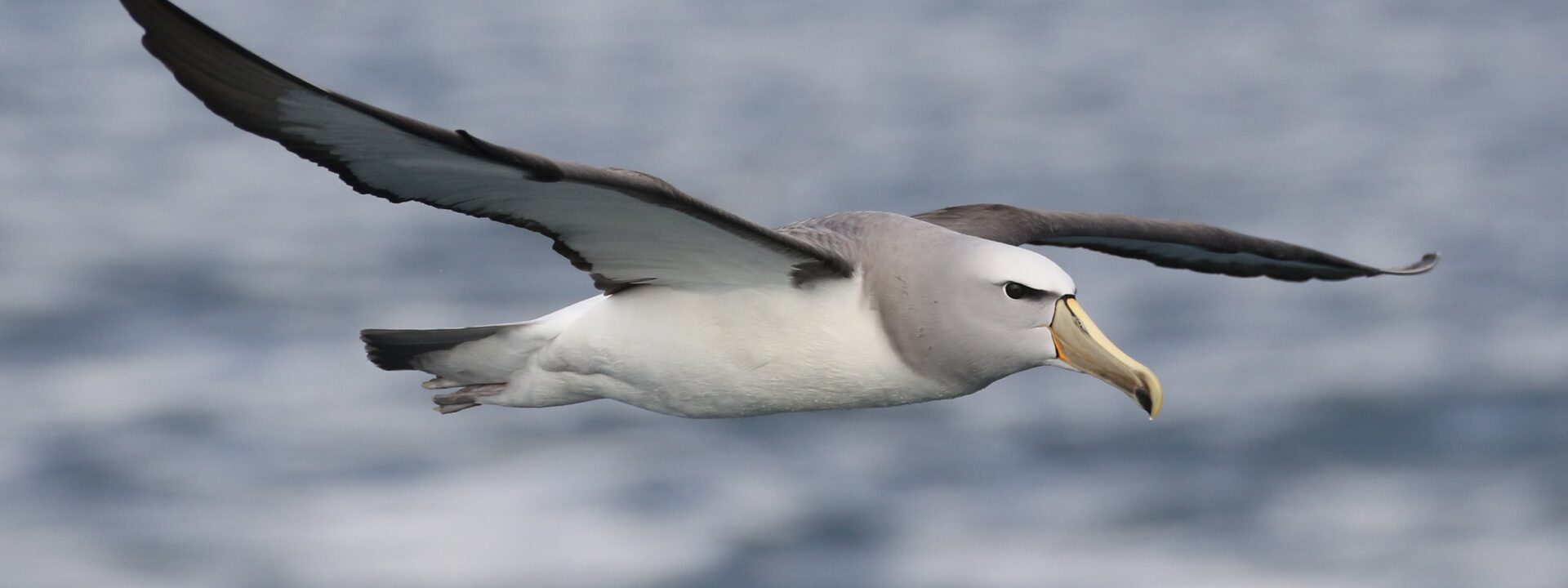
The seabirding really began then, and as we headed southwestwards towards the Snares Islands in fairly choppy seas we saw more and more albatrosses. Our list for the day ended with seven different forms (there is still no universal agreement on how many species there are!) both Northern and Southern Royals, Gibson’s Wandering, a Campbell or Black-browed, White-capped, Salvin’s, and a Chatham Albatross, well out of its normal rather limited range. With Snares Cape Petrels; Mottled, Grey-faced, White-chinned and
Northern and Southern Giant Petrels; Sooty, Short-tailed, Fluttering, Hutton’s and Buller’s Shearwaters; Australian Gannets; Broad-billed and Fairy Prions; and Black-bellied Storm-petrels; it was a spectacular start to a trip during which there was scarcely an hour without seabirds around the ship for two and a half weeks.
Snares Islands 14 December
Early morning found us approaching these islands on a still, misty and drizzly day. The ship passed through thousands upon thousands of Sooty Shearwaters, hundreds and hundreds of Common Diving Petrels and dozens of Snares Cape Petrels, all of which breed here. Before we reached our morning’s destination we had counted some 80 Mottled Petrels, passing with their wild impetuous flight, and our first Brown Skuas and Snares Crested Penguins.
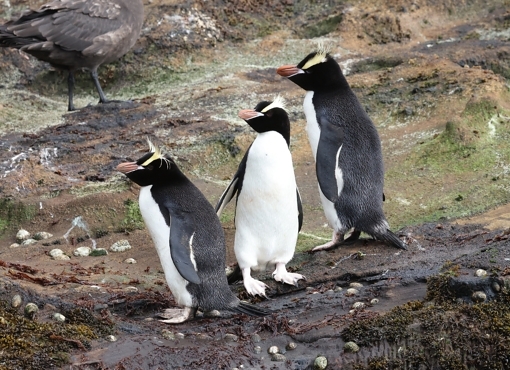
An unforgettable morning was spent cruising in the Naiads (metal-hulled inflatables like Zodiacs) along the sheltered shore and bays of these low, wooded islands, where landing is not permitted. The weather was still misty and drizzly, and it was becoming windier, but that did not dampen our enthusiasm. The highlight was the Snares Crested Penguins, with their heavy red bills and straight narrow yellow head plumes, all along the shore and under the trees below which they nest. Antarctic Terns, Red-billed Gulls, Common Diving Petrels, Fairy Prions and predatory Brown Skuas were all around us, and from the water we had good close views of the endemic Snares Tomtits and Snares Fernbirds on the rocks and in the trees. It seemed strange for British birders to also see Blackbirds, Song Thrushes and Redpolls above the rocks on which reposed Hooker’s Sea Lions and New Zealand Fur Seals. A single Welcome Swallow and two Silvereyes were seen, and a very unusual find was a Grey-tailed Tattler on the rocks. From the ship at anchor we watched half a dozen Southern Buller’s Albatrosses, which return to breed here at the turn of the year.
After lunch we continued our voyage southwards towards our next island group, the Auckland Islands, which was once more noteworthy for the procession of seabirds throughout the day. We were kept very busy in developing our albatross identification skills, with some 25 Salvin’s, 10 Southern Royal, a single ‘Snowy’ Wandering, 9 White-capped, and single Black-browed and Campbell’s Albatrosses. (the latter is the Black-browed with the honey-coloured eye). Other species identified included White-chinned and Mottled Petrels, our first two Flesh-footed Shearwaters, 10 Grey-backed and 120 Black-bellied Storm-petrels.
Auckland Islands Enderby Island 15 December
Dawn found us anchored off Enderby Island at dawn on 23 November, ready for our first landing on a still, misty and damp day. We spent all day on this marvellous rodent- and cat-free island, full of birds whose tameness was extraordinary. We walked right round the perimeter in fairly calm conditions, but with unrelenting light rain.. There were so many highlights - the Southern Royal Albatrosses breeding on top of the island, the elegant Light-mantled Sooty Albatrosses on the cliffs, hundreds of Fairy Prions feeding offshore, the Auckland Island Shag colonies, the conspicuous Auckland Island Banded Dotterels and skulking Sub-Antarctic Snipe, breeding Brown Skuas, the shy Yellow-eyed Penguins, Auckland Island Flightless Teal, Auckland Island Tomtits, Red-crowned Parakeets, Auckland Island Pipits - it was almost overwhelming.
With Bar-tailed Godwits and Turnstone, Blackbirds and Song Thrushes, single Dunnock and House Sparrow, and Starlings and Redpolls, one could be forgiven for thinking one was at home in Britain - until a Bellbird or a Tui appeared and sang loudly from the dense tree cover. Along the landing beach were about 150 breeding Hooker’s Sea Lions, with the pale-coloured females dominated by many aggressive and bad-tempered big bulls. This remarkable day on such an exceptional island helped us to appreciate the importance of eliminating predators from remote islands, an unqualified conservation success in work in which New Zealand leads the world. We returned to the ship in the gathering dusk, wet and exhausted but exhilarated. The spirit of Enderby had affected us all.
We stayed at anchor during the evening while we enjoyed dinner, and sailed on southwards during the night.
Auckland Islands Adams Island and Auckland Island 16 December
Another dawn, another island - in this case two islands, Adams Island to the south and Auckland Island to the north of our position in Carnley Harbour. We slowly entered this extensive natural refuge in the early morning, greeted by thousands of Sooty Shearwaters, over 50 Grey-backed and a couple of Black-bellied Storm-petrels. We passed Yellow-eyed Penguins, White-fronted Terns, Light-mantled Sooty Albatrosses and Auckland Island Shags.
After breakfast at anchor, we set out in the Naiads for two expeditions. The first, for about half the passengers, was an hour’s climb in the steady rain, up a long, steep, muddy hillside to South West Cape to see the breeding White-capped and Gibson’s Wandering Albatrosses. It was well worth the effort, and sitting for an hour among these magnificent birds at their nests high above the sea was a rare privilege.
A Naiad excursion was arranged for the other half of the group, who also got very wet, along the heavily wooded shores. They succeeded in their quest for the New Zealand Falcon, which we had missed yesterday at Enderby Island, watching one pass over with a Bellbird in its talons! They found another Auckland Flightless Teal, Tomtits, Silvereyes, Bellbirds, Blackbirds, Dunnock and Starlings.
We left Carnley Harbour after lunch, passing out between the high cliffs at the entrance and out into the open sea in improving weather. The wind dropped, the rain stopped and the sun even came out. In the entrance to the harbour were scores of Gibson’s Wandering Albatrosses, presumed to be birds arriving to breed high on the surrounding mountain grasslands, and we watched a second New Zealand Falcon pass over the ship.
At sea 16-17 December
Out at sea that afternoon we were soon surrounded by big flocks of prions and other seabirds as we headed on southwards. The 1,000+ prions were, as always, confusing, and were considered to be a mixture of Slender-billed, some Fairy and some Antarctics. Rather easier were the 500+ Diving Petrels which here are almost certainly Common. We saw our first Subantarctic Little Shearwaters (15) and White-headed Petrels (a total of over 200+, with several flocks of 5-10). Among the Southern Buller’s Albatrosses we spotted our first Pacific, or Northern Buller’s, Albatross, identified by its darker grey head and contrasting pale cap. Grey-backed Storm-petrels totalled 25 and Black-bellied were 100+. Eight Black-browed-type Albatrosses came close enough to be confirmed as Campbell Albatrosses (or ‘Honey-eyes’). A Minke Whale and four Dusky Dolphins completed the day’s totals.
At sea all through 17th, in calm and foggy weather, we continued this selection, with the addition of the first Grey-headed Albatross, Soft-plumaged Petrel, Wilson’s Storm-petrels and confirmed Antarctic Prions as we headed south towards Macquarie Island and our next landfall. It was a good day for cetaceans, with four Strap-toothed Whales, three unidentified toothed whales, four Southern Bottle-nosed Whales and seven Hourglass Dolphins.
Macquarie Island 18-19 December
This remote inhospitable island is about 18 miles long and three miles wide, windblown and wild. Just north of the Antarctic Convergence, where the icy cold Antarctic waters meet the more temperate Southern Ocean, it is Australian territory and home to a scientific base which we visited. The scientists call it ‘Macca’ but to us it became ‘Mecca’. After picking up the Rangers from the Anare Station who were to be our guides for our two-day visit, we landed in calm seas and patchy fog at Sandy Bay on the morning of 18th. An early excitement was the sighting of five Orcas close to the shore heading north as we passed south.
The beach landing was easy in slight swell and calm seas, and soon the fog was clearing and the sun emerging. It could not have been a better day for us! We spent the morning ashore, returned to the ship for lunch, and for those who wanted it (nearly everyone!) there was a return visit in the afternoon. Surrounded by teeming wildlife of unbelievable tameness, we wandered through thousands of Royal and King Penguins, and visited their breeding colonies, a cacophony of noise and activity. We met hundreds of young Southern Elephant Seals all along the beach, where Macquarie Island Shags and Northern and Southern Giant Petrels were on shore, including two striking all-white Southerns. All too soon it was time to return to the ship for dinner, as the fog returned at the end of the day.
In thick fog at dawn on 19th we found the ship surrounded by Antarctic Prions, several of them coming on board, attracted by the lights of the ship. We had to abandon the plan to visit Lusitania Bay to the south as the fog was too dense to see even the shore, and we returned north to Anare Station at Buckle Bay where we were able to go ashore and walk along beaches covered with Southern Elephant Seals and King and Gentoo Penguins. We watched Southern Rockhopper Penguins and Macquarie Island Shags, Brown Skuas and Antarctic Terns, and the incongruous sight of Rabbits hopping along the hillsides above the shore and Starlings flying over. Two Redpolls were heard, but most disappeared from the island after a big storm recently. The Elephant Seals dominated the scene, with huge bulls prostrate on the beach after the rigours of the mating season. Groups of Giant Petrels were feeding on the carcasses of those which had expired in their efforts, and endearing pups gazed at us with their huge soulful eyes as we gingerly edged past them. In contrast to the fog and drizzle outside, we enjoyed the warm hospitality of the Australian scientists inside the base before returning to the ship for lunch.
In mid-afternoon we raised the anchor and turned north-eastwards from this southernmost point in our odyssey to start our long journey towards our next stop, the legendary Campbell Island.
At sea 19-20 December
Before then, though, we had a day and a half at sea to enjoy. The weather continued to be foggy with rain or drizzle and at times watching was difficult. On the first afternoon/evening, we saw just small numbers of the species we had already observed, with no surprises.
The 20th started well, with our first three Kerguelen Petrels and a further 55 White-headed Petrels during the day, which ended much more quietly than it had begun. There were just small numbers of albatrosses, Sooty Shearwaters, White-chinned and Mottled Petrels, prions and storm-petrels.
Campbell Island 21 December
The day of the albatross - Southern Royal, to be precise. Dozens of these were on nests up on the hills in the centre of the island, white dots visible from miles away, and accessible from what must be the longest boardwalk in the world, about two miles from the landing place up to the main colony. Their serene and dignified demeanour complemented well the reasonably calm and settled weather during our visit. Most passengers made their way up the boardwalk, several spending the whole day in the company of the magnificent, huge, docile albatrosses. In the afternoon the numbers of albatrosses were swelled with several parties of 6-10 birds dropping in for ‘gamming’ sessions. These are usually younger birds which assemble for noisy social gatherings, displaying and calling to each other, and it is presumed to be part of their pairing process in advance of their mating for life.
While up on these higher hills, several people made their way across to the cliffs, which had been initially shrouded in low cloud, and were able to watch Light-mantled Sooty Albatrosses calling and displaying below them. Some 250 or more Rockhopper Penguins were visible on the lower cliffs and on the sea.
A smaller, more energetic, group of passengers went on an eight-hour march for miles across the island, through wet and dry, across low and high, forests and hills, returning exhausted but very satisfied at the end of the afternoon. A special Zodiac cruise was arranged in the late afternoon for birders who wanted to look
for the endemic Campbell Island Teal, and who, after various adventures with sealions, were rewarded with finding a very young bird.
The day’s combined bird list included Campbell Island Shags, Brown Skuas, Antarctic Terns, the inevitable Redpolls and Silvereyes and, of all things, several Blackbirds and Dunnocks. We did wonder how such typical British garden birds could survive on this wild, open, untamed and spectacular island. The recent eradication of rats must have helped all the breeding species to survive and thrive. We were later shown a video of this successful operation, which used half a dozen helicopters dropping poison pellets across the whole island with great precision to eliminate the rodents.
We left Campbell Island with that by-now familiar feeling that we had been privileged to land there and to see such magnificent wildlife at first hand in such a superb setting. After dinner at anchor in Perseverance Harbour, we left in the late evening, enjoying an hour’s seabirding with the regular and always-welcome variety of albatrosses, petrels, shearwaters and storm-petrels before darkness set in.
At sea 22 December
We enjoyed another day at sea, the weather being fairly calm but with a heavy swell. There were no ‘trip ticks’, but our regular seabirds were joined by 10 Antipodean Albatrosses, only the second and third Soft-plumaged Petrels of the trip and the first Broad-billed Prion since the day we left. Four Sperm Whales and four fur seals were also recorded. In the latter part of the day we had our first sighting of our seventh species of penguin so far, the Erect-crested, in advance of arriving tomorrow at their breeding islands.
Antipodes Islands 23 December
As we approached the islands on another cloudy, foggy, damp day, we saw a marked increase in the numbers of seabirds. Antipodean Albatrosses (not surprisingly) were up to 50; Subantarctic Little Shearwaters to 100+; White-chinned Petrels totalled 70; Soft-plumaged Petrels 40; Black-bellied Storm-petrels 65; Grey-backed 40; and Common Diving Petrel 250. More Erect-crested Penguins appeared on the sea, and the first Grey-faced Petrel since we left Dunedin was spotted. Twenty White-headed Petrels were the last double-figure score of the trip. Cetaceans included seven Southern Bottle-nosed Whales, 12 Hourglass Dolphins and a large unidentified whale.
We anchored as close in under the cliffs of the main island as we could in the dense fog, and took to the Naiads for one-and-a-half-hour crus below the cliffs where it was relatively sheltered. We had excellent views of an estimated 150 Erect-crested Penguins, some with tiny chicks, and with some 50 Southern Rockhoppers among them. Hundreds of Common Diving Petrels were flying about over the sea, and along the rocky shores were some 16 Antipodes Island Pipits and ten Elephant Seals hauled out. We were successful in looking through the Antipodes Red-crowned Parakeets high above us on the slopes to pick out the larger, greener Antipodes Island Parakeet, and managed to obtain adequate views (and photos) of at least three of this rare endemic species. It was a successful outing in the difficult foggy conditions particularly when returning to the invisible ship, which required the co-operation of the officers to sound the ship’s horn and guide us back….
Bounty Islands 24 December
We arrived at these extraordinarily bare and barren rocks in heavy rain in the early morning.. Thousands upon thousands of Salvin’s Albatrosses circled over the breeding islands, with smaller numbers of Erect-crested Penguins, Snares Cape Petrels and Fulmar Prions on shore or in or over the sea. There were an estimated 1,000+ New Zealand Fur Seals present, at all levels on the rocks, some high up close to albatross nests and apparently causing disturbance to the albatrosses. Bounty Island Shag was another endemic bird for the list. We had an interesting but very damp Naiad cruise in the steady rain, with photography being particularly difficult.
On our return to the ship, and before we left, Nathan and Rodney set up a ‘chumming’ session at the stern of the ship, throwing out chopped-up pieces of squid to pull in seabirds. Within minutes, while the rain stopped as though on cue, hundreds of Salvin’s Abatrosses were fighting over the bounty, showing the aggressive side of these otherwise docile birds. For photographers it was very satisfying.
After this exciting interlude, we headed on at 10.30 ever-northwards through the rest of the day. The weather improved until we were sailing along through warm sunshine. Six Orcas were the high spot of the afternoon, seen well by most passengers, with another six later, and there were plenty of good seabirds. These included two new trip ticks Cook’s Petrel, with 10, and White-faced Storm-petrel, of which we had 39. In addition we recorded 16 Cook’s-type petrels (‘cookelaria’) , 20 more Fulmar Prions, 9 Grey-faced and 40 Mottled Petrels among a wide range of species.
Next stop was to be the long-awaited Chatham Islands...
Chatham Islands Pyramid Rock & South East Island - 25 December
Christmas Day dawned sunny and clear, and continued so for the whole day. We sighted Pyramid Rock 24 miles and three hours ahead of us, in mid-morning. The number and variety of tubenoses increased as we steadily approached, and included more than 400 White-faced Storm-petrels; 30 more Grey-faced Petrels; the first (and only) Grey Petrel of the trip; four more Cook’s, single Pycroft’s and Gould’s Petrels and a further six cookelaria; one Flesh-footed and four Buller’s Shearwaters. Among the 11 forms of albatross seen during the day were 20 Northern Buller’s (or Pacific), single Grey-headed and Indian Ocean Yellow-nosed and our first beautiful Chatham Albatrosses. We also found 4-6 Sperm Whales at sea.
We reached The Pyramid in the early afternoon and encircled it, marvelling at the thousands of Chatham Albatrosses on their only breeding island in the world - how vulnerable they are. The Captain stopped the ship and Rodney did some more chumming. This was instantly successful, and we enjoyed spectacularly close encounters with the albatrosses and perfect photographic opportunities. Reluctantly we left Pyramid Rock, but very happy that we had been so close to this world-famous stack and its equally famous inhabitants.
We headed now for nearby South East Island for an overnight stop. We arrived earlier than expected in the beautiful warm sunny weather, so quickly we were out in the Naiads, cruising along the shore looking for the three endemics - Pitt Island Shag, Chatham Island Pied Oystercatcher and New Zealand Shore Plover. We succeeded in our quest, and found also some ten Little Blue Penguins. From the Naiads we also succeeded in spotting Chatham Island Red-crowned Parakeets, Grey Fantails, Tui and Pipit. Over 100 White-fronted Terns were fishing in the bay and the Russian crew were fishing over the stern of the ship. Some 20 Northern Buller’s Albatrosses gathered around the ship, attracted no doubt by the fishing success of the crew. Few of us had ever seen so many fish caught so easily!
We stayed at anchor overnight in the sheltered bay. In the evening a splendid traditional Christmas feast was enjoyed by all, and the Heritage Expedition team generously gave everyone a Christmas present. Those who were up on the deck later, enjoying the warm evening air and clear skies, found large numbers of White-faced Storm-petrels coming on board, attracted by the lights, which were then turned off.
Chatham Islands The Forty Fours, Mataraka & The Sisters 26 December
This was an ‘Expedition Day’, which describes a day where our itinerary is defined by weather conditions. We headed north from South East Island at 06.00 into a light northerly wind, passing through feeding flocks of White-faced Storm-petrels, obviously a common breeding bird in this area. Up to 140 could be seen in one sweep of the binoculars and we estimated a total of at least 400 by the time we reached the Forty Fours. These are a group of islands, one large and flat-topped and three adjacent stacks, which are home to breeding Northern Royal and Northern Buller’s Albatrosses. Here we stopped for a while in by-now sunny conditions to see an estimated 400 Royals and 2,000 Buller’s on and around the islands..
We next headed westwards around the northern coast of the main Chatham Island into a strengthening wind, with some drizzle and rain. We stopped offshore at Mataraka where the braver souls among us took a bumpy Naiad trip over to a small headland on which were nesting Chatham Island and Pitt Island Shags, with several adult and juvenile White-fronted Terns also present. On our return to the ship we found a number of Northern Buller’s Albatrosses around the ship, feeding on fish scraps thrown overboard by the Russian crew. Up to 50 of these handsome birds followed the ship for much of the afternoon, joined by several Northern Royals and the odd Southern Royal, White-capped and Salvin’s, coming in to grab pieces of fish a crew member was flinging over the stern. It was a veritable mobile chumming session…
We passed the distant hazy shapes of The Sisters, another Northern Royal Albatross breeding site, and in the late evening anchored off Waitangi in anticipation of a landing tomorrow morning.
Chatham Island Tuku Nature Reserve 27 December
By 08.00 on a windy morning we were all ashore. A Land Rover and two coaches took us to one of the forested valleys, Tuku Nature Reserve, where we saw the success of fencing off certain areas and systematically removing predators. Here we found the large and impressive Chatham Island Pigeon and the tiny Chatham Island Warbler, plus Chatham Island Red-crowned Parakeets, Silvereyes, Chatham Island Fantails, and nearby several European species including Skylark, Song Thrush, Blackbird, Dunnock, Starling, Greenfinch, Goldfinch, Chaffinch, Redpoll, and House Sparrow. A couple of Wekas were seen, half a dozen Australian Harriers and four White-faced Herons, two Chatham Island Pied Oystercatchers, two Spur-winged Plovers were heard and 20 Welcome Swallows seen. It turned into a lovely warm sunny day, and at the end of our morning walk we relaxed with a drink outside the hotel down by the beach.
Back on board we enjoyed a welcome lunch before the anchor was raised at 15.00 and we started the two-and-a-half day journey back towards South Island and the end of our expedition. Most seabird species were in small numbers in the Force 5-6 westerly wind, and included a dozen Fairy Prions and the first Australian Gannet since we left South Island two weeks previously. In mid-evening, when about 40 nautical miles west-south-west of Waitangi, we passed through a concentration of about 500 albatrosses, stretching from horizon to horizon and reflecting the range of nine forms recorded during the day.
At sea 28-29 December
Both of these final days proved to be interesting. On 28th highlights were 10 Sperm Whales in a dispersed group through which we passed in the mid morning; Cook’s and Pycroft’s Petrels causing us some identification problems; and an extraordinary record of a Canada Goose flying northwards when we were 240 nautical miles from the nearest land (fortunately a photograph was obtained to substantiate this to some of the doubters!). The weather was sunny and warm though windy.
The last day of the trip was even finer, hot and sunny with light winds. We enjoyed a good morning’s birding, with 500+ Buller’s Shearwaters, two more Cook’s Petrels and 26 cookelaria types, and 50 Fairy Prions. The best marine mammals were eight Gray’s Beaked Whales, not too far from sightings made in 2001 and 2003. The afternoon was rather birdless, giving us the opportunity to attend various final presentations and briefings without feeling that we were missing too much.
Dunedin 30 December
We travelled past Taiaroa Head, with its Northern Royal Albatross colony, in the half light of dawn and on into Otago Harbour on a dull drizzly morning. It was pouring hard by the time we docked. The coaches for the airport and the town arrived, farewells were said to friends old and new, and suddenly it was all over. Yesterday numerous tributes had been paid, formally and informally, to our Captain and his crew, to Nathan Russ our Expedition Leader and his team, and to all who had made this voyage such a resounding success. We had all visited a very special part of the world with exceptional wildlife, and our expectations had been well and truly exceeded. No-one could ask for more. |
||||||||||||||||||
|
WildWings, 577 Fishponds Road, Fishponds, Bristol. BS16 3AF.UK
|
|||||||||||||||||||