By Chris Collins, Tour Leader
Sunday 12 June: Yuzhno-Sakhalinsk
After crossing ten time zones in fifteen hours, we arrived at Yuzhno-Sakhalinsk to an overcast day and with an air temperature of only six degrees centigrade, it was somewhat cooler than the UK !! Before the coach had even arrived to take us to our hotel, Chris suggested we visit a damp grassland adjacent to the car park where we enjoyed looks at our first quality bird of the expedition, a Lanceolated Warbler.
It was then a short ride to our hotel, the appropriately named Mega Palace (!!) and after a quick lunch, the majority of the group set off to explore nearby Gagarin Park. This extensive area of woodland is home to an interesting range of species and as soon as we arrived, it was immediately apparent that the Spring migration was still underway with a flock of twenty or so Asian House Martins hawking over the small boating lake.
There were also an excellent range of flycatchers with Asian Brown, Dark-sided and Taiga all seen, along with some gorgeous male Narcissus Flycatchers surely one of the most beautiful flycatchers on the planet !!!
The Park is often an excellent spot for finding Rufous-tailed Robin but initially these were uncharacteristically silent, although we persevered and were finally rewarded with great looks at what was presumably two male birds having a territorial dispute.
After meeting our fellow travellers over dinner, most of the group headed off straight to bed it had been a long time since we had left Heathrow.......
Monday 13 June: Korsakov and cruising the Sea of Okhotsk
For many of the Wildwings group the day started at 05:30am, with another optional trip to Gagarin Park. With breakfast scheduled for 7:00am, we did not have long to explore but the day got off to a successful start with an Oriental Turtle Dove giving great views near the lake.
Whilst we were enjoying this, a Sakhalin Warbler was heard singing and we set off to search for it, as this would almost certainly be our only opportunity to see this species.
Despite their powerful songs, these birds can be difficult to spot in the thick vegetation but on this occasion, we found it reasonably quickly and most of the group got scope views of this rather plain Locustella.
With Pallas’ Warbler and another Rufous-tailed Robin found, it was a short but successful visit to the Park but all too soon, we had to return to the hotel for breakfast and for the transfer to the Port at Korsakov.
Shortly after 8:30am we boarded the coach and it was then a 40 minute ride to Korsakov and we were soon onboard the Spirit of Enderby which would be our home for the next couple of weeks.
Although our departure was delayed for an hour whilst the Russian Border Guards conducted an unannounced ship inspection, we were able to begin birding (as the top deck provided an excellent vantage over the surrounding bay) and a variety of species were seen including both Japanese and Pelagic Cormorants, Slaty-backed Gull and Pacific Swift. Our first cetaceans were also spotted with a number of Dall’s Porpoises cruising distantly around the Bay.
By eleven o’clock, the Border Guards were satisfied and we set off for Kunashir Island and were soon enjoying some great looks at the Dall’s Porpoises. From the wharf, it had not been possible to see the diagnostic white wedge which this species has on its dorsal fin but with several pods passing within a couple of hundred metres of the ship, we were able to clearly see this.
Although we all had to attend three compulsory briefings (the theoretical and practical part of the lifeboat drill plus a short lecture about using the zodiacs), there was still plenty of time for birding and with excellent visibility, it was a very pleasant afternoon sailing through the Sea of Okhotsk.
For sheer numbers, the commonest seabird was undoubtedly the Short-tailed Shearwater and there were literally thousands of these sitting around on the ocean. As we approached some of the flocks, it was possible to see that many of the birds were really tatty they had flown all the way up from south of Australia and New Zealand and were here to moult.
Other species seen included our first Rhinoceros Auklet, Spectacled Guillemot and Fork-tailed Storm-Petrels, although the most unexpected sighting was surely an Oriental Turtle Dove that made repeated passes of the ship and was clearly wanting to land. With almost everyone out on deck, it eventually gave up and presumably headed over towards Sakhalin Island which was still distantly viewable behind us.
Tuesday 14 June: Zapovednik-Kurilskaya Reserve, Kunashir Island
For the “early birds”, the day started at 05:45am as the Spirit of Enderby rounded the Northern end of Kunashir Island heading for our anchorage off the Zapovednik-Kurilskaya Reserve. There were even more Short-tailed Shearwaters than the previous afternoon, with a constant stream of birds passing the ship. Many of the group also saw their first Tufted Puffins and others caught up with Rhinoceros Auklet.
With breakfast available from 6:30am, Expedition Leader Rodney had hoped to start ferrying us ashore from about 8am, however, we were delayed for about 30 minutes by the Border Guards who wanted confirmation that the ship really did have all the necessary permits for visiting the island which it did !!!
Despite the short delay, we were soon heading for the shore in four zodiacs and the fortunate ones had some reasonable looks at a Long-billed Murrelet, with others also seeing a Spectacled Guillemot.
Reaching the beach, we were met by three Wardens from the Reserve (who had come to meet us on three rather impressive looking quad-bikes) and divided into two groups with Chris taking the keener birders and Adam those who wanted a more general experience. Due to the higher density of bears in the reserve (it is thought there are at least two hundred of them), we had to stay with one or other of the groups with each of these led by a Ranger carrying a loaded rifle.
Chris’s group headed inshore and quickly found a pair of Siberian Stonechats and then several Long-tailed Rosefinches. These appropriately named birds showed extremely well and after we had all enjoyed some nice looks, we headed deeper into the forest. This was rather quiet, although the somewhat dank conditions certainly did not help. Nevertheless, we still saw several species including the interesting eastern form of Bullfinch, where the males have only pink throats with greyish bellies.
Arriving at the river, a White-backed Woodpecker was seen in flight and then we headed downstream towards the sea. Whilst this walk had previously been a pleasant stroll, on this occasion the Ranger took us along a track which was very overgrown and it proved to be quite a challenge getting through the vegetation. Despite this, we still saw some interesting birds including a party of ‘Northern’ Long-tailed Tits. Most of the birds were youngsters but there were also two or three adults which had pure white heads, unlike the birds that many of us were familiar with from home.
Whilst Chris’ group battled the vegetation, Adam took his group along the shore where they saw hundreds of Harlequin Ducks and an assortment of other waterfowl, as well as several White-tailed Eagles. They then headed inshore to visit the Blakiston’s Fish-Owl nesting boxes, however, these were not occupied, so the group returned via a track where many Latham’s Snipes were seen.
By 1:30pm we were all back on the ship and after the damp morning, it was good to be able to get out of wet clothes and the Chefs then served up a very welcome hot lunch.
At 3pm zodiac operations restarted and with the rain still falling, just over twenty people decided to return to the shore. They were, however, instantly rewarded when a Brown Bear was spotted as soon as we reached the landing site. This was ambling through the low vegetation just behind the beach and we enjoyed some great looks as it slowly walked away from us occasionally looking over its shoulder at the group who were intently watching it.
Given the overgrown state of the river trail, Adam took those exploring with him along the path that Chris had taken in the morning but only as far as the river. This was, however, still very successful as they were extremely fortunate to find a Crested Kingfisher, a species which is rarely recorded on Kunashir.
Whilst Adam headed inland, Chris’ group went along the shoreline to the river mouth where we enjoyed some nice views of several dozen Harlequin Ducks and at least eight White-tailed Eagles. The group then headed back along the beach in the other direction where there was a selection of species including Black-faced and (Eastern) Reed Bunting. A Japanese Bush Warbler was also heard singing but with the weather far from ideal, it proved difficult to get prolonged views of the bird. Most of those who persevered, however, eventually got reasonable views of this very elusive but extremely vocal species.
Wednesday 15 June: Iturup Island
We arrived off the village of Kurilsk shortly after 05:00am, however, with a ‘pea-soup’ fog surrounding the ship, there was not a great deal to see. After breakfast and a briefing from Expedition Leader Rodney, we split into two groups with some heading ashore to explore the village whilst others opted for a zodiac cruise to look for Long-billed Murrelets and Spectacled Guillemots.
Whilst the birders who went ashore were rewarded with several pairs of Chestnut-cheeked Starlings, a species which is at the Northern edge of its range on Iturup, conditions remained poor for the zodiac cruise and after 45 minutes or so, it was obvious that we would struggle to see anything of note. As a result, the zodiacs returned to the landing site in Kurilsk thus allowing everyone else to have a short wander around the village.
After lunch on the ship, we returned to Kurilsk where we boarded two substantial Ural trucks for the ride up into the mountains. It took about 40 minutes to reach our destination and as the vehicles climbed up the side of the Rubeytsky volcano, we passed through a mixture of broadleaf woodland and more open areas where the dominant vegetation was Stone Pine.
Whilst some of the group enjoyed a swim in the thermal pools, the rest joined Chris for a walk back along the track where we soon heard a Japanese Robin singing. Although this species looks superficially similar to the Robin in Europe (which is surely one of the friendliest of garden birds), its Asian equivalent is a really ‘skulker’ and getting good looks can be challenging.
On this occasion, however, we were very fortunate and a short while after Chris played a recording, it popped into view. Indeed, things got even better when it hopped into the open and gave a brief burst of song, fanning its orange banded tail as it did so. A great treat for all who were fortunate to see this gorgeous little bird !!
Returning to the Urals, we headed to an area of Stone Pines where a Japanese Accentor was heard singing but could not be located, although a male Siberian Rubythroat was a lot more obliging and sung from an open perched giving us some fantastic views.
A little further along, we stopped again and enjoyed some great views across the forests looking down the slopes and another attempt was made to tape in another Japanese Accentor. Whilst this was once again heard, it refused to come into view. Two-nil to the Accentor !!!
Returning to the village we had a group photo in front of the Public Hall and then it was down to the beach and back onto the ship. It had been a great day with some absolutely fantastic weather.
Thursday 16 June: am-Novokuril’skaya Bay, Urup Island; pm-Bukhta Peschanaya, Chirpoi Island
For the insomniacs, the day began with a spectacular sunrise a little after 5am and as the light improved and we cruised towards the northern end of Urup Island and Novokuril’skoya Bay, we could see the mountains and volcanoes of Urup on our starboard bow. Many of the peaks were still covered in snow and at least one was clearly an active volcano, as steam could be seen coming from the crater on its summit.
Prior to breakfast, several species of Auks were seen including the first Brunnich’s Guillemots of the expedition, as well as Crested Auklets and Tufted Puffins. With no wind to assist them in getting airborne, the Tufted Puffins employed what looked like a rather inefficient technique of using their wings to shuffle across the water. Other species included our first Laysan Albatrosses and Red-faced Cormorants, as well as good numbers of Dall’s Porpoises, with upwards of forty animals seen.
After a briefing from Rodney, the zodiacs ferried us ashore in glorious sunshine and we then had almost three hours to explore the area around an old abandoned fishing community which was surrounded by forested hills.
The birders split into a number of groups to explore and over the course of the morning an excellent selection of species were seen including Middendorf’s Grasshopper Warbler, Eurasian (or Spotted) Nutcracker, Brown-headed Thrush, some stunning Siberian Rubythroats and the recently split Kamchatka Leaf-Warbler (previously part of the Arctic Warbler group). A number of those who had not connected with Japanese Robin the previous afternoon made considerable efforts to see this species as there were a number of birds singing, however, we were sadly thwarted despite the assistance of Chris’ iPod.
Returning to the ship, we continued northwards and the prediction that we might encounter some Sperm Whales proved to be spot on, with at least twenty animals seen including several which were within a couple of hundred metres of the vessel.
The conditions remained utterly glorious with no fog and great visibility and as we approached the Chirpoy Islands, it was possible to see a steaming volcano with a large patch of yellow sulphur near its summit. It was very easy to understand how this area had become known as the “Ring of Fire”.
Passing Little Chirpoy Island, we saw a couple of hundred Steller’s Sea-Lions hauled out on the beach but as these animals can be rather nervous, we did not approach them particularly closely.
By late afternoon, we were at our anchorage and with the pleasant conditions continuing, we boarded four zodiacs to explore Bukhta Peschanaya. As we cruised around the bay, we saw good numbers of Pigeon Guillemots (of the local Kuril race, snowi, which is sometimes considered a separate species, the ‘Kuril Guillemot’), as well as Brunnich’s Guillemots and Red-faced Cormorants. Rounding the point, we came across several Horned Puffins before crossing to the other side of the bay, where there were spectacular numbers of Black-legged Kittiwakes breeding on the cliffs and an enormous male Steller’s Sea-Lion hauled out on the rocks.
After an hour and a half in the zodiacs, we landed on a sandy beach where some elected to stretch their legs and warm up with a brisk walk as the zodiac ride had been chillier than expected. The birding highlight, however, was a pair of Japanese Grey Buntings which gave some nice looks as they fed on the slopes above the landing site. A great end to a fantastic day.
Friday 17 June: am-Shimushir Island pm-Yankicho Island
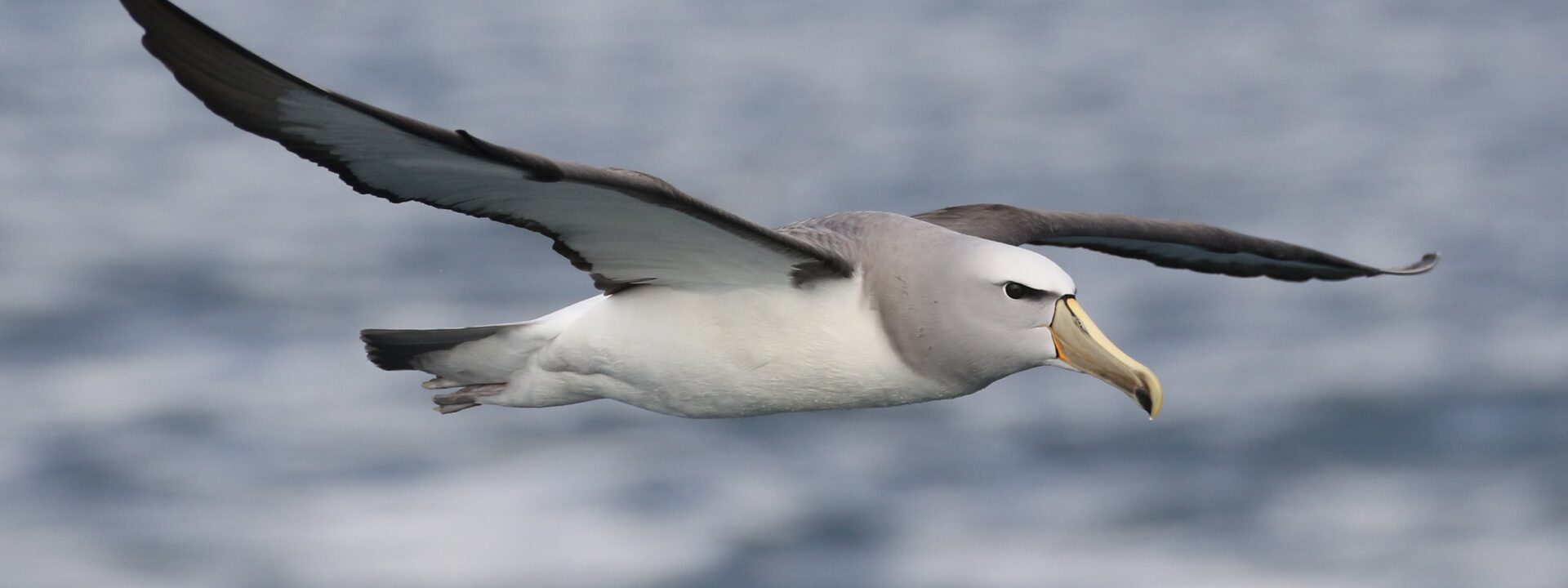
For many the day began somewhat unexpectedly, when there was an announcement just after 06:00am to tell everyone that there were two Short-tailed Albatrosses sitting on the sea close to the ship. The two birds were very obliging and despite the somewhat misty conditions, we were able to enjoy some fantastic views of this extreme rarity which has an estimated world population of only a couple of thousand individuals.
After breakfast and a briefing, we set off for Shimushir Island and after five minutes or so on the open sea, the zodiacs entered the caldera of Broutona Bay and we were soon ashore by the abandoned submarine base. The weather remained glorious for the rest of the morning and we had three hours to explore.
Although many of the buildings were rapidly falling into a state of serious disrepair, the main office and barracks had been largely built of concrete and some went inside to see the Soviet-style murals on the walls.
For those looking for birds, there were an excellent range of species and every few metres there seemed to be either a singing male Siberian Rubythroat or Kamchatka Leaf-warbler. Other species seen included Japanese Grey Bunting, Pine Grosbeak, Nutcracker and Brown-headed Thrush.
By midday we were all back onboard the Spirit of Enderby and the Captain then set a course for Yankicho Island. With forty nautical miles to run, it took several hours to reach our destination with the undoubted highlight being another Short-tailed Albatross, with this one being a subadult bird. As we approached Yankicho, the number of alcids increased with good numbers of Tufted Puffins, Crested Auklets and Whiskered Auklets.
In the late afternoon, we boarded the zodiacs for our planned visit to Yankicho Island but we soon encountered some thick fog and then a sudden and unexpected patch of extreme tidal turbulence. The zodiacs were tossed around violently and when two passengers lost their balance, they were thrown into the water. Emergency procedures were immediately put into action and in less than a minute both were plucked from the water, wet but safe.
As a result, we returned to the ship where everyone disembarked but twenty minutes later, those who wished were back in the zodiacs and on this occasion, we safely reached the entrance to the caldera on Yankicho Island. Cruising inside, we experienced the truly phenomenal spectacle of tens of thousands of Crested and Whiskered Auklets streaming overhead.
Whilst the vast majority seemed to be heading directly for their nests, we also found hundreds of birds sitting on the water and by cruising slowly in the zodiacs, we were able to approach some of the flocks obtaining some amazing views. The Expedition Team had suggested earlier that the Auks at Yankicho could be one of life’s most memorable birding experiences and there were few that would disagree with that assessment.
After enjoying the birds, we made a brief landing near an area of thermal activity where there were a number of boiling water pools and sulphur vents before returning to the ship for a late dinner. It had been an eventful, but ultimately, spectacular day.
Saturday 18 June: am-Toporkovy Island pm-Shiashkotan Island
With a thick fog surrounding the ship, it was 8:15am before the morning wake-up call and after a brief reconnaissance trip by the Expedition Team, we boarded the zodiacs and set off for Toporkovy Island. Closer to shore, conditions were somewhat better than around the ship and we had a fantastic couple of hours.
Several large male Steller’s Sea-Lions came over to investigate and two of these then proceeded to have what seemed to be a territorial tussle, with the animals lunging out of the water and creating huge splashes close to the zodiacs.
For many of the birders, the undoubted highlight was an exceedingly obliging Whiskered Auklet which showed at close range for several minutes. As well as the Auklet, we also saw several dozen Pigeon Guillemots which like the ones we had seen a couple of evenings before, were of the Kuril race, snowi, and thus had very little white in the wing.
Other species seen included Tufted Puffins, Crested Auklets and Slaty-backed Gulls. We then cruised over to Matua Island but the sea conditions were not as favourable as around Toporkovy so we headed back to the ship.
As the Spirit of Enderby headed North, the weather conditions improved considerably and shortly after lunch the island of Raykoke came into view. With thousands of Fulmar about, Chris announced that there would be a chumming session from the stern (using the guts and heads from the fish the crew had caught whilst we were zodiac cruising). It was impossible to accurately estimate the number of Fulmars but the number of birds which ended up following the ship was incredible and there must have been between 50,000-100,000 individuals. The highlight for the keen birders, however, was a Black-footed Albatross, a species which is only infrequently recorded in this part of the Russian Far East and an excellent addition to the trip list.
As we approached Ekarma Island, the sea was fairly lumpy, so Rodney took the decision to take the ship over to Shiashkotan Island where we made an early evening landing. There was a group of Volcanologists working on the island and they took some of the group on a walk up to some old Japanese gun emplacements and a pillbox. One of them was also an enthusiastic amateur historian and he explained some of the history including how dozens of Japanese citizens had starved to death when they had tried to settle the island one hundred years ago.
As the climb was fairly steep, others stayed on the shoreline and strolled along the beach with the birds seen including Middendorf’s Grasshopper Warbler and a couple of Peregrine Falcons.
Sunday 19 June am-Onekotan Island pm-cruising off Paramushir
After a 06:15am wake-up call and a briefing from Rodney, we headed ashore landing at Nemo Bay on Onekotan Island. Conditions were somewhat murky with a steady drizzle but despite this, most of the group decided to go ashore.
The trail climbed steeply up the side of a raised beach and then crossed a relatively flat area of tundra like vegetation with Stone Pine, Polar Willow and Dwarf Birch being the main trees. Most of these were growing no more than a metre or so above the ground (despite some of them clearly being very old), giving us an idea of how extreme the weather could be on this rather exposed island.
There were also a range of colourful flowers including some beautiful Goldish Rhododendrons. The timing of our visit was perfect for these flowers as there were yellow patches right across the tundra.
Whilst some were doing the round trip to Black lake, most of the birders explored the stands of Stone Pine and Dwarf Birch, with the highlight being a fine pair of Pine Grosbeaks. Other species seen included Buff-bellied Pipit, Middendorf’s Grasshopper Warbler, Siberian Rubythroat and Brown-headed Thrush.
Back on the ship, we headed onwards towards Paramushir Island but the weather remained far from ideal with a steady drizzle for much of the afternoon. Many of the Short-tailed Shearwaters were in far better plumage than those we had seen around Sakhalin and the Southern Kuril Islands and had clearly finished moulting and were presumably now continuing their northward migration.
At 7:00pm, the Expedition Team organised a recap in the bar which included a summary of some of the birds we had seen, details about Sea Otters and Rodney describing some of the history of the region. After this, many people headed for the Bridge as we entered ‘Second Straight’ at the north end of Paramushir. This is a well known area for Sea Otters and despite the visibility being only a few hundred metres, several dozen animals were seen over the course of the evening.
Monday 20 June: Bukhta Russkaya, Kamchatka
After all the recent early starts, many welcomed the fact that today’s wake-up call was at 08:15am and by the time Rodney’s post-breakfast briefing had finished, we were entering Russkaya Fiord. There were Harlequin Ducks, Pigeon Guillemots and Tufted Puffins but the species we were keenest to find was Long-billed Murrelet and several were soon seen floating on the sea a couple of hundred metres or so from the ship. As we waited for permission from the Border Guards to go ashore, a distant Steller’s Sea-eagle was also spotted.
After ¾ hour, Rodney and Katya returned to the ship with the requisite authority from the local officials and we boarded the zodiacs for the ride to the head of the fiord. We passed a group of fifty or so Harlequins and had hoped to ‘sneak up’ on an immature Steller’s Sea-eagle which was sitting on the beach but this had other ideas and when we were still three hundred or so metres away, it flew off and joined the adult we had seen earlier.
Once ashore, two walks were offered with some joining Rodney, Katya and Chris to explore the forested valley whilst Adam led a walk along the foreshore. A range of birds were seen including Eye-browed Thrush, Kamchatka Leaf-warbler and good numbers of Eastern Yellow Wagtails.
As soon as lunch was finished, the ship left the fiord and repositioned a few miles to the south to an area where the Expedition Team knew there were likely to be some Steller’s Sea-Lions. These were indeed present but before we had even reached the rocks, some Orcas were spotted. The four zodiacs carefully approached and we enjoyed some spectacular views of what is considered to be the largest member of the dolphin family. There was at least one large male present and he had an impressive dorsal fin which was well over one metre high.
After some great looks at the Orcas and Sea-Lions, we explored the coastline to the north and found about fifteen Sea Otters feeding around some rocks. Although somewhat wary, some of these were reasonably curious and studied us from what they considered was a safe distance, before diving when the zodiacs continued along the coast.
A Steller’s Sea-Eagle nest was also spotted high up on the rocks and two adult birds could be seen looking down on us from the top of the cliff-face. Having seen four different individuals in Bukhta Russkaya, this took our tally to an impressive six for the day a very satisfactory total for such a spectacular bird.
All too soon, it was time to turn round but before returning to the ship, we were able to enjoy some more looks at the Sea-Lions and Orcas. It had been a highly memorable zodiac cruise and whilst the cloud level had been fairly low, the rain had held off and we had had a fantastic time.
By late afternoon we were back on the ship and heading towards our next destination with the ornithological highlights being a somewhat out of range Red-legged Kittiwake and a fully summer plumage Grey Phalarope which had brick red underparts. Whilst ‘grey’ might accurately describe the plumage of this species in winter, the American name ‘Red Phalarope’ certainly seemed more appropriate at this time of year.
With another early start scheduled for the following morning, there was very little socialising after dinner and most people headed off to bed with the prospect of the Zhupanova river trip to look forward to the following day.
Tuesday 21 June: am-Zhupanova River pm-at sea to the Commander Islands
A little before 05:00am, the Spirit of Enderby arrived at the anchorage off the Zhupanova river mouth and after breakfast and a briefing from Rodney and Katya, we set off in five zodiacs for the fishing community.
After Katya had confirmed we were indeed expected and that there were no restrictions on our planned activities, we set off to explore the area. Initially the river was several hundred metres wide but it quickly began to narrow and we soon found a feeding flock of Common Terns. These were a different subspecies from those in Europe (longipennis) and we could easily see their all black bills and darker plumage.
Whilst we had seen a distant Steller’s Sea-eagle as we had arrived, one of the main objectives of the zodiac cruise was to get some really good looks at this species and during the course of the morning, at least three nests were found with adult birds in attendance. We slowly cruised up to one of these and everyone was more than satisfied with their views of this spectacular eagle.
Other birds seen during the morning included Red-throated Diver, Goosander, Goldeneye, Wood Sandpiper and Taiga Flycatcher, but after cruising upstream for eight miles, the zodiacs turned round and headed back towards the fishing community.
Here, there were two options with some of the group being entertained by the very hospitable locals whilst those who wished to continue birding explored an area of wet grassland and scrub behind the buildings. Here our main target was Long-toed Stint and it didn’t take too long to find this diminutive wader but getting good views of it on the ground was challenging as the birds kept creeping away from us through the grass. With Pechora Pipit and Yellow-breasted Bunting also found, it was a highly successful walk.
All too soon it was time to return to the ship and as the zodiacs left the river mouth, it was apparent that the seas were somewhat rougher than when we had set out and with the swells of around three metres at the gangway, it took a while before everyone was safely back onboard.
As we cruised away from the Kamchatka coastline, the low level cloud we had experienced for the last few days finally began to lift and we could see a number of the snow-covered volcanoes which dominate the area. After several days of restricted visibility, it was great to finally see some views.
Although there were fewer birds than we had seen in the Central Kurils, there were still plenty to look at with good numbers of Tufted Puffins, Laysan Albatrosses and Northern Fulmars but the undoubted highlight was at least fifteen Mottled Petrels.
By 19:00 the weather had deteriorated significantly and the ship was moving quite significantly in a storm as we headed eastwards for the Commander Islands. Despite there being another excellent dinner in the restaurant, there were plenty of absentees due to ‘mal de mer’........
Wednesday 22 June am-Nikol’skoye, Bering Island, Commander Islands
The storm continued to blow throughout the night and when the breakfast announcement came, we were told that the ship was about three hours behind schedule. As a result, Katya gave a lecture entitled “An introduction to the Commander Islands”.
With the conditions steadily improving during the morning, a range of seabirds were also seen with many of those who had not seen Mottled Petrel the previous day catching up with this species.
After we reached our anchorage off the small town of Nikol’skoye, Rodney and Katya went ashore to finalise arrangements with the Border Guards and as soon as confirmation reached the ship that everything was in place, we boarded the zodiacs for the short ride to the landing site.
Walking along the shoreline, we passed several Glaucous-winged Gulls but the main target for the morning, Rock Sandpiper, was soon found. There were about ten individuals feeding along the beach and these looked extremely smart in their fine summer plumage.
Further along the track, we saw several hundred Dunlins and then another of the morning’s target birds, Mongolian (or Lesser Sand) Plover, was also located. A couple of Pechora Pipits were also seen but with the wind blowing strongly, it proved impossible to get decent looks at the birds on the ground and we had to be content with flight views.
Whilst the birders explored the foreshore and marsh, others visited the small museum in the middle of Nikol’skoye where there were a range of exhibits. These included the skeleton of a Steller’s Sea-cow which had become extinct within thirty years of the archipelago being discovered on the second of Bering’s expeditions which had landed on the Commander Islands in 1741.
Shortly after 17:00, we were all back onboard the Spirit of Enderby and Rodney announced that we would be heading to Ariy Kamen Island to see if it would be possible to do an early evening zodiac cruise. When we arrived off the island, conditions were much improved on earlier in the day and four zodiacs were soon in the water.
As we approached the island, there were plenty of auks floating in the water including several groups of Parakeet Auklets. Some of these gave exceptional views and we were able to approach to within a matter of metres of them. Whilst they were in the water, it was difficult to see their white bellies but as soon as they took off, these were very apparent.
Around the island itself, the swells were much reduced and we had some nice looks at a couple of dozen Red-legged Kittiwakes perched on rocks conveniently close to the shore, whilst around the corner there were literally thousands of Black-legged Kittiwakes on their nests.
Both Red-faced and Pelagic Cormorants were also present in good numbers and there was a constant stream of Tufted Puffins going to and fro between the higher slopes (where they had their burrows) and the sea. It was to be another late dinner but the day had, yet again, ended with some fantastic wildlife experiences.
Thursday 23 June am-Medney Island pm-At sea
After another early wake-up call followed by a short briefing from Rodney, we boarded the zodiacs for the short ride to Gladkhovskaya Bay on Medney Island, the more easterly of the two islands in the Commander Islands archipelago. Although there was some low level cloud, visibility was much improved and we were free to explore the area.
Almost immediately a Grey-crowned Rosy Finch was spotted on one of the old buildings near the landing site. This soon flew off but there were good numbers of Pechora Pipits and those who wanted to see this species got much better views than at Nikol’skoye as with no wind, the birds were perching up rather than disappearing in the grass. Several were also singing and we were able to watch their display flights.
The more energetic walked up a nearby slope and promptly found a Rock Ptarmigan. Another was then found lower down the hillside, so most people were able to get some nice looks at this cryptically coloured grouse as it fed within a matter of metres of us clearly unconcerned by our presence and utterly confident in its camouflage.
Some walked out to the lake where there were good numbers of Northern Eiders. Although superficially similar to the birds of Northern Europe, the males here (subspecies v-nigra) have bright orange bills and feet and we were able to appreciate this very obvious difference.
Back on the beach, Lapland and Snow Buntings were seen and out in the bay there were both Tufted and Horned Puffins. A couple of Arctic Foxes, which presumably had their den underneath one of the buildings, were a little more elusive but nevertheless many eventually got views of these.
At 10:00 we returned to the ship but less than an hour and a half later, the zodiacs were back in the water as we set off for a cruise around Matvey Point at the western end of Medney Island. On previous visits, the Expedition Team had found this area to be excellent for birds and other wildlife and, once again, this location lived up to expectations with multiple sightings of Sea Otters including upwards of twenty in one small bay alone !!
Those who had not yet seen Horned Puffin were also more than satisfied as we had some fantastic views of several dozen birds including several perched on rocks close to the shore.
The scenery was also very impressive with the hillsides rising steeply and many of the higher peaks disappearing into the clouds. Higher up, there were hundreds of Tufted Puffins commuting backwards and forwards, as well as thousands of Northern Fulmars soaring around the cliffs.
All too soon it was time to return to the ship, although the zodiac cruise had been a fitting climax to our time in the Commander Islands and for many one of the highlights of the entire expedition.
After a late lunch (we had spent too long enjoying ourselves around Matvey Point!!), many were back outside to look for birds and cetaceans. Rounding the western end of Medney Island, we saw thousands of alcids including all three Guillemots (Common, Brunnich’s and Pigeon), Crested and Whiskered Auklets and both species of Puffins. At least four tiny alcids were also seen and although views were far from ideal, those who saw these were confident that these were Least Auklets a species which is always tricky to see this far south.
Passing the south-east tip of Bering Island, we began to encounter a few whales as the shelf drops off very steeply a matter of miles offshore. Rodney asked the Captain to turn the ship and we first approached a group of Sperm Whales and then another turn took us closer to a group of Humpback Whales. At least one of these was seen breaching and with the islands disappearing behind us, this was a great end to our visit to the Commander Islands.
Friday 24 June: at sea heading to Petropavlovsk-Kamchatskiy
After the hectic programme of the last few days, many chose to have a lie in and few made it onto the bridge or out onto the decks before breakfast, although those who made the effort were rewarded with sightings of a Sperm Whale, as well as ten Mottled Petrels and similar numbers of Fork-tailed Storm-petrels.
After breakfast, many people headed towards the stern where several Red-legged Kittiwakes had taken up residence. These allowed the photographers to get some great shots of this somewhat localised species and for much of the day, the birds remained with the ship.
At 10:00 Adam gave a presentation entitled “The Legacy of Steller” during which he discussed the life and times of this 18th century naturalist who was the first to document the biology of Kamchatka and the Commander Islands. Steller also left his mark on the region with his name being commemorated in many of the names of the plants and animals.
Later in the morning, Katya gave an illustrated talk on Sea Otters describing their behaviour and, for example, how ungainly they are on land and that males often bite the noses of the females during mating !!! Katya also talked about the recent collapse of the Aleutian population with the suggestion being that this could possibly be caused by predation by Orcas.
With thick fog surrounding the ship during the latter stages of the day, no new seabirds or cetaceans were seen and after a gala dinner many headed off to bed.
We had travelled over 1,500 nautical miles and had seen many sights and sounds which would live with us for a long long time.

|
| home | introduction | news | tour list | trip reports | media resources | brochure request | booking form & conditions | contact us |
|