![]() |
The Galapagos Islands Trip report 2007 by Tour Leader Dick Filby |
||
|
Ultimate Galapagos 2007 Trip report by Tour Leader Dick Filby Another excellent trip, with, notably, all the endemic Galapagos birds seen yet again, keeping up a fantastic track record for WildWings! This year we also had the added bonus of two nights on the outbound journey in the Ecuadorian cloud forest based at Tandayapa Lodge. Thoroughly recommended!
Day 1 We all met up at Amsterdam Airport for our overnight flight to Quito on KLM. An uneventful flight with two stops firstly at Bonaire in the Dutch Antilles where it was still dark and we were allowed to go to the terminal building, and secondly at Guayaquil (Ecuador) where dawn broke, and we had to stay on board the aircraft. Day 2 We arrived at Quito on a cool sunny morning, teamed up with our guide Olger and set off for Tandayapa without further ado. We made a brief stop en-route for shampoo and bananas, and then at Chilachili where we saw Giant Hummingbird and White-tailed Shrike-Tyrant before we arrived in good time for lunch. After checking into our rooms were able to spend time on the veranda getting to know the numerous hummingbirds. In the afternoon we spent some more time on the veranda and lower veranda (or napping) before going out for a late afternoon walk. Back to the Lodge for dinner and early to bed. It was an excellent start! Day 3 Up early we headed off by mini-bus with a sandwich to the forest where we spent the entire morning. Descending down a path with our guides we paused to play tapes of Rufescent Screech Owl (which we heard but did not see) and of Montane Pygmy Owl which we did not hear at first (although one called later and flew over our heads but seen only by one of the guides). Just as dawn broke: Cock of the Rock lek hide, a totally captivating captivating display, then fantastic views of Toucan Barbets, Crimson-rumped Toucanets and Olivaceous Pila. Moving on our guide led us to an area where he fed ‘Maria’, the Giant Antpitta which duly gave fantastic views, before we moved on to see two Dark-backed Wood Quail feeding on a side trail. Then, on the way up the hill we paused to see a Yellow-breasted Antpitta. Back at the top of the trail more hummingbird feeders attracted several different species to those found at the lodge plus we saw Scaled Fruiteaters and many more birds. Back to Tandayapa in time for a late lunch, relax, late afternoon walk on the trails, before heading out by mini-bus for Lyre-tailed Nightjars success at our second attempt hurrah! Then back for beer and dinner - very civilised indeed. Day 4 We spent the morning birding up the hill above the lodge, again seeing many birds, the major highlights including Plate-billed Mountain Toucans, and (heard only) Ocellated Tapaculos plus Rufous-capped Antpittas. Back to Tandayapa for lunch, a short relax enjoying the numerous hummingbirds at the patio feeders, and an Ecuadorian Thrush at the hide, before the late afternoon drive back into Quito where we arrived in time for an early dinner. Day 5 Up early we headed to the airport after breakfast and took the early morning flight to the Galapagos. On arrival at Baltra we watched our first Galapagos endemics: Small Ground Finches, and briefly a couple of Land Iguanas before we even got inside the terminal! We collected our National Park Entry Tickets and we proceeded through customs into the terminal and met our guide Galapagos National park Guide, Monica. Our bags went straight to the ship and we followed them to the jetty where we donned lifejackets, distracted by Galapagos Sealions on the seats, Lava Heron on the rocks, and a Lava Gull. Soon we were on board the Cachalote, and settled into our cabins, followed by lunch and then we headed for our first landing at South Plaza Island. En-route there was plenty to watch: Blue-footed Boobies, Elliot’s Storm Petrels, Galapagos Shearwaters, Galapagos Petrels, Red-billed Tropicbirds all close to the vessel. South Plaza: after lunch: What a fantastic start! Firstly though the bull sealion on the jetty vs the ship’s engineer Pedro. Pedro of course finally managed to encourage the sealion to relinquish his jetty and we landed in comfort. What a wealth of life: Land Iguanas, Lava Heron, Brown Pelican, Small Ground Finches, Common Cactus Finch, Yellow-tailed Mullets, Prickly Pear cactus trees, batchelor sealions at the clifftop, and a spectacular feeding frenzy of Galapagos Shearwaters and Common Noddies offshore. We also witnessed a fallen cactus, a veritable feast for the Land Iguanas, and finally returned back to the ship. The first landing is often one of the most memorable. Dinner at anchor, then later we sailed the short distance to Sante Fe Island for an early start the next morning. Day 6 Disembarking the pangas onto a white sandy beach, we were treated to silhouetted Blue-footed Boobies and Brown Pelican against the crimson sunrise.. sealions on the beach, Galapagos Mockingbirds and Yellow Warblers and then walking inland to find Santa Fe Land Iguanas plus Galapagos Dove and Galapagos Flycatcher. More endemics were soon being notched up! Late morning we set off for San Cristobal, with many seabirds seen on the crossing, including our first Waved Albatrosses, as well as more Elliot’s and Wedge-rumped Storm-Petrels, Galapagos Shearwaters and Galapagos Petrels. Lunch then ashore and into our bus and off into the hills. Our main target bird here was the endemic mockingbird. Stopping at our regular spot for this species, we scored almost as soon as we got out of the bus, with several individuals showing well. This was rapidly followed by a Vegetarian Finch, several Small Tree Finches, Warbler Finches (perhaps a future separate species?) and many Small and Medium Ground Finches too. On to the cemetery where wild orange trees delighted and quenched thirsts, thence back to town and some free time. We admired the new seafront including the topographic model of the Galapagos. We had dinner at anchor before sailing overnight to Espanola Island.
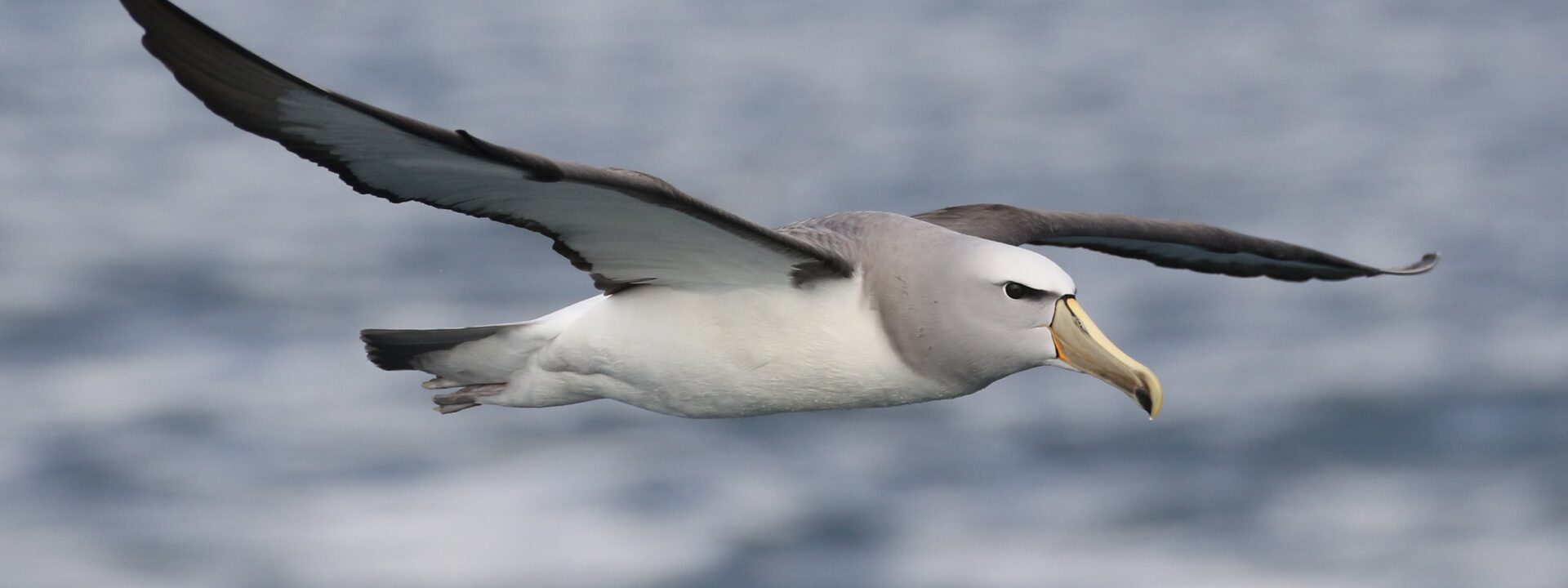
Day 7 Today is always a very special day, Espanola, home to the endemic albatross. Dawn: Gardner Bay: We were still the first ashore (even though it was a “late start” for us - 7am) onto the white sand beach, greeted by the endemic Hood Mockingbirds, plus Yellow Warblers, Galapagos Doves flying through by the score, Small Ground Finches, Warbler Finches, and finally some Large Cactus Finches too. Inshore we watched Pacific Green Turtles, Marine Iguanas.. and on the beach Espanola Lava Lizards. We rounded off the morning’s activities with swimming and snorkelling for those that wished the latter being particularly noteworthy for sealions and colourful fish too. After lunch on board we disembarked at Punta Suarez for a full afternoon at Punta Suarez one of the great sites on the Galapagos and it was to prove an excellent afternoon. Landing on the little stone jetty we were greeted by the Marine Iguanas, Sealions and Sally Lightfoot Crabs and great rollers pounding the rocks at the point. Near the beach an adult Yellow-crowned Night Heron loitered amongst the rocks. We headed on, to the top of the low sea cliffs where Nazca Boobies nested in profusion, offering some great photo opportunities, past Blue-footed Boobies on the path itself, and Espanola Lava Lizards posed atop rocks, pausing to admire the Red-billed Tropicbirds screaming round and round in display, and yet more Yellow-crowned Night Herons and Nazca Boobies, and thus to the nesting Waved Albatrosses.. so many so close.. It was fantastic to watch them at close quarters. Nearby the blowhole performed too, drenching a displaying albatross party. We watched as some albatrosses headed to the cliff edge to take off into the prevailing wind. It was magical. Finally as sunset beckoned it was time to return to the Cachalote, home for drinks and supper.. and with nice light made it one of the best afternoons possible! Day 8 The island of Floreana. We awoke off Champion Islet at dawn: into the pangas and off to the islet and enjoyed almost immediate success with excellent close up views of several Charles Mockingbirds from the pangas : one with silver rings, another with blue and at least one juvenile with none. Seven or more in total plus Cattle Egrets, Common Noddies, sealions and Blue-footed Boobies… then back to the ship for breakfast. Then we headed to nearby Pta Cormorant and onto the olivine beach with its black mangrove tree, underneath which was a collection of sea urchins remains and shells, and nearby a Hudsonian Whimbrel on the rocks. Thence to the lagoon: Flamingos (35 in all) and Black-necked Stilts, Semi-palmated Plovers one even showing well enough to see the semi palmations. Back to the beach, where five Galapagos Penguins cruised by just offshore another endemic bites the dust! Then over to the other beach floury sand and as Dick picked a rubber glove out of the surf a first for the Galapagos trips a Portugese Man-O-War sting on his toes.. youch! Time for swimming back at the landing beach followed by lunch on board as we sailed round the corner to Puerto Velasco Ibarra where we disembarked into the new “bus” and headed up to the highlands. At about 1100 feet we disembarked at a favourite spot and within minutes had Medium Tree Finch (endemic to the highlands of Floreana) as well as many Small Tree Finches, Small and Medium Ground Finches and great views of a Galapagos Flycatcher. Further on we walked on up to the original home of the Wittmers when they first arrived the pirates’ water source, and saw more Medium Tree Finches there too. Back to town for a relaxing beer on the waterfront, we then sailed after dinner for Santa Cruz Island
Day 9 Santa Cruz: Academy Bay and Puerto Ayora Leaving the vessel early and getting onto a small bus, we drove up to Media Luna where we enjoyed great success with seeing the endemic Galapagos Rail (and hearing at least two more) as well as several Woodpecker Finches and three Dark-billed Cuckoos before we headed off to have an very pleasant lunch by the swimming pool at the Altair restaurant. Some of the party enjoyed the pool, whilst others birded or relaxed with a drink. Large Ground Finch was a target bird today and we saw a couple. Also, today was the only day we saw Large Tree Finch, with a couple in the morning, another two at lunchtime, as well as two Vegetarian Finches, and yet another in the afternoon. We headed off to the El Chato reserve in the afternoon in the expectation that we could find some wild Giant Tortoises and were not disappointed, finding several. They were magnificent, slowly lumbering around their ancient native forest home. Also, at the lagoon, we saw some American Purple Gallinules and frigatebirds, drinking on the wing by skimming low over the water like Swallows do at home. Day 10 Santa Cruz: The Charles Darwin Institute and then at sea after lunch Whilst Monica took most of the group to the Charles Darwin Institute, David and I headed back up the hill to Media Luna David’s wife Mary had decided to stay on Santa Cruz for the rest of the trip to recover from a bug that she had brought with her, so David had missed the Rail yesterday. We enjoyed success quickly and were back with the main group by mid morning. The research station gave everyone an opportunity to gain an insight into the history of evolution and the Galapagos National Park, and to see the captive rearing program for the Giant Tortoises. Also, more Large Ground Finches, Common Cactus Finches, another Vegetarian Finch, plus the opportunity to do some souvenir shopping whilst at the same time benefiting the institute. After some free time in town it was back on board for lunch before we set sail for Isabella Island. The afternoon at sea was relaxing, with plenty of the by now familiar seabirds: Galapagos Petrels, Waved Albatross, Audubon’s Shearwaters, Elliot’s and Wedge-rumped Storm Petrels plus a single Madeiran Storm Petrel.
Day 11 Punta Moreno We landed at Punta Moreno at dawn and enjoyed the mangrove edge to the magnificent lava field. Once onshore we explored the freshwater pools and succeeded in seeing the only Galapagos Martins of the trip yet another but a difficult endemic to see. The flamingos made for pretty photos and White-tipped Reef Sharks were the best of the many fish on parade. Afterwards some enjoyed snorkelling with the Pacific Green Turtles whilst others relaxed on board. Then we set sail across Elizabeth Bay taking lunch enroute to Tagus Cove, where some went swimming in the sheltered waters before we all went for a terrific late afternoon panga ride, where highlights were undoubtedly the great views of Galapagos Penguins and Flightless Cormorants. Back on board we enjoyed a sunset cocktail on the top deck before returning into the cove for the night.
Day 12 Isabella Island: Morning We landed at 0600 at Black Turtle Beach where had a Great Blue Heron and a Galapagos Penguin to greet us. We changed into walking boots and set off up the beach: success almost immediately with at least four Mangrove Finches including some colour ringed birds. The second to last endemic safely “underthe-belt” Only one more endemic bird left to go for yet another full set. There were plenty of other birds and wildlife to see here: Galapagos Mockingbirds, Yellow Warblers, Medium and Small Ground Finches. The beach was idyllic and we saw Lava Heron, several more penguins, Flightless Cormorants, Marine Iguanas, Galapagos Sealions, Blue-footed Boobies plus Common Noddies. It was a glorious and peaceful morning. Back on board we headed out into Elizabeth Bay in search of whales which we found pretty quickly on the calm seas. There were several whales in a small area, all of them medium sized baleen whales, and their blows, dorsal fins and general behaviour was consistent with Bryde’s whale, although we never saw any rostrum views to 100% confirm this ID (with the three longitudinal ridges which are diagnostic). We stayed with a cow calf pair for around an hour, gently following them around slowly before we left them in order to explore the shelf edge in an area where I have previously encountered Cuvier’s Beaked Whales in the past. No luck this year, but a pleasant time at sea, enjoying the now familiar suite of seabirds; Elliot’s and Wedge-rumped Storm Petrels, more Galapagos Shearwaters, interrupted by lunch, prior to our disembarkation at Pta Espinosa on Fernandina. A dry landing onto the uplifted National Park jetty at high tide, then across a small creek on the stepping stones, with Monica’s helping hand. A Galapagos Hawk eyed us from a perch above, and a Lave Heron crept through the mangrove. We walked across the Pahoe hoe lava to gain a view of the Aa-aa lava that stretched endlessly towards the Cumbre Volcano that dominates this, the youngest island of the archipelago. Not a difficult walk but dramatic with the crevices and cracks formed when the lava cooled. Pioneer Lava Cactus were already invading, as well as some sedges. Other distractions en-route included a Galapagos Western Racer snake, a Striated Heron (or two), some Small Ground Finches and the inevitable Yellow Warblers. Monica pointed out the three species of Mangrove, Red (with its red roots), Black standing tall above, and white with its small rounder leaves. Then to the water’s edge where we found two Hudsonian Whimbrel, two Wandering Tattlers and two Ruddy Turnstones resulting in a quip about Noah and an ark being made! A Galapagos Hawk came to watch the goings on, a Lava Lizard was eying a fly overhead before performing an incredible aerial leap to snatch it from the sky, but perhaps best of all Monica found us another Western Racer snake, some 75cm or so long that was hunting on the lava in the shade of the Red Mangrove. It offered some good photo opportunities, and provided quite a show for a while as it came eye to eye with a lava lizard that it made an attack on but was not quite quick enough. The Lizard escaped and the snake continued to lie in wait for its next opportunity. Once again past the whale skeleton, across the beach where Marine Iguanas lay their eggs and on towards the point itself where Marine Iguanas basked in the late afternoon sun along with two American Oystercatchers. Highlight of course were the nesting Flightless Cormorants with their beautiful blue eyes and stubby winglets which kept us occupied until the sun was about to sink below the horizon signalling once again the end of another magnificent day. Day 13 At sea via Roca Redonda We upped anchor at dawn at set sail for Pta Vicente Roca and thence onto Roca Redonda, crossing the Equator for the first time on the ship this voyage. It was an exciting morning with highlights including two Galapagos Fur Seals at Vicente Roca, at least 20 Ocean Sunfish (Mola Mola), at least one Parkinson’s Petrel, a pod of five Killer Whales (Orcas) that we followed southwestwards for a while, and at least 100 Common Dolphins that lept and swam close to the boat. We arrived at Roca Redonda at lunchtime and enjoyed the spectacle of the tens of thousands of seabirds wheeling around its cliffs, most especially the Wedge-rumped Storm Petrels swarming like midges! Swallow-tailed Gulls, Red-billed Tropicbirds and Common Noddies all added to the throng. In the afternoon as we sailed east we saw another two Parkinson’s Petrels as well as many other seabirds, the best of which were at least 30 Madeiran Storm Petrels. Sunset saw us sipping cocktails, compliments of the bar, whilst watching the last Parkinson’s Petrel from the top deck. A relaxing yet fun day at sea! Day 14 Genovesa Island After breakfast it was into the pangas to go to Prince Phillip’s Steps (El Barranco). Parties of Galapagos Shearwaters wheeled round the bay, Swallow-tailed Gulls flew along the cliffs, and Blue-footed and Nazca Boobies perched up. Onshore, we headed up the cleft in the rock they call Prince Phillip’s Steps, to be greeted by a wonderful scene at the top. Nazca Boobies everywhere, many Sharp-beaked Ground Finches (our final endemic hurrah a full set for the third year in a row), Large Cactus Finch and then later Large Ground Finch too. Many Red-footed Boobies in the Palo Santo trees, and you could see that one on a nest by the path had an egg when the adult stood up.. Another great sight was a Nazca Booby with tiny chick under it, we saw it being fed later.. Galapagos Doves walking quickly like clockwork toys, then later some were more lethargic and therefore photogenic. We finally made it (the 200 metres) to the other side of this part of the island and to the incredible view over the Wedge-rumped Storm-Petrel colony thousand upon thousand wheeling low over the lava, searching for their nest hole and keeping watchful eye for the Short-eared Owls, adapted to hunting by day. The Galapagos form is especially dark, adapted to the lava landscape. We found the remains of several Storm-Petrels along the way before we spotted our first owl, then a second that was much close, which flew closer still and landed right by the trail giving excellent photo opportunities, mobbed by the Galapagos Mockingbirds these ones on Genovesa apparently candidates for a future species split (as are the Large Cactus Finches). Also entertaining to watch were the Red-billed Tropicbirds returning from sea but having to run the gauntlet of the ever watchful Great Frigatebirds circling above. One hapless tropicbird screamed loudly as a frigate held it by the wing in front of us, tumbling earthward until the frigate released it in a heap just above the lava. It lay there for a few minutes before flying off, only to get harried again and able to effect escape by disgorging its meal. Later another under duress let its meal drop into the Palo Santo trees, and several frigates gathered low over the trees in an attempt to locate their “lost” meal. Back into the pangas, several Galapagos Fur Seals hauled out in the shadows near the bottom of the cliff, one next to a Swallow-tailed Gull. Then back to the ship, drinks, snacks and the snorkelers went out for an enjoyable session with Monica. Finally lunch and a siesta before heading out again, to the white coral of Darwin’s Beach. It was a paradise that required no exploring it was all their in your face! Galapagos Sealions lounging on the beach, a couple of tattlers on the rocks, Swallow-tailed Gulls great views best of the trip giving photo opportunities to die for, Great Frigatebirds on nests, a Nazca Booby on a log, Red-footed Boobies in the Red Mangrove bushes, including white morph birds the rarer form on the Galapagos unlike elsewhere and a Yellow-crowned Night-Heron. It was a beautiful sunny afternoon that gave us wonderful pre-sunset photo light. Finally, as the sun sank, it was time to head back to the ship.. Dinner and then we set sail for the last time. Day 15 We had an early morning dinghy ride before breakfast and enjoyed a peaceful last morning in a mangrove fringed lagoon Blue-footed Boobies streaming past westwards, Cattle Egrets dispersed from their roost, Pacific Green Turtles and reef sharks swam under the boats, and all too soon it was time to be back on board, and sail across the bay to disembark, make our fond farewells to the crew and to catch the plane back to Quito.
We arrived in Quito with daylight to spare, so after the short ride to the hotel there was time for those interested to take a walk to the local park. We found Rufous-collared Sparrow, Eared Dove, Great Thrush and Sparkling Violetear in the gardens before getting to the park, and once there we added Black-tailed Trainbearer and Vermilion Flycatcher to the list. A very enjoyable and productive little stroll. Back at the hotel farewell dinner, preceded by drinks, rounding off the day and the trip in fine fashion. Day 16 Up early, we made our way to the airport and boarded the KLM flight to Amsterdam. The plane made a brief stop on the way in the Caribbean on the Lesser Antillean island of Bonaire. However there was no opportunity to disembark as we were running a little late. Day 17
We arrived in Amsterdam early morning to connect with our flights to our own local airports, the end to another very successful Ultimate Galapagos trip.
www.wildwings.co.uk
|
||||||||||||||||||||||
|
WildWings, 577 Fishponds Road, Fishponds, Bristol. BS16 3AF.UK
|
|||||||||||||||||||||||