|
WildWings, 577 Fishponds Road, Fishponds, Bristol. BS16 3AF.UK
|
|
ON BOARD PROFESSOR MOLCHANOV
Trip Report 5th March 10th April 2007

Saturday March 3
After a long journey with Aerolinas Argentinas it was good to reach our first base at Ushuaia in Tierra del Fuego with spectacular views of the mountains and coast from our accommodation. Contact was made with our local guide, Marcello Cruise, and plans confirmed for a visit to the Tierra del Fuego National Park the following morning.
Sunday March 4
Ushuiai
Despite dismal, overcast conditions our group got off to a resounding start when two Magellanic woodpeckers were seen close to our bus. This massive, stately woodpecker was just the gold standard bird we needed to begin our journey. A black-chested buzzard eagle perched close by was much appreciated and the passerines were putting in a good show too with parties of thorn-tailed rayaditos proving particularly popular. Some of the passerines appeared in very good numbers with over 60 Patagonian sierra finches seen and good numbers of black-chinned siskins and fire-eyed diucons. Great grebes were also in good numbers and some were displaying. One of the world’s largest kingfishers ringed kingfisher was seen and nearby a group of rufous-chested dotterels. We went for a tramp in the woods in search of another local endemic Magellanic Tapaculo but only one alert party member saw the bird. With the rain continuing to make birding difficult we slowly began to make our way back into Ushuaia.
Monday March 5
Beagle Channel
Position 54°45’S / 68°30’W
Air temperature: 4°C. Windy with scattered snow showers.
Snow flurries and falling air temperatures reminded us that this was autumn but some hardy souls made off to the Ushuaia rubbish tip where they got good views of turkey vulture, chimango, crested and white-throated caracaras. Around the coast more rufous-chested dotterels were seen along with over 60 white-rumped sandpipers. Chilean skuas showed well and provided our first look at some of these southern Catharacta skuas. By late afternoon we had joined the ship and at 18.02 hours the Professor Molchanov began to move off down the Beagle Channel heading for the open ocean. Apart from stops at islands or island groups it was going to be difficult to orientate so our position at sea at 08.00hrs each day (ship’s time) was recorded by Troels Jacobsen and is repeated in this account. As we moved down the Beagle Channel a small little auk like bird was seen, our only Magellanic diving petrel of the trip. More common were southern black browed albatrosses , southern giant petrels and sooty shearwaters.
Tuesday March 6
Drake Passage
Position at 08.00: 55°58’S / 65°41’W,
Air temperature: 4°C. Wind force 8-9 southwest, swell 7-8 metres, overcast, moderate visibility
Strong (Force 9) gales in the Drake Passage had an impact on many of us, not least me. It is only fair to state here that because of sea-sickness and a mystery stomach virus I was incapable of fully leading the group at times. In particular I want to record my personal thanks to Graham Tucker who not only stepped in to call the log on a number of evenings, but also set about finding and identifying birds from the ship and setting up a logical set of timed counts from the bows. An added bonus was Graham’s keen interest in cetaceans which on a trip where generally sea mammals were scarce meant we all benefited from his observations.
Out on deck sightings included the first wandering albatrosses, the only southern royal albatross of the trip, our first light-mantled sooty albatross and first Antarctic fulmar. An early Kerguelen petrel was recorded and two hourglass dolphins.
Wednesday March 7
Drake Passage
Position at 08.00: 58°08’S / 61°25’W
Air temperature: 5°C. Wind force 7-8 from southwest. Swells of 6-7 metres. Mostly overcast, Visibility good.
On our way to the South Shetlands today the real highlight were sightings of at least 10 fin whales. Eight hourglass dolphins were logged. Our first grey-headed albatrosses appeared today along with over 500 Antarctic prions. Debates began over the difficulty of identifying prions and diving petrels and these lively discussions were to last for many evenings to come.
Thursday March 8
South Shetland King George Island
Position at 08.00: 61°40’S / 57°40’W.
Air temperature 3°C. Wind force 7-9 from the southwest. Swells 5-6 metres - dropping as we reached more sheltered waters off King George Island. Mostly overcast with a bit of sun shining through later in the day. Good visibility.
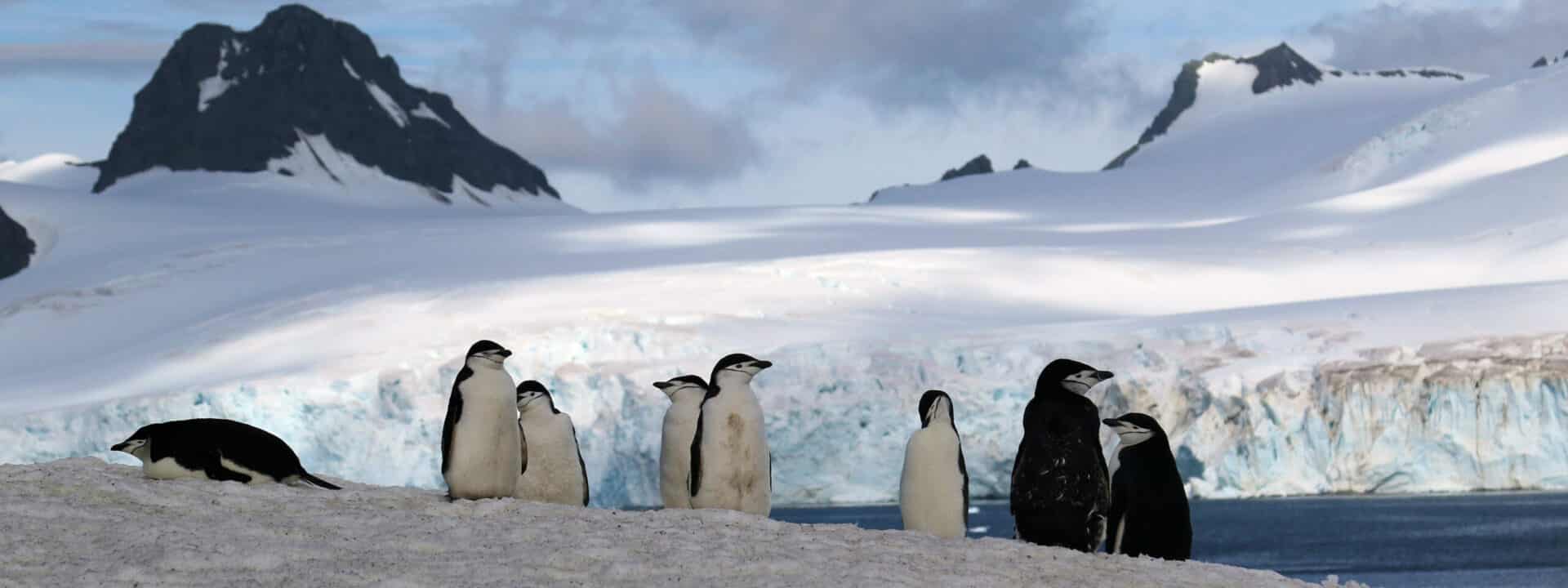
As sea conditions calmed down in Admiralty Bay it was easier to see our first penguins, gentoo and chinstrap penguins ‘porpoising’ beside the ship. Our vessel was shadowed by numbers of cape petrels and up to ten Antarctic fulmars were seen. A dramatic reduction in Antarctic prions today brought numbers crashing from yesterday’s 500 to 1.The first white-chinned petrel of the trip was seen. It was appropriate that as we left the shelter of Admiralty Bay and approached the Bransfield Strait we should record Antarctic shag (Phalacrocorax bransfieldensis), the only issue to consider was is this a form/race/sub-species of imperial shag (P.atriceps) or is it a true species in its own right? Consult your local taxonomist for the latest opinion. Some observers thought they may have seen a chicken fly past the bows, but it was that weird, plump little scavenger the snowy sheathbill, more at home among the penguin faeces. A very memorable sight today, in the shelter of King George Island was the sight of some 40 south polar skuas sporting wonderful blond napes and neat black bills. We all enjoyed the chance to see these birds at close quarters.
Friday March 9
Travelling through the Antarctic Sound towards the site of our Antarctic landing at Brown Bluff on the Antarctic Peninsula.
Position at 08.00: 63°20’S / 53°54’W, in the Antarctic Sound off Hope Bay.
Air temperature -1°C. Light winds from varying directions to none at all. Overcast with spells of sun, visibility good.
The morning began with the best possible start a juvenile emperor penguin was found among the ice and the ship was manoeuvred carefully towards it. Eventually we were looking right down on the bird, though sadly it had a large gaping wound on the left side and would probably not survive. The likelihood was that a top predator, probably a leopard seal had attacked it. As the day progressed we experienced three more juvenile emperors, all fit and healthy individuals. One bird swam and dived very close to the bows, a mega bird for us all. Another denizen of the true Antarctic the adelie penguin was seen in good numbers. One of the best petrels, and looking almost like daintier versions of an adult ivory gulls, were lesser snow petrels and six were seen today.
Mammals took a real boost today, perhaps the highlight was the dwarf minke whale which passed under the ship allowing some photographers a great opportunity. Thirty Antarctic minke whales were recorded today and four humpback whales. Our seal sightings took a welcome boost too, besides the now ubiquitous Antarctic fur seals, crabeater, leopard and weddell seals were all seen today.
Saturday March 10
Travelling through the Powell Basin, to the south of the South Scotia Sea towards the South Orkney Islands.
Position at 08.00: 62°05’S / 52°31’W, in the Scotia Sea.
Air -4°C. Strong breeze from the south. Moderate swells of 3-4 metres. Visibility good, mostly overcast.
Remarkably the fifth emperor penguin of the Odyssey was seen today and almost as spectacular, we passed an iceberg estimated to be over 8 nautical miles long. Around the edge of the iceberg were up to 80 Antarctic petrels, a huge flock and this was to be the only day we saw this southern species of petrel. Other petrels were in good numbers too, with over 30 lesser snow petrels and over 50 cape petrels. Antarctic fulmars reached peak numbers today with over 200 birds recorded.
Three humpback whales were seen but it was the birds of the Antarctic which stole the show today along with the spectacular icebergs and ice sheets around us.
Sunday March 11
Arriving at South Orkney Islands and landing at the Argentine base Orcadas Station - on Laurie Island. Then cruising along the northern edge of Coronation Island before heading towards South Georgia.
Position at 08.00: 60°47’S / 44°40’W, in the Scotia Sea
Air temperature: -1°C. Calm with very little swell. Some snow. Good visibility. In the afternoon the wind was very light from southeast.
With light snow flurries we landed at the Argentine base and were made very welcome by the base commander and his men. There were some chinstrap penguins ashore and a solitary adelie, but these were young birds finishing their moult from downy plumage and looked a bit dishevelled. Until the short, stiff feathers are present young birds like this are not waterproof and insulated so they can only fast on the shore until their moult is complete.
Back at sea today southern giant petrel numbers increased dramatically, with over a hundred being seen. We had seen small numbers ( up to 20 ) of black-bellied storm petrels on three days but over a hundred on March 11 set a new record for us. Another shag put in an appearance, this time c.300 South Georgia Shags again a taxonomic puzzle waiting to be clarified, as Phalacrocorax georgianus is in the same ‘super group’ as Antarctic shag and might well be an imperial shag got it ? Approaching Laurie Island a group of 36 elephant seals were seen in an adjacent bay and near the base itself two or three animals gave good, close up views. In the afternoon while heading west towards Coronation Island we were treated to some whale sighting with at least two sperm whales and, much more unusual in these waters, a southern right whale.
Monday March 12
Traveling in the Scotia Sea towards South Georgia
Position at 07.30: 58°50’S / 42°10’W, in the Scotia Sea.
Air temperature -1°C. Strong breeze force 5-6 from north-northeast. Swells 4-5 metres. Visibility moderate, clearing somewhat over the day.
Leaving the relative shelter of the South Orkneys the ship soon experienced heavier seas making seawatching conditions more difficult. This said, albatross sightings increased , with black-browed recovering to a respectable 30 and our first wandering albatross for five days. Light mantled sooty albatross increased to a new high of 10 and a solitary grey-headed put in an appearance. We had not seen any soft plumaged petrels since the rough weather in the Drake Passage so a single bird today was excellent, as were two Kergulen petrels. Both blue petrels and Antarctic prions came back in abundance today. Fifty white-chinned petrels were also seen.
The great advances in digital camera technology, and more compact high power lenses mean that any photographers on board have a key role in helping (and indeed often solving) difficult identification dilemmas. This of course applies to all taxa not just birds, indeed if it were not for the keen photographers on board many sea mammals would have gone unrecorded. Such was the case with the dwarf minke whale and, today, with two sei whales where separating them from the similar fin whale was made possible using digital images. Seven hourglass dolphins were also seen today, as well as a single orca.
Tuesday March 13
Reached South Georgia, sheltering in Drygalski Fjord
Position at 08.00: 54°04’S / 37°53’W.
Air temperature 1°C. Wind force 6 from the east. Swell 3-4 metres. Overcast with snow showers.
As to be expected bird numbers and diversity increased as we approached South Georgia. Two more penguin species were logged with some forty macaroni and ten kings. Black-browed albatross numbers soared with in excess of a hundred birds being seen. Difficulties in separating the two giant petrels were discussed, in younger birds in particular the bill tip colour is not diagnostic or maybe very difficult to see properly at any range. The white-phase southern giant petrels did not, of course, cause us any headaches. Today we logged in excess of 50 giant petrel ‘sp’ so that reflected the concerns over specifically identifying some birds. Prion numbers reached a new high today with an estimated 5,000 Antarctic prions logged. In contrast the first fairy prions totalled just five. Two petrels appeared in very good numbers with over a hundred each of white-chinned petrel and black-bellied storm petrel.
Cetaceans were represented by two fin whales and two hourglass dolphins and we saw the last weddell seals of the trip. When most marine creatures die their remains sink to the ocean floor. One sea creature which bucks this trend is the ‘nematine’ or giant sea worm. This worm which can grow to several metres long normally lives on the detritus on the sea bed but when it expires it floats upwards. Today one nematine did just that and was caught on camera for posterity.
After dark a number of diving petrels were attracted to the ship’s lights. The similarity between Magellanic, South Georgia and common diving petrels makes certain identification of these three species hard. Whilst location/range is a key factor with Magellanic, common diving petrel overlaps Magellanic’s range and positive field marks are needed. With such small birds viewed at sea from a moving/rocking vessel specific field characters are not easy to see. Tonight, however, we were able to examine four South Georgian diving petrels in the hand. Some characters including leg colour however did not match up with texts in e.g. Shirihai (2002), so more work to be done on this difficult group.
Wednesday March 14
South Georgia - visiting Grytviken , the site of the old whaling station and then Fortuna Bay.
Position at 08:00 54°16’S / 36°30’W, in Cumberland East Bay, off Grytviken.
Air temperature 3°C, wind force 4 off shore, calm in the bay. Mostly overcast with sun spells and snow showers.
Before we landed we could see small groups of king penguins and loafing fur and southern elephant seals, we also saw our first South Georgia pintails, currently named as Anas georgica georgica, a race or sub-species of the yellow- billed pintail we saw in Tierra del Fuego but it is quite likely this isolated duck will achieve full species status and it is worth watching the ornithological press to see if any taxonomic decisions are forthcoming.
As we walked around the outside of the former whaling station I think most of us were quietly reflecting on mankind’s exploitation of the ocean’s whales. This is a sad place but perhaps the old factory and its rusting equipment do provide a strange memorial to the whales which perished in such large numbers. One very positive aspect was the quality of the museum and the helpful staff, everything from information on South Georgia pipit to the programme for the whaling men’s 1961 Christmas concert and film show were on display and much more besides.
The sight, sound and smell of the king penguin colony at Fortuna Bay was an amazing site. We landed close to hundreds of Antarctic fur seals with light-mantled sooty albatrosses wheeling overhead and up to a thousand gentoo penguins along the shore and in the sea. There are, apparently, 7,000 breeding pairs of king penguins at this colony. We saw birds still incubating eggs, some adults still brooding small young, large brown fluffy juveniles waiting their moult and hundred of adults just off shore and walking to and from the colony. Evil looking southern giant petrels with their cold, pale eyes sat watching for something to expire. In the background, quite bizarrely, about 50 reindeer were grazing. Introduced by the Norwegians between 1911- 1925 for sport and presumably a welcome change in meat , they did seem to fit into the scene rather well.
Thursday March 15
On South Georgia, visiting the king penguin colony at Salisbury Plain and the wandering albatross breeding area on Prion Island
Position at 08.00: 54°03’S / 37°19’W, approaching Salisbury Plain in the Bay of Isles.
Air temperature: 1°C, wind moderate from southwest. High cloud and sunny, good visibility with occasional snow showers.
Salisbury Plain is home to an estimated 150-200,000 king penguins and we were able to spend time capturing wonderful images of these stately birds. In among the noise of the penguins we could see snowy sheathbills bobbing around on the look out for dropped food and seal droppings. In the shallow pools in the tussock grass we located up to 10 South Georgia ( yellow-billed) pintails and got extremely close to one or two well hidden southern elephant seals.
In the afternoon we took the Zodiacs to Prion Island. Hardly ashore we saw the first of our seven South Georgia pipits that day, affording great opportunities for photographers.
Our group spilt up into smaller units and each moved up the hill to the summit of the small island. The ground was covered with the remains of Antarctic prions, presumably victims of skua attacks? The first breeding birds we saw were giant petrels, both species were seen today and some southerns were on nest sites. The wandering albatross race/form here is the ‘snowy’ albatross Diomedea exulans exulans. What a privilege to be able to watch these magnificent birds at such close range. Sometimes birds leaving the breeding areas would lower their heads and try to slink past as far as a bird with a body much larger than a domesticated turkey and with feet like spades could slink by. Immature birds were engaging in ‘gamming’ where groups of three or four birds would spread their wings out to face each other, lift their necks high and emit sounds like a donkey braying. Bills were being vibrated and clattered with would be partners or rivals and we were simply on the sidelines watching this whole wildlife spectacle unfold…
Friday March 16
At sea between South Georgia and Gough Island
Position at 08.00: 52°21’S / 33°26’W, the Southern Ocean, 1000+ nautical miles from Gough.
Air temperature: 1°C, wind moderate force 4 from the southwest wearing south during the day. Swell 1,5-2 metres. Overcast with frequent snow showers, later sunny and good visibility.
Coming out into more open sea we were able to record many more petrels, and some 200 soft-plumaged petrels were logged today along with c.40 white-chinned petrels, our first grey petrel and up to ten great shearwaters. Black-bellied storm petrels were still showing well with 60 logged today.
Cetaceans today were significant with a group of over 30 long-finned pilot whales watched approaching the ship and, more distantly, six fin whales seen.
Saturday March 17
At sea between South Georgia and Gough Island
Position at 08.00: 49°35’S / 27°29’W, 926 nautical miles from Gough.
Air temperature: 4°C, wind near gale force 6-8 from southwest. Swells 4-6 metres. Visibility good in the morning with partly clear skies but decreasing in heavy rain showers throughout the day.
We didn’t know at the time but a single macaroni penguin logged today was the last of this species we saw; we did have one more penguin to look forward to though. Wandering albatrosses declined down to two individuals but grey-headed albatrosses increased to seven. The most impressive , and very welcome influx was that of over 40 Kergulen petrels with their erratic nightjar-like swooping flight. Soft-plumaged petrels were still in very good numbers with about 90 seen today. Grey petrels showed that yesterday’s bird was no fluke, and today we saw 15. By now we were clearly in great and sooty shearwater feeding areas and by close of play over 300 were logged. Another clear cut off saw the last, 25, black-bellied storm petrels of the Odyssey. Almost by divine compensation over 80 white-bellied storm petrels were seen today, the first of the voyage. Four southern bottlenose whales were seen today, another new whale for the trip.
Sunday March 18
At sea between South Georgia and Gough Island
Position at 08.00: 46°58’S / 22°10’W, 654 nautical miles from Gough.
Air temperature: 6°C, overcast in the morning clearing later. Visibility good. Wind force 5-6 from the southwest. Dropping in the afternoon. Swells of 2-3 metres.
Interest in the superb wandering albatrosses continued, with our first sightings of our next race/form the Tristan(wandering) albatross Diomedea exulans dabbenena. We also saw 4 sooty albatrosses as their numbers picked up. Grey petrels continued a healthy increase to 50 and sooty shearwaters reached their trip peak with 30 sightings. A new bird for many was little shearwater an interesting observation on the flight of this species was that it looked rather like a common sandpiper from above with wings bowed and two or three quick, shallow downbeats interspersed with a longer glide. The frosty edges to the secondaries were very obvious on these birds too, which are of the southern race/form Puffinus assimilis elegans. No doubt about the star bird of the day, at least for those who got onto it the only white-headed petrel of the Odyssey. Another excellent species, and one which is extremely rare globally, was seen for the first time today spectacled petrel. These birds look like their skulls are exposed as the variable head markings contrast sharply with the rest of the plumage.
A small pod of four whales close to the ship sparked a lot of interest, sadly views were very brief and no firm conclusion could be reached other than they were beaked whales. The general consensus was that these animals were either southern bottle-nosed whales or the much rarer Shepherd’s beaked whale.
Monday March 19
At sea between South Georgia and Gough Island
Position at 08.00: 44°14’S / 16°55’W, 381 nautical miles from Gough.
Air temperature: 9°C, visibility good, overcast. Wind force 2-3 from the northwest, with a swell of 1-2 metres from the southwest.
Among sightings of wandering, grey-headed and sooty albatross came a scarce Odyssey bird a shy albatross with its characteristic black ‘thumb marks’ on the white under-wing at the join with the body. Apart from the very early sighting in the Drake Passage we had not seen any more Atlantic petrels, but today changed all that as we moved into their feeding zone about 30 were seen. Our first broad-billed prions appeared and those taking digital images were of crucial help. By re-visiting the birds of the day in the evening on computer screens we could examine the weird Donald Duck like upper mandibles of this prion and confirm its identity. Six of the diminutive grey-backed storm petrels were observed, with single birds on three other dates this was the key day for this species. Possibly one of the most attractive seabirds of the journey appeared today when five white-faced storm petrels were seen, their long legs looking like springs as they moved across the sea.
One curious item appears in the log for today. An insect species was noted by one observer, some 300 nautical miles from Gough.
Tuesday March 20
At sea between South Georgia and Gough Island reaching Gough @ 16.30 hrs
Position at 08.00: 41°24’S / 11°43’W, 105 nautical miles from Gough.
Air temperature: 14°C, visibility good, mostly overcast first, but soon clearing to scattered clouds and sunny later. Wind force light, 1-2 from the northwest, with a continued swell of 3 metres from the southwest.
The prize for observation of the day goes to Graham, who used his image stabilising binoculars to good effect to home in on a distant splash. Graham saw a shark emerge from the water in the distance. Apparently great-white sharks do occasionally partly emerge when they are chasing seals, and so our first shark of the trip was recorded. It was not to be our last shark of this Atlantic Odyssey.
As we got closer to Gough Island we saw more and more birds as well as sub-Antarctic fur seals, a sure sign that land was nearby. Sooty albatross numbers increased, with up to 200 being seen, Kergulen petrels peaked at a hundred birds and we saw our first yellow-nosed albatrosses. The highest day total for soft-plumaged petrels and Atlantic petrels was achieved with approximately 500 being recorded for each species today.
Before dark we were able to make a Zodiac cruise along part of the Gough Island coastline. Both the endemic Gough Island Moorhen and the Gough Bunting were seen along with good numbers of the form/race of brown skua seen in this area known as ‘Tristan Skua’ Catharacta antarctica hamiltoni.
Wednesday March 21
Early morning Zodiac cruise off Gough Island, then ‘chumming’ as we left the area and headed for Tristan da Cunha.
At anchor off Gough Island (40°18’S / 9°53’W) and then on towards Tristan (235 nautical miles).
Air temperature: 16°C, visibility good, mostly sunny. Wind force close to nil in the morning in the afternoon picking up from the northeast to force 4. Swells of 1-2 metres.
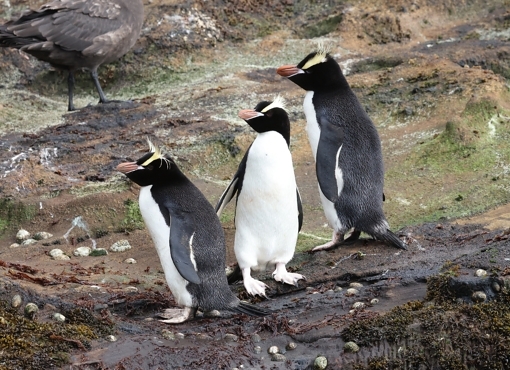
An early morning cruise boosted moorhen and bunting numbers considerably with at least 7 Gough Island moorhens being seen and no fewer than 20 Gough Buntings. More prolonged views were had of the colony of northern rockhopper penguins with their bright yellow head plumes and pogo like jumps.
By chopping up some scraps from the kitchen and adding the entrails from a few fish we were able to attract a great following of petrels and other tubenoses as we left Gough. Good, close images were taken as wanderers, spectacled petrels, yellow-nosed albatrosses, sooty albatrosses, southern giant petrels, great shearwaters and other birds followed the smell and sight of the ‘chum’. The first Cory’s shearwater of the Odyssey was recorded today.
Antarctic terns were much in evidence with a log total over 200 and although two brown noddies were seen yesterday, numbers doubled to four today.
Not content with the shark observation yesterday, Graham also recorded about twenty (one group) southern rightwhale dolphins today.
Position at 08.00: 37°03’S / 12°18’W, at anchor off Edinburgh, Tristan da Cunha.
Air temperature: 18°C. Clear skies in the morning with cloud coming in during the afternoon. Wind force 2 from the northeast, swells of <1 metre from the north.
We arrived early morning off Edinburgh and waited for customs clearance. Ashore we enjoyed a relaxing day eating in the café, visiting the post office and general store as well as some South African beer. There are, sadly, no passerines on Tristan and indeed only three species of birds were seen there all day yellow-nosed and sooty albatrosses overhead and confiding Antarctic terns, some of the latter catching caterpillars outside the settlement.
From the ship in the morning over a 100 great-winged petrels were seen but most of us were wondering how we would fare tomorrow with the anticipated visits to Inaccessible and Nightingale Islands.
Friday March 23
Off Nightingale Island
Air temperature: 20°C. In the early morning misty and a bit rainy, soon clearing to a great partly cloudy and sunny day. Moderate visibility. Wind force 2-3 from the northeast. Large oceanic swells from northeast 3-5 meters.
The swell prevented any landings on the islands today and so time was spent cruising slowly around the inshore areas watching wildlife from the ship. A huge number of great winged petrels were seen, over 350 by the end of the day. As for great shearwaters we were unable to put a figure on the numbers seen, not surprising seeing estimates by Ryan et al (1990) of over 3 million pairs on Nightingale and Ryan and Moloney (2000) of over 2 million pairs on Inaccessible make this a very abundant bird around here. Our cruising also allowed good views of more spectacled petrels as well as over 200 white-bellied storm petrels.
Saturday March 24
Making landings on Inaccessible Island and Nightingale Island today, returning to Tristan in the evening to drop our islander guides, and then heading off towards St.Helena.
Air temperature: 20°C, clear conditions, partly cloudy with much sun. Wind force 2-3 from the south, but ah, the cursed swells: Northeast 1-3 metres.
On his reccy visit Renie, our Expedition Leader, saw the new bird he most wanted. For the first time in his nine visits to the South Atlantic he had seen Inaccessible Island rail. Without delay the rest of us were scrambling ashore from a flotilla of Zodiacs and resting beside the tussock grass on the rocks of the higher shoreline. Around us the very tame Tristan thrushes bobbed from rock to rock, heads on one side looking at these strange invaders. Over half an hour passed with no sign of our quarry when suddenly first one then a second tiny rail walked up on the scarcely bending tussock grass leaves. These birds looked like tiny, tiny kiwis and had similarly strange fur like feathers. I read later that the innocent looking Tristan thrushes sometimes kills and eats young rails so thank goodness they did not have a go at the adults we were watching.
After watching a third rail we realised that time was pressing and if we were to reach Nightingale today we’d have to get back to the ship. We left the three species of landbird the rail , the thrush and Tristan bunting in peace.
Next stop Nightingale, more Tristan buntings at the landing area and even more Tristan thrushes on the path sides on the way up the hill. Only one lucky observer saw the grosbeak bunting but everyone enjoyed the visit to Nightingale with the encounters with fledgling yellow-nosed albatrosses being remarkable. Suddenly a thump on the ground at our feet would signal the arrival of another great shearwater homing to its natal area. You really had to take care not to collide with these birds at times. More good views of our last penguin species signalled the end of another brilliant day. A combined total for the two islands yielded 50 Tristan thrushes and 20 Tristan buntings, but most people would agree that the tiny Inaccessible Island rail was the only candidate for bird of the day.
Sunday March 25
At sea on way to St Helena
Position at 08.00: 34°48’S / 11°33’W. 1160 nautical miles to St Helena.
Air temperature: 20°C. Visibility good, later in the day poor, cloudy. Wind force 3-4 from the northeast, swell 2-3 metres.
One wandering (Tristan) albatross and one sooty albatross today set the pattern for a quiet passage. Virtually all seabirds were in much reduced numbers, and many simply could not be found. Even the usually dependable soft-plumaged petrels were reduced to five sightings from over 100 the day before. White-bellied storm petrels reduced from about 200 on the 24th to a mere twenty but at least a handful of spectacled petrels stayed close to the ship. A new trip species was Leach’s petrel and no fewer than 11 were seen today.
Monday March 26
At sea on way to St Helena
Position at 08.00: 30°40’S / 10°12’W, 905 Nautical miles to go to St. Helena.
Air temperature: 23°C, visibility good, partly cloudy and sunny. Wind force 2-3 from the southeast, swells also southeast 1-2 metres.
The great (and indeed the not so great) albatrosses had left us. One quality species with a wider oceanic distribution was seen however, our first three Bulwer’s petrels. Frustrating, distant views of about 50 dolphins did not help but the appearance of hundreds of flying fish made us think of warm waters and calm seas.
Tuesday March 27
At sea on way to St Helena
Position at 08.00: 26°16’S / 08°49’W, 635 Nautical miles to go to St. Helena.
Air temperature: 21°C, visibility good, partly cloudy and sunny. Wind force 1-2 from the northwest, swell also southwest <1 metre.
Bulwer’s increased to 7 and a promise of times to come in the shape of 2 red-billed tropic birds.
Wednesday March 28
At sea on way to St Helena
Position at 08.00: 21°39’S / 07°26’W, 353 Nautical miles to go to St. Helena.
Air temperature: 23°C, visibility good, rather cloudy. Wind force 2 from the east; swell from the east 1 metre. Picking up in the afternoon.
Closing in on St Helena we started to pick species we were perhaps more familiar with. The Bulwer’s petrel day total reached 20. The first long hard looks at Leach’s petrel and one of its close congeners Madeiran petrel took place with 10 and 3 respectively. Some birds too far away simply could not be identified accurately so we also logged a total of 10 ‘storm petrel sp’ , really meaning 10 Leach’s/Madeiran.
Gerry had the good fortune to see a sperm whale breaching almost vertically as he stared out on the horizon. If we missed the whale the compensation of a school of well over 50 striped dolphins, although fairly distant, were still a joy to see.
Thursday March 29
At sea on way to St.Helena
Position at 08.00: 17°10’S / 06°08’W, 72 Nautical miles to go to St. Helena.
Air temperature: 24°C, visibility good, overcast. Wind force 2 from the northeast, swells northeast <1 metre.
It was getting hotter by the day, and as we began our run in to St Helena we noticed, as elsewhere when approaching island groups or land masses that bird numbers and diversity improved. Bulwer’s petrels put in a respectable total of 20, making these last two days the best for this excellent seabird. We noticed how quite a lot of seabird illustrators make the mistake of exaggerating the tail length and not emphasising the very long wings particularly the ‘arm’ of the bird (i.e the wing between the body and the ‘wrist’ or carpal joint).
Madeiran storm-petrel and Leach’s storm- petrel totals also improved but we were unable to distinguish some 70 birds. Over 50 red-billed tropic birds were seen and the first boobies of the Odyssey appeared when ten masked boobies were logged. Closer still to St Helena and white terns, and brown and black noddies were all around the ship. Our welcome party was superb, a group of 20 rough-toothed dolphins really close to the Molchanov.
As we landed in the late afternoon some of the island’s naturalised birds were evident, a peculiar mixture of zebra doves, common mynas, Madagascar fodies, common waxbills, yellow canaries and java sparrows. It was a bit like walking into the annual Cage and Aviary Show!
Friday March 30
St Helena
Position: At anchor off Jamestown, St. Helena 15°55’S / 05°43’W.
Air temperature: 24°C, visibility good, light cloud and mostly sunny. Light local breezes, mainly southeast.
At 06.50 hours three people were out on the anchored ship looking for wildlife when they saw a large shark close to the port side. Peter Meijer, from the Netherlands, had the presence of mind to put the news out over the ship’s address system. Within a few minutes virtually the whole company was watching a whaleshark just below them. The magnificent animal moved very slowly towards the stern only a few centimetres below the clear water. It then swam up the starboard side before it turned and repeated the route just in case anyone had missed it. Had it mistaken the ship for a kindred spirit? Or was it Jason’s breakfast preparations which had lured it to us? This sighting was, for many of us, probably the highlight of the entire Odyssey.
After a start like this what else? Well, a visit to Deadwood Plain to see one of the world’s rarest waders St Helena plover. Seven birds were seen very well and a recently hatched chick. An inshore boat cruise in the afternoon was arranged and many people saw two Atlantic green turtles mating as well as close views of St. Helena’s seabirds such as the white terns, Madeiran petrels (over 100 seen), and red-billed tropicbirds. Sea mammals today were over 100 pan-tropical spotted dolphin and 5 rough-toothed dolphins.
At 21.00 hours we left St Helena for the journey to Ascension.
Friday March 31
At sea on way to Ascension
Position at 08.00: 14°26’S / 07°20’W, 562 Nautical miles to go to Ascension.
Air temperature: 23°C, visibility good, mostly cloudy. Wind force 3-4 from the south. Swells around 1 metre.
A quiet, calm day with few birds and only a very distant whale fin breaking the surface. A Cory’s shearwater was good to see and other birds included up to 15 Bulwer’s petrels. Today there were 10 Madeiran storm-petrels identified, along with 5 Leach’s and 12 Madeira/Leach’s at a distance. A long-tailed skua was a good find.
Saturday April 1st
At sea on way to Ascension
Position at 08.00: 11°04’S / 10°22’W, 272 Nautical miles to go to Ascension.
Air temperature: 26°C, visibility good, partly cloudy. Wind force 2 from the south, swell also southerly 1-2 meters.
Apart from the movement of flying fish in front of the bows there were, as expected at this stage in the journey, few things to see from the ship. A large flock of over 500 terns in the vicinity of the Grattan Sea Mount were probably sooty terns and Leach’s petrel overtook Madeiran comfortably with 15 of the former and 3 of the latter today.
Sunday April 2nd
Arriving at Ascension in the morning, Zodiac cruises around Botswainbird Island (an off-shore stack) and then landing on Ascension. In the evening visit to Long Beach to see the Atlantic green turtles egg-laying.
Position at 08.00: 3 miles off Boatswainbird Island, Ascension Island. 07°55’S / 14°18’W
Air temperature: 24°C, soon soaring to above 30, visibility good, partly cloudy and mostly sunny. Wind force 2-3 from the south. Swells <1 metre
Botswainbird Island (the name is the old term for frigatebird) looked like a southern version of many British seabird colonies, for example the busy summer scenes at Bempton Cliffs. The sky was full of Ascension Island Frigatebirds and below them on the stack faces were nesting black noddies and brown and red-footed boobies. Masked boobies were hunting in the seas around and , in small indents and crannies the tails and heads of red-tailed and white-tailed tropicbirds could be seen poking out. Some lucky observers saw a young manta ray, and most people got a great view of about 20 bottlenose dolphins which followed our ship and played around in the bay.
The fun didn’t end with nightfall as most people were escorted by the Ascension Conservation staff to the green turtle ‘nursery’ sands at Long Beach. It was a rare privilege to be able to see the huge female turtles depositing their sticky white eggs in the ditches in the sand. Each egg pit was carefully covered in and then the animals lumbered their way back to the sea. Over 70 female turtles had been counted in one evening recently. Some people returned early morning the next day to witness the last adults returning seawards and to see some of the tiny hatchlings emerging. By then Long Beach looked like a trial site for some new JCB’s , the tracks left by the turtles marking deep grooves across the sands.
Monday April 3rd
On Ascension all day
At anchor off Georgetown, Ascension Island. 07°55’S / 14°25’W
Air temperature: 26°C, visibility good, partly cloudy and sunny. Wind force 2 from the south.
People had choices today, a visit to Green Mountain encompassing the peak of the old volcano dominating the island, a look around Georgetown and a visit ( in the afternoon) to the Wideawake Fairs, near Mars Bay and area of land close to the air base. The ‘wideawake tern’ is an alternative common name for the sooty tern. The race involved on Ascension is S.t.fuscata, and is found breeding in both the Atlantis and the Caribbean. Sooty terns do not breed until they are 6 or 7 years old and can breed every 10 months (or even every 6 months at some colonies), shortening the usual gap between breeding seasons. On Ascension there can be a number of breeding colonies, this one numbered approximately 75,000 pairs. At any colony there can be a variable percentage of non-breeding immature birds. Sooty terns do not have particularly good waterproofing and are not terns which plunge dive or even partially submerge to feed. Instead they seek areas to feed at sea where there are upwellings rich in surface food. The distant flock of birds we saw feeding on April 1st were probably sooty terns surface feeding.
With the sounds of the sooty terns still ringing in their ears it was soon time for the majority of the WildWings group to start planning to leave the ship. After a hearty meal and with fond farewells accompanied by the music of the Doctor’s accordion the ship started to empty. After the evening meal the anchor was pulled up and the journey to Cape Verde begun.
Tuesday April 4th
At sea on way to Cap Verde
Position at 07.30: 5°55’S / 15°12’W, 1346 nautical miles to go to Cape Verde.
Air temperature: 26°C, visibility good, scattered cloud, mostly sunny. Wind force 2 from the south, swell 1-2 metres
The ratios of the ‘Oceanodroma’ storm petrels were changing again, with a more balanced set of figures as we left Ascension- 9 Madeiran’s, 11 Leach’s and 20 too far out to identify safely. Our last red-billed tropicbird for a while was logged too. Long-tailed skuas had their best day of the Odyssey, with four being recorded and the only Arctic skua of the trip was seen. A large group of over 400 sooty terns was a real bonus. Funny how you can be next to thousands of birds at a colony one day but still thrill to the sight of hunting the birds the next.
Wednesday April 5th
At sea on way to Cape Verde
Position at 08.00: 01°28’S / 16°58’W, 1057 nautical miles to go to Cape Verde.
Air temperature: 26°C. Visibility good, in the morning overcast with sunny spells later mostly sunny. Wind negligible, light swell <1 metre.
Two Cuvier’s beaked whales were seen early on by Peter Meijer at close range, a great start to the day. It was hot and a little humid and the sea was very calm. Somehow conditions were more akin to a tropical cocktail party than a sea-watching expedition but most of us were quite happy to go with the flow. The running ‘Oceanodroma’ scores? Well Madeirans notched up 44, Leach’s 36 and un-decideds 37. Bulwer’s petrels were still evident with 9 being seen. The only 2 Pomarine skuas of the trip were seen and 2 more long-tailed skuas were also recorded.
Thursday April 6
On way to Cape Verde
Position at 08.00: 02°57’N / 18°43’W, 770 nautical miles to Cape Verde.
Air temperature: 27°C, visibility very good, sunny with scattered cloud. Very light wind. Swell <1 metre plus.
Yes it was getting even hotter, and in the afternoon some ice cream was very much appreciated.
Cory’s shearwaters began appearing today with a total of ten logged. We also broke into double figures for Bulwer’s petrels with 10 birds seen. The running Oceanodroma contest provided most of the ornithological action with 4 Madeirans, 34 Leach’s and (were we slowly losing our sight?) 89 un-decideds. Migration proper was represented by 9 Arctic terns but the real highlight today was a large mixed group (about a 100 animals) of clymene and white-belly spinner dolphins. The spinner dolphins threw themselves high in the air twisting and flexing as they dropped back to the sea a tremendous sight.
Friday April 7th
On way to Cape Verde
Position at 08.00: 07°04’N / 20°21’W, 506 nautical miles to go to Cape Verde.
Air temperature: 25°C, visibility good, sunny with a thin veil of high cloud. Wind force 1 from the north. Swell negligible.
Only five species of birds seen today , and all in low numbers. Madeiran petrels reduced to 2, Leach’s still hanging in the lead with 21 and Storm petrel sp’s 40.
A group of distant dolphins were probably pan-tropical spotted dolphins.
At sea on way to Cape Verde
Position at 08:00: 11°14’N / 22°02’W, 237 nautical miles to go to Cape Verde.
Air temperature: 25°C, visibility good, scattered cloud and dust in the horizon. Wind force 1 from north, swell 1-2 metres.
The highest day total of the Odyssey for Bulwer’s petrel was achieved today with 14 birds being logged. Our last sooty shearwater slipped by and Madeiran petrels (2) were roundly defeated by Leach’s ( 14) , the undecideds clocked up 14. One long-tailed skua provided some variety.
Two fins of a shark breaking the surface looked like a basking shark, but as Troels pointed out it was more likely to have been a small whaleshark in these warmer waters.
Sunday April 9
San Tiago, Cape Verde
Position at 08:00: Alongside at Praia, Sao Tiago, Cabo Verde. 14°54’N / 23°30’W
Air temperature: 20°C, good, mostly sunny, increasingly overcast and on the east side a few raindrops. Wind force 2 from north-northeast.
Arrangements had been made to hire a mini-bus and search for the key endemic birds and other wildlife here on Sao tiago, or Santiago as it is called in some references. Uppermost in our minds were how to see Iago sparrow, Cape Verde cane warbler, Cape Verde swift and if at all possible Cape Verde (purple) heron. The best place to start was deemed to be the Botanical Gardens north of Santiago in the foothills. It was warm and bright and it felt good to be on shore. The gardens had a number of blackcaps in them, some in full song. It wasn’t long before we were watching our first Iago sparrows, small sparrows the males having bright chestnut hind superciliums, napes and shoulders. The females were, if anything, more surprising, as contra most book illustrations these birds had very pale (off-white) underparts, quite uniform brown upperparts and very conspicuous, thin pale supercillia almost like an Arctic warbler!
It was not long before a Cape Verde cane warbler was located, a gentle brute of an acrocephalus with a curious muted sub-song of whistling, bulbul like notes. The bird had very short wings hence ‘brevipennis’, a long tail and a serious looking long bill.
Two down one to go, so back to the hills. Sadly although some recently occupied stick nests were seen in the trees near Banana de Ribeira Montanha, there was no sign of any Cape Verde (purple herons) so we continued to look at more cane warblers and some passing brown-necked ravens. We had excellent views of the local spectacled warblers , these are of the race/form S.c.orbitalis and appeared to be much bluer on the crown than most of us could recall birds around the Mediterranean.
Eventually we had to quit the hills and head for the coast by re-tracing our route through Praia to the settlement at Cidade Velha. Near here we saw our first bar-tailed desert larks, a big (250 plus) flock of cattle egrets and , at last, a group of Cape Verde swifts at close range.
The last stop today was to visit some land near the Shell oil terminal in search of cream-coloured coursers and black-crowned sparrow larks. We had very good views of red-billed tropic birds which were nesting on the steep cliffs, two people saw the Sparrow-lark but no sign of any coursers. In the evening, after dark, the ship made off straight to Sal.
Monday April 10
On Sal, Cape Verde
While catching a Zodiac ashore some of the party saw an osprey fly overhead, a good omen for our last day. We had anchored off Palmeira and arrangements for an island bus tour worked very smoothly. First impressions were that we had been taken to a moon landing training session or a tennis court after a nuclear war, but we could forgive such a bare and unforgiving surface when we watched two of the world’s best waders (personal opinion) walking across it cream coloured coursers, scrumptious.
There were plenty of bar-tailed desert larks to see and Iago sparrows. We visited a salt works at Pedra de Lume, a baking cauldron of a place but hooching with waders. We soon added a whole load of trip ticks including curlew sandpipers, green and redshanks, sanderling, Kentish and ringed plovers.
Out last throw of the dice was on the bus route back to ‘town’, I was lucky enough to see a hoopoe lark and Peter and I heard it sing briefly but really the fat lady had stopped singing and it was time to put the scopes in the case……
We left Sal for Heathrow, via Lisbon, having sailed 7181 nautical miles (13,299kms) and a return to less out of world experiences.
Tim Cleeves