|
|
Summary
Few trips can be described as perfect, but this one came about as close to it as one could ever hope. The group of 32 (twice the usual number of participants) plus the two leaders enjoyed beautiful weather in the Antarctic Peninsula and encountered virtually all the species of bird and
marine mammal to be expected there at this time of year. Unforgettable experiences included an exquisite sunny, warm, still day passing through the straits and channels of the Peninsula surrounded by magnificent snow-covered mountains stretching for 20-30 miles in every direction, and counting over 200 whales and 6 Snow Petrels in some eight hours; a heat wave in Buenos
Aires and brilliant birding there at Costanera Sur, the famous wetland just ten minutes from our hotel; a marvellous day out in the Tierra del Fuego return crossing of the Drake Passage in storm-force winds which will surely be a talking point for us all for years to come. Add to this exceptionally punctual and hassle-free flights and transfers, the comfort and luxury of the Sheraton Hotel in Buenos Aires and of the prestigious and stable liner 'Marco Polo', helped by Orient Lines efficent and friendly service, and you have an experience which would be difficult to beat.
For the leaders, Tony Marr has rarely seen the Antarctic Peninsula looking lovelier nor had such satisfying wildlife viewing on his many visits, and for Mark Andrews, whose first visit this was, it was an experience like no other, where breathtaking views really did take your breath away, where awesome could be used in its proper sense, and where one just ran out of superlatives to describe the sights and sounds of this pristine white wilderness and its unique wildlife.
Daily account
Wednesday 5 January
Most of the group met at London's Heathrow Airport in the afternoon for the short flight to Milan, from where a couple of hours later we took off on the long haul overnight to Buenos Aires, to meet up with the other participants the next day at our hotel in the city.
Thursday 6 January
We arrived on time on a very warm morning, to learn that the city was experiencing one of its longest and hottest heatwaves in recent memory. After depositing our luggage in our rooms in the comfortable Sheraton Hotel, most of us took taxis for the short drive down to Costanera Sur Ecological Reserve, the world-famous wetland between the city and the River Plate.
This proved to be a great introduction to South American birds for most people, and it took us an hour to cover the first 100 metres! As the heat intensified, several people returned to the hotel for a rest, or to join a city tour arranged by Orient Lines as part of the trip. A few diehards stayed through until early evening, contributing to a long list of birds which included Roseate Spoonbills, Black-necked and Coscoroba Swans, Cocoi and Whistling Herons, Rufescent Tiger Herons, Chimango and Southern (Crested) Caracaras, Plumbeous Rails and Giant Wood Rails, three species of Coot, Wattled Jacanas, over 100 each of Lesser Yellowlegs and Pectoral
Sandpipers and a whole range of different passerines. Two hummingbird species were Glittering-bellied Emerald and Gilded Sapphire; there were Monk Parakeets and Guira Cuckoos; Green-barred Woodpeckers and Narrow-billed Woodcreepers; Fork-tailed Flycatchers and Great Kiskadees; Red-crested and Yellow-billed Cardinals; and Black-capped and Black-and-rufous Warbling Finches.
To recover from the intensity of this first birding experience, and from the intensity of the heat, we all met up in the hotel bar for a cooling drink before crossing the road to our regular steakhouse for another type of introduction - huge Argentinian steaks and fine wines. It was a very tired but satisfied group who made their way to bed later that evening.
Friday 7 January
We made a return visit to Costanera Sur by minibuses early this morning with our two local guides. Once again, we were dazzled by the variety of species, and in the increasing heat we added more to yesterday's list. Highlights included Yellow-billed Pintail, Red Shoveler and Black-headed Ducks among the wildfowl; Grey-necked Rail and American Golden Plover; and many new passerine species. These included Freckle-breasted Thornbirds, Spectacled and Cattle Tyrants, Brown-chested Martin, Creamy-bellied Thrushes, Masked Yellowthroats, Saffron Finches, Great Pampa-finches, White-tipped Dove, Straight-billed Reedhaunter, Screaming
Cowbirds, Chestnut-capped and White-browed Blackbirds, and the recently-introduced Plush-capped Jay. Coypus were much in evidence, with several Cavies, Terrapins and huge Tegu Lizards.
Some of the above bird species were found in the afternoon by stalwarts who returned after most of the group had decided to stay in the air-conditioned hotel, when the outside temperature was reported to have reached 40 degrees C (104 F). Those returning experienced the dubious benefit of a cool but thorough soaking when the heavens opened later in the afternoon, with over an hour of tropical rain and strong winds. In the now-fresher evening temperatures, we returned to the local steakhouse for a satisfying dinner before an early night, ready for a dawn start tomorrow when we fly down to Ushuaia to join the Marco Polo. Antarctica was suddenly getting closer...
Saturday 8 January
Breakfast was served from the crack of dawn at 5.30 am, and we were subsequently taken by coach to the airport for the three hour non-stop flight down to Ushuaia in a very quiet and comfortable Airbus A340. We arrived at the southernmost city in the world, at the tip of the island of Tierra del Fuego, in the early afternoon, our aircraft descending over the dramatic snow-capped mountains and the beautiful Beagle Channel on a clear day as it came in to land at the foot of the Andes. From the airport buildings some of us watched two handsome Black-chested Buzzard Eagles soaring overhead, mobbed by a much smaller Chimango Caracara. A short coach
ride took us to the harbour to board the Marco Polo, where we settled into our cabins, toured the ship, and managed a short walk into town before returning for the mandatory safety and lifeboat drill.
After this we met on the aft deck for some birdwatching over the harbour, our powerful telescopes helping us to spot and identify a range of species on the water and along the shore. These included our first Black-browed Albatrosses, Southern Giant Petrels, Chilean Skuas, Dolphin and Kelp Gulls, Antarctic Terns, Imperial and Rock Shags, a flock of Great Grebes and the similar Flying and Flightless Steamer Ducks. There were several waders along the shore beside the old airfield opposite - Magellanic Oystercatchers, White-rumped and Baird's Sandpipers. A party of three scarce Black-faced Ibis was seen briefly, a few Upland and Kelp Geese and Crested Ducks, and two South American Sealions. By straining our eyes through the 'scopes, we managed to identify several small birds on and around the airfield - a Correndera Pipit, a male Austral Negrito and a male and female Long-tailed Meadowlark, the red on the last two species
showing up well even at some distance. Two Chilean Swallows and a Rufous-collared Sparrow completed the list.
It was then time for a pause for some socialising. Orient Lines had arranged a champagne reception, with live musical accompaniment, for the WildWings group as a regular annual customer, in the prestigious Charleston Club. Most of us took advantage of this civilised welcome to the ship, with views out over the town and harbour of Ushuaia surrounded by spectacular jagged mountains, before heading down to the Seven Seas Restaurant for our first lavish dinner on board. We were soon to become accustomed to the grand style, excellent food and wines, and faultless customer service of this comfortable liner.
But the day was not over yet. Several of the group had decided to forgo dinner in the hope of seeing Magellanic Penguins and the rare Magellanic Diving Petrel as we raised the anchor at 8.00 pm and commenced the 50-mile journey down the Beagle Channel towards the open sea. Their mission was successful, and many of the group joined them up on deck later as we passed the Magellanic Penguin colony at Harberton, although few were lucky enough to catch the Magellanic Diving Petrel. But compensations included over 250 Black-browed Albatrosses, 100+ Southern Giant Petrels, 75 Sooty Shearwaters, 25 Chilean Skuas and at least 2,000 of the beautiful all-white South American Terns, and over 100 Upland Geese along the shores.
Sunday 9 January
The early birders were up on deck around 5.30 am to be told that the Marco Polo was some 75 miles south of Cape Horn. We were heading at a steady 18 knots across this 500-mile natural and unpredictable barrier which separates the southern tip of South America from the north-pointing tip of the Antarcic Peninsula and the South Shetland Islands. There was a brisk wind blowing from the south, which increased during the morning to almost gale-force, but the sheer size of the ship, and its large fin stabilisers, enabled us to watch from the stern with little discomfort.
There were already several Wandering and Black-browed Albatrosses in our wake at dawn, and during the day we noted among them a handsome Northern Royal Albatross and what may have been a Southern Royal (both breed in and around New Zealand). The identification of the Wandering/Royal group is difficult and their taxonomy still unresolved, and this particular bird did not come close enough for us to see the dark line along the bill which is the important clinching feature. Later in the day we saw three Grey-headed and a surprising total of five elegant Light-mantled Sooty Albatrosses, which quickly established itself as the loveliest of the albatrosses we were to see. Among the 20 or so Southern Giant Petrels following the ship, almost
as large as the smaller albatrosses, we picked out one Northern, identifiable only by the reddish tip to its pale bill.
As we headed on southwards during the day, new species began to appear in the increasingly cool conditions. There was a good passage of lovely little Blue Petrels past the ship, totalling some 200 in the day (although estimating numbers of seabirds from a ship is notoriously difficult - are we seeing the same, or different, birds around us through the day?). Prions, small grey and white seabirds not much larger than a Grey Phalarope, are another identification challenge, and by dusk we had certainly seen 20 Slender-billed (in the north) and 10 Antarctic (in the south), but a further
40 could not be identified. Ten White-chinned and 10 Cape Petrels appeared, the latter also known by the affectionate name of 'Pintado', the Spanish word meaning 'painted' to describe their spotted black-and-white plumage. Final totals of 10 Wilson's and three Black-bellied Storm-petrels were counted by dusk, when, eyes smarting from the salt spray and hours of watching, we
repaired to the bar for a drink before attending the Captain's Welcome Reception and then to the Restaurant for dinner.
Monday 10 January
The Marco Polo's size and speed mean that it completes the often-turbulent crossing of 'The Drake' faster than its smaller rivals, so if you are affected by 'mal de mer' it's over more quickly. Thus it was that at 4.30 am we had reached the South Shetland Islands, slipping through the wide channel between Smith and Snow Islands en route for the flooded caldera of the aptly-named Deception Island. Soon, on a dull, grey but not too cold or windy morning, we could see the almost-permanent cloud-cap over Deception as we passed through small numbers of Antarctic Fulmars, Wilson's and Black-bellied Storm-Petrels, Southern Giants, Brown Skuas and Antarctic
Terns. Soon up went the cry of 'whale', as ahead of the ship a Humpback blew, and by the time we reached Deception we had counted no fewer than 18, plus two of the smaller Minke Whales.
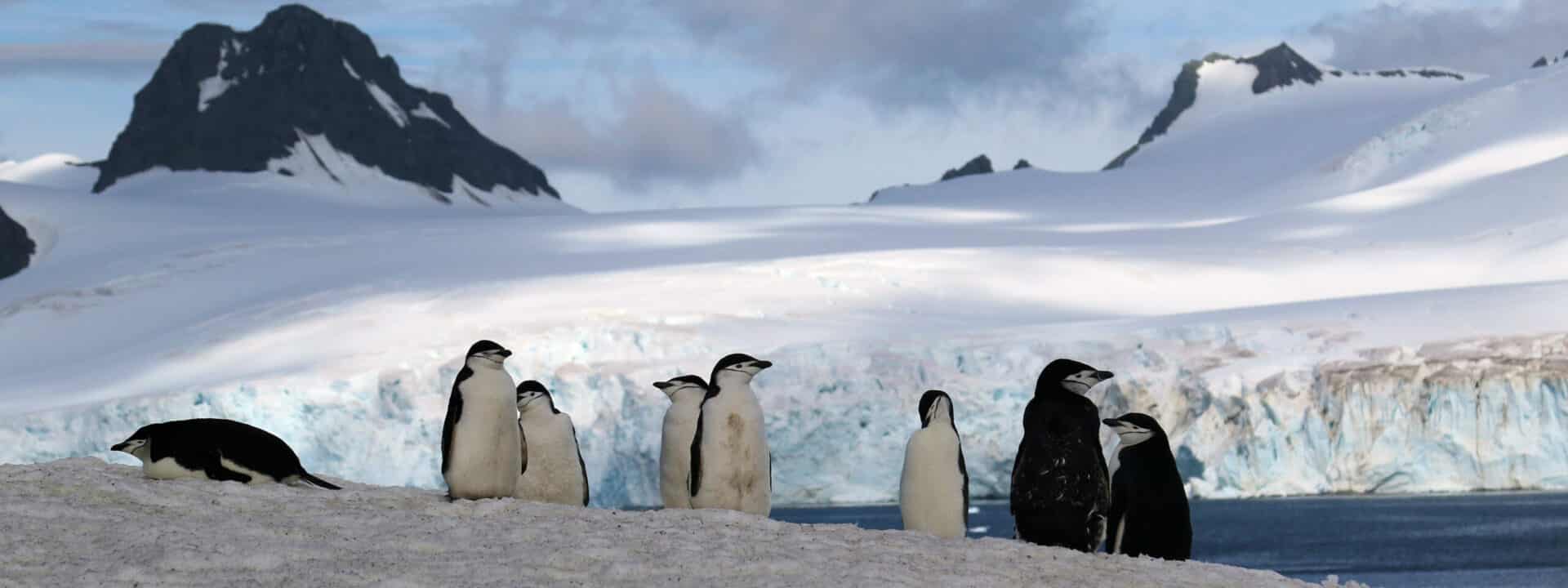
As we neared the narrow entrance to the caldera, we could see on the hillsides around Bailey's Head, about a mile away, a pale cast to the grey-brown slopes. Scanning through a telescope revealed immense colonies of Chinstrap Penguins all along the ridges and down the hillsides towards the sea. It was here that David Attenborough´s memorable 'Life in the Freezer´ sequences of these birds were filmed. Hundreds of Chinstraps were on the sea or 'porpoising' quickly along just above it, and wheeling crowds of Cape Petrels escorted us into the narrow entrance of Neptune's Bellows.
As the Captain and his crew skilfully squeezed the ship through the entrance, we could see in the very close starboard-side cliffs the open archway of 'Neptune's Window', from where it is claimed the first-ever views were had of the distant mountains of the Antarctic Peninsula. We could
believe this, as we ourselves could see the snow-covered peaks in the far distance to the south, some 75 miles away, towards which we would later be sailing.
On the port side we could make out several small colonies of Chinstraps high up on the hillsides, and on the beach as we passed were half a dozen large Weddell Seals and a group of Southern Giant Petrels, the striking all-white morph. We made a fairly quick circuit of the flooded interior of the volcano, which our Expedition Leader Allan Morgan informed us had last erupted in 1970, while he pointed out the remains of a whaling station and of the Chilean and British bases destroyed by lava flows. Argentinian and Spanish bases are still staffed, and carry out seismological research.
We were soon heading back out into the open Bransfield Strait, the remaining stretch of sea to cross before reaching the Antarctic Peninsula, now clearly visible across the horizon. The next couple of hours were fairly quiet for wildlife, but soon we were approaching the islands and icebergs of the Peninsula and the pace quickened. Humpback Whales were much in evidence, and
our methodical counting paid off, revealing a total of 62 by the time we reached our afternoon destination of Cuverville Island, through the Gerlache Strait. Three Minkes were spotted, but more exciting were Orcas, or Killer Whales - a lone male passed by at midday, followed an hour later by a rather distant, but nonetheless distinctive, pod of six more of these charismatic creatures. Other highlights included a trio of penguins on a small ice flow - single Chinstrap, Gentoo and Adelie together, most unusual! - and 10 Crabeater Seals on ice floes ('Crab' is a Scandinavian word for 'krill' - there are no crabs in Antarctica). Over 1,000 Antarctic Fulmars were estimated on the last stretch of the journey, and about 100 Wilson´s Storm-petrels, with a further nine whales too distant or too quick to be identified.
Marco Polo anchored close to Cuverville Island in the late afternoon, and began the complex and lengthy business of organising 'Zodiac cruises' for the 550 or so passengers. These excursions, like the shore landings in these sturdy inflatables, are managed with military precision, meticulous timing and unequalled attention to passengers' safety and the protection of the environment. Our group watched with concern as the earlier groups went off for their hour-long excursions in a light blizzard and freezing cold, but by the time we were on our way, it was dry and the wind had dropped.
Many of us had stayed up on deck while awaiting our turn, and among the birds we had seen from the ship were two ethereal all-white Snow Petrels flying gracefully over some distant ice floes. They had gone by the time we went out in the Zodiacs, but we cruised along the edge of the Gentoo Penguin colony, spotting two Chinstraps at the edge of the colony, a Snowy Sheathbill among the Kelp Gulls, and several Antarctic (or Blue-eyed) Shags, Antarctic Terns and Wilson's Storm-petrels.
Back on board after an exhilarating experience, we retired to the bar for a pre-dinner drink and to complete our checklist of the day's observations, a necessary and sometimes stimulating ritual. Soon it was time for dinner, and before long the final passengers returned from their excursion, the anchor was raised, and our 20,000 tonne home manoeuvred away from Cuverville for the relatively short journey through some of the scenic channels and straits of the Peninsula towards tomorrow morning's destination, the legendary Lemaire Channel.
Tuesday 11 January
It was a dull and cloudy morning as we slowly approached the high mountain peaks at the entrance to the seven-mile long Lemaire Channel, the southernmost point in our long journey. The cloud cover began to lift, revealing a narrow canyon between high cliffs on the starboard side and precipitous mountains to port. As the ship moved slowly forward, we saw clearly that there was a lot of ice away to the south, but it was hard to tell if it actually blocked our exit at the southern end. We had managed to navigate about one-third of the channel when the announcement was made that we could not go any further, and by then we could see for ourselves that the ice did in fact fill the whole exit. We learned later that very few ships had been able to get through the channel this summer owing to the persistent ice.
Just before we turned, a Humpback and a Minke Whale surfaced ahead of us, and on our return we saw one more of each and suddenly, right alongside the ship, a pod of four Orcas heading swiftly north. They, too, must have been thwarted by the ice. A delicate Snow Petrel passed high over the ship, and two Weddell and two Crabeater Seals were observed before we reached open
water again.
We now headed towards Paradise Bay and our first landing, at Waterboat Point, on the Antarctic Peninsula itself. We were about to walk on the continent! On an increasingly bright day, we reached our destination at the Chilean Base, and the landing operation began, as impressively organised as the Zodiac cruising had been the previous day. The WildWings group were in
the middle part of the landing schedule, so we busied ourselves on deck keeping a keen eye open for wildlife around the ship and on the shore. We quickly located the two pairs of Chinstrap Penguins which breed here every year among the thousands of Gentoos, and saw dozens of Snowy Sheathbills, Antarctica's refuse collectors, fussing around busily among the penguins.
Single Humpback and Minke Whales passed the ship at anchor.
Soon it was our time to go ashore, and on a still, mild afternoon, we were on the path leading through the penguin colony to the buildings. Most pairs of Gentoos had small chicks; some were still incubating eggs. All around us was noise, activity and smell - the pungent aroma of guano. Stone-stealing from each other's nests was a popular and, for us, an entertaining activity.
We reached the end of the walk, and suddenly a different penguin walked across in front of us - a cheeky little Adelie. It strutted around confidently, right in front of the group, most of whom managed to see it before our hour was up and we had to return to the ship.
People relaxed on board after the landing, and just a handful of our group who remained on deck saw a dramatic event - a Leopard Seal, Antarctica's second most-feared predator after the Orca, caught a Gentoo Penguin near the shore, and proceeded to thrash it on the water to skin it. Gruesome as this was, it illustrated the daily life-and-death struggle which penguins experience in this dangerous and unforgiving environment.
When all were back on board, we moved slowly away from this beautiful bay, so tranquil and unspoiled, and headed off through more narrow channels towards tomorrow's destination, Port Lockroy. The wind got up as we left the shelter of Paradise Bay, and Wilson's Storm-petrels, Brown Skuas, Kelp Gulls and Antarctic Terns were all round us as we steamed along. Two more
Humpbacks and two Minkes ended another wonderful day. But the best was yet to come...
Wednesday 12 January
Port Lockroy is a refurbished British wartime base on a small island, with access for cruise ships to an adjacent island to see the wildlife. Both islands have thriving colonies of Gentoo Penguins, and there are Sheathbills and Antarctic Shags breeding as well. On a glorious sunny, warm, still
morning, it was a real pleasure to land and walk slowly through the penguin colony, observing again the antics of the birds on their stony nests. The surrounding mountain peaks, including the Seven Sisters, were sharply etched against a brilliant blue sky and bathed in sunshine - not the nomal weather here, which is very often cloudy, wet and windy with the mountains obscured.
One of our group excelled by drawing a leader's attention to two pale skuas sitting on rocks above the penguins. Through telescopes, they could clearly be seen to have pale sandy-brown bodies and heads, with dark brown wings. And as he had surmised, they were pale-morph South Polar Skuas, showing also the small heads and bills characteristic of this species. Another one for
the list, and, as they say, much needed. On the ice behind the island were a Crabeater and four Weddell Seals sunbathing.
As we enjoyed an al fresco lunch in the sunshine on the aft deck, the peace of this idyllic scene was shattered by a microlite type of machine crossing the nearby mountain slopes and then the bay, finally coming right over the ship several times while the pilot waved to the passengers. The aural and visual intrusion this created upset many people, and was the very sort of environmental pollution which people come to Antarctica to escape from. The pilot was thought to be from a nearby small yacht, some of whose crew had been seen (and photographed) earlier walking among the nesting penguins, violating the visitor guidelines established by IAATO (the International Association of Antarctic Tour Operators).
This type of irresponsible and selfish behaviour, very much on the increase in the Antarctic Peninsula, can have unfortunate results if not controlled or curtailed. Accidents among participants in these foolhardy 'adventure tourism' activities are not unusual, and involve others in risking their lives in search and rescue operations. Antarctica is not a theme park. It is the most dangerous and unpredictable place on earth.
And in a bizarre postscript to this event, we have just learned that a few days before this, the cruise ship 'Orion' was involved in exactly this type of rescue operation at Port Lockroy. Four climbers, again from a small yacht, chose to ascend a snowfield overlooking the base when one of them fell into a crevasse. He was rescued, badly injured, and taken aboard the 'Orion', where he was beyond help and died from his head injuries. Such incidents spoil the pristine experience of Antarctica for the great majority of responsible travellers and operators. But enough of such unhappy events...
We sailed out of the small bay at Port Lockroy at 4.00 pm in the sunshine, passing a very close Leopard Seal basking on an ice floe, and entered the channels and straits which were to lead us northwards back towards the Bransfield Strait and the South Shetland Islands, for tomorrow's final landing, at Half Moon Island. On a spectacularly beautiful afternoon, we could see for miles and miles in the clear, unpolluted Antarctic air as we passed range after range of high mountains. Mount Francais, a little under 10,000 feet high, towered above the rest, and the pointed peaks at the entrance to Lemaire Channel stood out clearly. There was not a cloud in the sky. If anyone needed persuading that Antarctica is a different, magical world, then this one day would have done it.
As we cruised along, so we began to realise that wherever we looked, there were whales, and we began a careful count. Most were Humpbacks, with many Minkes, and a distant though exciting scattered pod of 15 Orcas, with a single one later. By the time we reached the Bransfield Strait around midnight, our eight hours of watching and counting had logged 202 whales in all - 128 Humpbacks, 58 Minkes and the 16 Orcas (Orcas are actually large dolphins, but with a little licence we've included them in the overall whale total - they are also known as Killer Whales, after all).
Flocks of hundreds of feeding Wilson's Storm-petrels and Antarctic Fulmars crossed our path, there were many Southern Giant Petrels and Brown Skuas, and one pale-morph South Polar Skua. An exquisite Snow Petrel, like the dove of peace, circled over the stern of the ship, and departed with a round of applause from the birders ringing in its ears. Five more were seen later. An
Antarctic Fur Seal floated past on an ice floe, as did small numbers of Chinstrap and Gentoo Penguins, with one Adelie, and a Crabeater and four more Weddell Seals were doing the same.
We were able to enjoy our dinner at tables on the stern in the exceptionally warm evening sunshine, surrounded by magnificent scenery and wildlife. Such days are very unusual in Antarctica, and it was with this knowledge that we happily and exhaustedly made our way down to our cabins at the end of a perfect day.
Thursday 13 January
The curved shape of Half Moon Island greeted us in the early morning as we arrived back in the rugged South Shetland Islands. WildWings was in the first group of passengers to go ashore, before breakfast, on a grey but bright day. Chinstraps are the principal species here, and we could quickly separate those on their way to the sea (covered in mud and guano) from those returning (with gleaming white underparts). They had large chicks, bigger than the Gentoos which enable them to start breeding earlier.
Sheathbills, Kelp Gulls, Antarctic Terns and Brown Skuas breed here, and were all active. A surprise for the last few of our group returning to the Zodiacs was the sight of a Macaroni Penguin walking up the beach, quickly entering the Chinstrap colony and disappearing. Frustratingly, we could not see it from the ship later, despite hours of searching, and many missed it. C'est la vie..
However, from the ship we did watch half a dozen Humpbacks in the mouth of the bay where we were anchored, several of them leaping clear of the water in their remarkable breaching behaviour.
At 1.00 pm the anchor was raised, the ship turned, and we headed for home - Ushuaia, on the other side of the feared Drake Pasage, 500 miles to the north. We passed through Nelson Strait into an area of bizarre-shaped rocks and icebergs as we entered the open sea, and the movement of the waves began to increase. So did the number and variety of seabirds, and by the end of the day we had logged three Black-browed and one Grey-headed Albatross, 100+ Pintados and 10 Antarctic Fulmars, 35 Southern and one Northern Giant Petrel, two Blue and three White-chinned Petrels, 30 Wilson's and three Black-bellied Storm-petrels, and six unidentified prions. Two Minkes and 11 Humpbacks completed the day's watching.
As we headed for bed, the wind was increasing, and we made sure that nothing was lying loose about the cabin and that all drawers and wardrobes were firmly closed. The Captain had announced that the first part of the Drake crossing should be reasonable, but that it might get rougher as we approached Cape Horn. But who knew exactly what lay ahead?
Friday 14 January
The wind was up to Beaufort Scale Force 7 at dawn - just below gale force - and the sea quite rough, but the size and stability of the Marco Polo masked the real effect of this. There were fewer on this return journey than we had going south. There were just half the number of Wandering Albatrosses (only five) but the same number of Grey-headed (three), this time giving us closer views. Black-browed increased steadily as we approached Cape Horn. There were single suspected Northern and Southern Royals, but they infuriatingly did not come close enough to conclusively confirm identification. Just one Light-mantled Sooty was seen, and one Northern Giant among the Southerns. Similar numbers of Blue Petrels (200) but fewer White-chinned (four) were recorded, and fewer prions - just two Antarctics earlier in the day and six Slender-billed later. Sooty Shearwaters increased as we approached land, with a total of some 500, and there were still a few Cape Petrels in our wake.
But it was the sea state, not the birds, which was the focus of attention. During the morning the wind steadily increased from the west until it was reading Force 11 on the weather report on the screens in our cabins - one notch below hurricane force! The Marco Polo held its course well - now revised to head as quickly as possible towards Ushuaia, due to a medical emergency on board, so we sadly missed seeing Cape Horn. A few people felt under the weather (this is clearly where the phrase comes from!) but the remarkable stability of this big ship was very impressive. The experience of the Drake Passage in such weather helped to reinforce our impressions and
memories of the magical, isolated and remote continent which we had now left a long way behind us at the bottom of the world.
In the early evening we reached the shelter of the southern tip of South America, entered the Beagle Channel, and were able to enjoy a relaxing dinner as we headed past the Magellanic Penguin colony at Harberton en route to a midnight arrival in Ushuaia.
Saturday 15 January
No peace for the wicked - we gathered on the quay at 8.15 am to meet Marcelo de Cruz, local expert bird guide, with a coach to take us round the beautiful Tierra del Fuego National Park for the day. This is always a highlight of the trip, and continuing our run of amazing luck, we had
another perfect day. Not only was the weather perfect - still, sunny and warm all morning, with some cloud and wind in the afternoon - but we found virtually all the very special birds of the National Park. From the stunning giant Magellanic Woodpeckers to the appealing tiny Austral Pygmy Owls; from Andean Condors to Black-faced Ibises; with Austral Parakeets screeching
overhead and the rare White-throated Caracara with the Chimangos and Southern (Crested) Caracaras on the disused rubbish tip; a pair of Black-chested Buzzad-eagles hovering low and Ringed Kingfishers; Dark-bellied Cinclodes and Fire-eyed Diucons; Thorn-tailed Rayaditos and White-throated Treerunners; Tufted Tit-tyrants and White-crested Elaenias, Austral Thrushes and Austral Blackbirds; and Patagonian Sierra-finches and Black-chinned Siskins. The list seemed endless.
Back to the ship, tired yet triumphant, we celebrated over our final dinner on board before remembering to put our suitcases outside our cabins by midnight, ready for tomorrow's flight back to Buenos Aires.
Sunday 16 January
With a few hours spare before our flight, most of the group agreed to a trip up to the Martial Glacier above the town, where several new species were possible. We organised a fleet of taxis, which took us quickly up into the mountains, but the heavens opened just as we arrived at the chairlift and it rained steadily and heavily from then on. Our apparently endless good luck
had finally come to an end! We moved to a hotel overlooking the very misty and obscured Beagle Channel with our taxi drivers, drinking coffee and playing ping pong.
At the airport, we continued birding from the terminal, seeing a Cinereous Harrier, three Bar-winged Cinclodes, four Dark-faced Ground-tyrants and four Austral Negritos. A punctual and comfortable flight brought us back to the heatwave city, where a few birds were seen from the coach to the hotel, including five Plush-capped Jays, an Aplomado Falcon and a Swainson's Hawk. We ended the day in our favourite steakhouse where we toasted the end of a
wonderful trip.
Monday 17 January
An early visit was made to Costanera Sur, where although the Reserve was closed for the day, we found plenty to look at along the roadside lagoon. Highlights were a Field Flicker, two Wren-like Rushbirds and a Yellow-winged Blackbird among the more regular species.
At 11.0 am the coach departed for the airport and the flight home. Soon we would be back in Britain. Antarctica was already seeming to be like a distant dream.
Conclusion
It was our good fortune to have such a very successful visit to the pristine continent of Antarctica. We enjoyed wonderful weather and great wildlife, and have all returned with a deep awareness of nature of this unique part of the world. Long may it be thus. And may we all now be ambassadors for Antarctica. In this uncertain and quickly-changing world, it needs all the help and protection we can provide and encourage.
|