Adobe

ANTARCTIC PENINSULA: JANUARY 2004

ANTARCTICA LINKS
Antarctic Peninsula 2008
Antarctica, The Falklands & S. Georgia
Atlantic Odyssey
Sub Antarctic Islands of NZ
Independant Travel to Antarctica
Antarctic Icebreakers
Trip Reports

WILDWINGS LINKS

Welcome
Travel Agency
BirdWatching Introduction
BirdWatching Calendar
WildOceans Introduction
Trinidad & Tobago Introduction
Mammal tours
Wildlife Cruises
Wild Insights
DeepOcean Expeditions
Space Adventures

Trip Report by Tony Marr & David Rosair - Tour Leaders

Summary

Of all the WildWings Antarctic Peninsula trips on the Marco Polo over several years, this was one of the very best. After some initial travel difficulties, which included an unscheduled overnight stay in Madrid and a very lively crossing of the Drake Passage, we entered the magic pristine wonderland of Antarctica in settled, mostly sunny, calm weather. All our landings were successful, as compared with the previous Marco Polo trip the week before which we were told had experienced bad weather and only one of their three landings had been accomplished. Wildlife sightings were excellent, and, as an example, the bird highlight of a total of 12 Snow Petrels and the marine mammal one of 120 whales (if one can be excused for counting Orcas or Killer Whales as whales for this purpose) are each far higher than we usually encounter at this time of the year. The albatrosses, petrels and prions were in impressive form in the Drake Passage and the penguin colonies in the South Shetlands and the Peninsula in full swing with their attendant skuas, sheathbills and giant petrels all on the lookout for easy pickings.

We enjoyed rewarding birding in Argentina around Buenos Aires and Ushuaia, where most of the group encountered families and species of birds totally new to them. The day out in the Tierra del Fuego National Park near the end of the trip was spectacularly successful; even the Tour Leaders saw new birds, and one participant said so many birds were being found that even a Dodo would not have surprised him. Dodo there was not, but Andean Condors, Magellanic Woodpeckers, Black-breasted Buzzard Eagle, White-throated Caracara, Austral Pygmy Owls, a magnificent and quite unexpected Southern Horned Owl, an out-of-place Magellanic Diving-petrel, and a close Magellanic Tapaculo, like an all-black Wren, were the icing on the cake of a great trip.

Chronology

Friday 9 January

The departure day for our great adventure at last arrived, and the group met up at London Heathrow for our afternoon flight to Madrid. Two of the group had flown out two days earlier and experienced problems with their overnight connection to Buenos Aires which had led to them having to stay in a Madrid hotel overnight. Frustratingly, and almost unbelievably, the same fate befell us, owing to the well-known airline euphemism 'technical problems'. The hotel was a good one, thankfully, even providing a lavish buffet and free red wine at 1.0 am! And so to bed...

Saturday 10 January

We enjoyed a trouble-free morning departure from Madrid on our B747 and landed in Buenos Aires 12 hours later on a cool evening. We reached the Sheraton Hotel too late to see much of the city, but in good time to walk across the road to a favourite steakhouse for an excellent meal and fine wines which helped to erase the bad memories of the long journey. The manager greeted our principal leader like a long-lost brother, and gave us a very worthwhile discount on our bill. The day ended very satisfactorily.

Sunday 11 January

A local birding guide collected us in a minibus early in the morning to take us to the internationally-renowned nature reserve of Costanera Sur, a mere ten minutes away between the edge of the city and the River Plate. An enjoyable, and hot and sunny, morning was spent identifying a great range of South American birds. Conspicuous were the Black-necked and Coscoroba Swans, Neotropic Cormorants, Great White and Snowy Egrets, three species of Coot, various herons and ibises, and numerous grebes and duck. A huge Gey-necked Wood-rail and colourful Wattled Jacanas were also easy to see, unlike the skulking waders on a distant patch of mud. Here persistent staring through telescopes produced the best wader list yet of our trips - Pectoral Sandpipers, Greater and Lesser Yellowlegs, Southern Lapwings, American Golden Plover, South American Stilt, Two-banded Plovers and, best of all, a very smart and colourful female South American Painted Snipe. Both local species of hummingbird, Gilded Sapphire and Glittering-bellied Emerald, were found, together with a host of other colourful small birds, from Spectacled and Pied Water Tyrants to Rufous-bellied Thrushes, from Great Kiskadees to Black-and-rufous Warbling Finches, all of which were very much in evidence among the walkers and joggers on this busy Sunday morning in this popular locality.

People took advantage of the free afternoon to go sightseeing, shopping or to rest and relax and catch up on missing sleep. Another good meal was again enjoyed in 'our' local steakhouse in the evening.

Monday 12 January

We took a big step closer to Antarctica today, but it was a slow and frustrating one. An extremely early breakfast was followed by a coach trip to the International Airport where we joined a very long snaking queue for our chartered B747 to take us the 1,700 miles south to Ushuaia, gateway port to the Peninsula. Our old enemy 'technical problems' surfaced again. We think that in this case it meant that the plane had broken down. Fortunately an energetic and enterprising Orient Lines representative 'found' two smaller planes into which we were decanted. The Airbus A340 in which most of us travelled was extremely spacious and comfortable and an improvement on the intended aircraft.

At the end of our three-and-a-half-hour non-stop flight we came into Ushuaia over the spectacular snow-capped mountains and extensive beech forests which line the Beagle Channel. Strong winds were whipping up white crests on the waves as we made a rather bumpy approach to Ushuaia Airport, and soon we were on the ground. Here we were met by Orient Lines ground staff who led us to our coaches and very quickly we were at the ship. It had looked fairly large from the air but now appeared enormous in comparison with the other expedition cruise ships also in port.

We settled into our comfortable, luxurious cabins and started to find our way around. The mandatory safety and lifeboat briefing and drill over, we had a birding session from the aft deck where with telescopes we were able to identify many of the typical birds to be found in the harbour. The windy weather encouraged Chilean Skuas, Southern Giant Petrels and Black-browed Albatrosses to sweep by close to the moored ship, and Great Grebes, Imperial Shags, Flying and Flightless Steamer Ducks, Crested Ducks and Upland Geese were much in evidence. Waders included Magellanic and Blackish Oystercatchers, there were Kelp and Dolphin Gulls close to the ship (some even landed on it) and the lovely very white South American Terns were all round the harbour.

The ship sailed as we made our way down to the Seven Seas Restaurant for our first dinner aboard. We could even see albatrosses and skuas from our two tables as we headed down the Beagle Channel. Soon we were approaching Harberton, where there is a Magellanic Penguin colony which affords the only opportunity to see this species on the trip, so we made our way back up on deck. In the gathering dusk, we could just see the penguins gathered on the shore as we swept by on our way to the open sea. We retired to the small Palm Court Lounge to complete our checklists, which was to become a regular feature on each evening of the trip. It was, at last, time for bed. The Antarctic adventure had really started...

Tuesday 13 January

The small number of us who made it on deck early in the morning were greeted by huge seas and great albatrosses. In a force 8+ wind and a 20-foot swell, and with the Marco Polo by now well into the Drake Passage to the south of Cape Horn, up to eight albatrosses were following the ship, effortlessly riding out the winds and scarcely flapping their enormous wings. Four heavy-bodied Wandering Albatrosses, each with a wing span of nearly twelve feet, almost dwarfed the slim Black-broweds in the wake. Southern and Northern Giant Petrels and the first Blue and Cape Petrels soon appeared, and throughout the day, as the wind slowly abated, the seabird species came and went. As we lost Sooty Shearwaters and White-chinned Petrels, so we gained Slender-billed Prions and Grey-headed Albatrosses.

A Southern Royal Albatross, all the way from New Zealand, was a nice surprise, as was a lone and distant Light-mantled Sooty Albatross. As we passed through the Antarctic Convergence, where the more northerly temperate waters meet the cold Antarctic ones, we began to pick up Wilson's and Black-bellied Storm Petrels. Cetaceans were hard to find in the rough seas, but four handsome Hourglass Dolphins in the morning and a rare Southern Bottlenose Whale in the afternoon were seen. The rough conditions suited the seabirds, giving the huge albatrosses the uplift necessary to get them aloft, but did not suit all members of our group, some of whom did not appear until quite late in the day when calmer conditions prevailed. For keen seawatchers, though, it had been a memorable day.

Wednesday 14 January

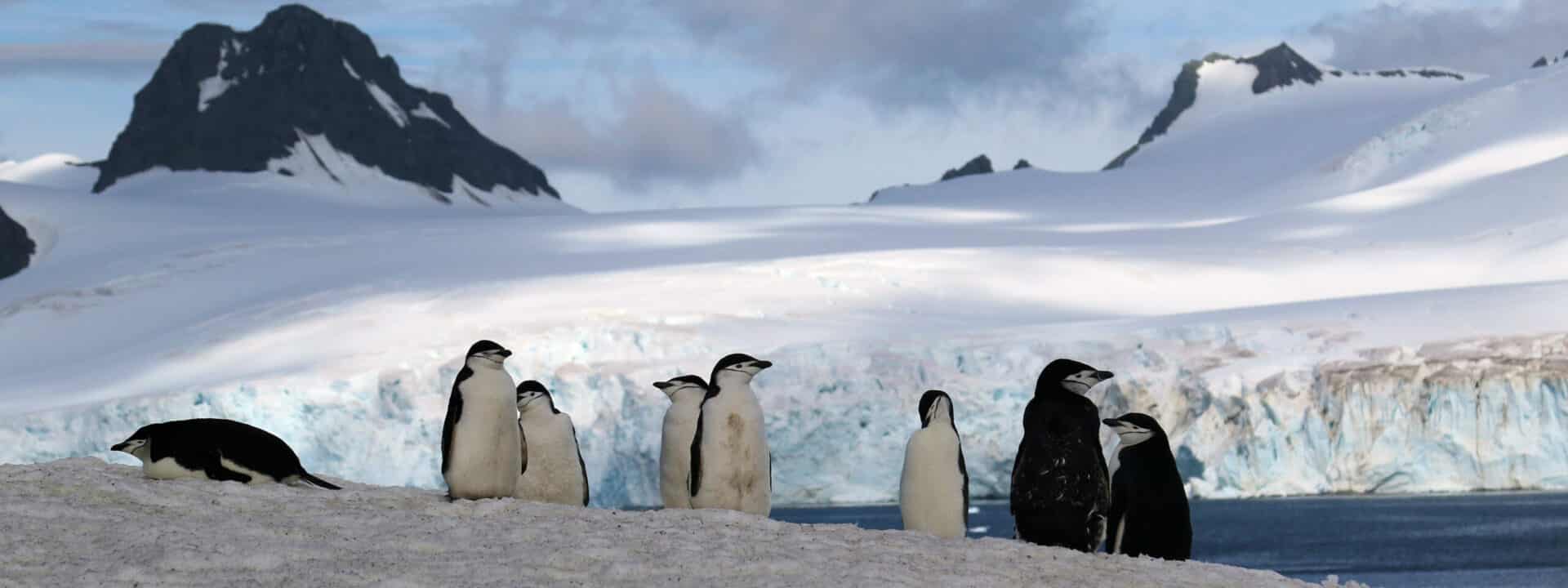
Land ahoy at dawn! The early birds came up on deck on a freezing cold morning to witness the unparalleled sight of Smith Island ahead of the ship in full sunlight. This island of high mountainous peaks, perpetually snow-covered from top to bottom, offers a dramatic welcome to the southern end of the South Shetland Islands. We passed slowly between this and the long, flat, white shape of Snow Island to see our destination, Deception Island, ahead of us under its own cloud cover. Small numbers of Antarctic Fulmars, Cape Petrels, and Wilson's and Black-bellied Storm-petrels were flying between the islands, and two Humpback Whales were seen briefly as we approached the aptly-named Neptune's Bellows to commence our entry through this gap into the flooded caldera of the dormant volcano appropriately known as Deception Island. The ridges and hillsides on the outside of the island were covered in thousands of Chinstrap Penguins whose total numbers run into tens of thousands (and which were filmed here for David Attenborough's series Life in the Freezer). We cruised slowly round inside the island, where there was little wildlife apart from Weddell Seals and Southern Giant Petrels in the rather forbidding black, volcanic surroundings of Port Foster and the long-abandoned whaling and British and Chilean scientific stations.

Soon we were back in the outside waters of the Bransfield Strait and starting the last leg of our very long journey, the remaining 50 or so miles to Antarctica proper. There was much anticipation in the air as we saw our first really big icebergs and the high snow-covered mountains of the Peninsula in the distance. By early afternoon we were into the renowned Gerlache Strait, where its reputation for whale sightings became a reality. Ten Humpbacks, four Antarctic Minkes and a single Killer Whale (or Orca - which is in fact a large dolphin, not a whale) were seen among the many Antarctic Fulmars, Subantarctic Skuas and the first Antarctic Terns.

In the late afternoon our next destination, Cuverville Island, came into view, and soon we were anchored nearby. Here we all enjoyed an exhilirating Zodiac cruise along the shore, spotting Antarctic Shags and Pale-faced Sheathbills among the thousands of nesting Gentoo Penguins. We even picked out two Chinstraps on the beach, probably refugees from a colony visible through telescopes on a distant island seen later from the ship. A sinister-looking Leopard Seal and five Weddell Seals were basking on iceflows or on distant beaches. Two more Humpbacks and two Minkes completed our whale viewing for the day. We had been lucky enough to be in the first group to go out, on a still and relatively mild afternoon, and had the satisfaction of relaxing back on the ship, and enjoying an excellent dinner, while later groups were out on the water until very late into the evening.

Just two days on board had shown everyone what an extraordinarily well-organised and managed ship is the Marco Polo. Everything runs smoothly and apparently effortlessly. Everything is on time. All the staff are unfailingly friendly and helpful. The evening's Zodiac cruising confirmed this impression in a big way. With some 560 passengers on board for this trip, it required something approaching military precision to successfully carry out a logistical exercise of this magnitude. And it worked very well for our subsequent shore landings, too.

The huge variety of activities available on board ship is equally impressive. Most of our group were primarily interested in wildlife watching, which we carried out comfortably from the sheltered aft deck where endless tea and coffee is available. The Raffles self-service restaurant is close to hand, with big windows for watching when the weather outside is too inclement, and there is even an outside bar and seating area for al fresco refreshments while you continue watching. All the dozens of other daily facilities, from quizzes and competitions through to a casino and mini-golf tournaments, are regularly publicised through the medium of a daily programme placed in your cabin each evening. Many are promoted by announcements by the ship's Cruise Director, which most of us chose to ignore (only joking...). There's certainly plenty of choice for everyone on board. We believe that there were even some other passengers who were interested in the wildlife.

Thursday 15 January

Our approach to the jewel in the crown of the Antarctic Peninsula, Lemaire Channel, was on the most perfect of Antarctic days. It dawned clear and sunny with little wind as we approached, the surrounding mountains reflecting the sun's rays and changing colour subtly and imperceptibly. The clatter of the ship's helicopter taking off brought more people up on deck, and it soon returned with the good news that the way through was clear of ice. We headed on between the high cliffs on either side, watched by small colonies of Gentoo Penguins and groups of feeding Antarctic Shags. Leopard, Weddell and Crabeater Seals were hauled out on to iceflows and beaches. Subantarctic Skuas and Antarctic Terns passed us and Wilson's Storm-petrels danced over the water. Four Minke Whales briefly surfaced, then disappeared.

Soon we reached the end of the narrow seven-mile long channel and turned in Pleneau Bay. Here is an iceberg graveyard, where we saw dozens of huge grounded bergs of all shapes and sizes. Our return northwards was equally dramatic, until we came out into more open water at the northern end and headed on towards Port Lockroy and our first landing of the expedition.

The perfect weather remained with us all morning, and as our group, quite fairly, was last off the ship this time, we sat up on deck basking in brilliant warm sunshine while keeping an eye on the wildlife through binoculars and telescopes. As the other passengers travelled back and forth in the Zodiacs, we watched busy Antarctic Shags carrying beakfuls of seaweed to their nests; a noisy lost Chinstrap Penguin calling plaintively to the surrounding Gentoos as though to ask the way home; and two Minke Whales briefly entering the bay in which we were anchored. The sun shone on the Seven Sisters and the other mountains surrounding the bay. Slowly clouds descended, but it stayed calm and mild.

Soon it was our turn to get on our extra clothing and head for the shore. An hour on the small island provided us with endless noise, action and drama. The Gentoo Penguins had small young, most with two, and were feeding them and fighting off other adults intent on stealing stones from their nests. Overhead passed Subantarctic Skuas on the lookout for abandoned eggs or young. Sheathbills fussed about among the nests, picking up guano and anything else that caught their fancy. Two Weddell Seals ignored all the disturbance and carried on sleeping, their twitching whiskers the only sign of life. A little further off, an evil-looking Leopard Seal snoozed on a sloping rock, its dark-spotted breast and huge triangular reptilian head confirming its identity. Through the telescope we saw its huge teeth when it opened its mouth, and it twitched as it snoozed, perhaps dreaming of the next penguin meal it would enjoy.

Back on the ship, we enjoyed an evening drink before dinner, which started just as the ship raised anchor and headed off into the twilight. It had been a wonderful day, rich with memorable wildlife experiences and achingly beautiful scenery. It had been Antarctica at its very best.

Friday 16 January

The day dawned wild and windy as we came through the Gerlache Strait towards our second landing, this one to be the only one on the Antarctic Continent proper - thus a fairly important one. Just as we doubted that we would be able to land, we came into sheltered water, where two Humpback Whales were lying motionless on the water looking like huge floating logs - behaviour appropriately called 'logging'. We rounded a headland and there before us was the beautiful Paradise Bay, its still waters full of icebergs and icefloes as far as the eye could see. Close to was our destination, the Chilean base at Waterboat Point. In the distance, looking tiny, was an Argentinian naval vessel anchored off their base of Almirante Brown, the ship and buildings being almost invisible to the naked eye, so huge was the scale of the vista.

There was plenty to occupy us as we waited for our turn to go ashore. A couple of Minke Whales appeared from time to time but, in characteristic fashion, just as quickly vanished. Scanning the Gentoo Penguin colony from the ship with telescopes revealed four Chinstrap Penguins high on a ridge where they are seen every year, probably breeding. A single Adelie Penguin was found on the rocks by the shore, and fortunately was seen by those present before it dropped into the water and swam away, not to be seen again. Nearby were a Leopard Seal and five Weddell Seals hauled up on the ice and snow.

Once on land, after stepping on to the landing platform (real luxury!) and walking up the concrete path, we had difficulty in observing the 15-foot rule, as the Gentoos were nesting very close to all the paths. A strange pale-brown one seen was a leucistic bird, a form regularly seen in the Peninsula and caused by a dilution of pigment in the egg; such birds show the normal white head band and reddish bill, feet and legs, and are thus unlike albinos.

Another good penguin sighting on land was an obliging Chinstrap, which appeared among a colony of Gentoos and walked closer and closer to us. There were suggestions that it had been planted! As at Port Lockroy, the skuas and Sheathbills were busy all around the colony, which with plenty of young to be seen was clearly enjoying a successful season.

After lunch the anchor was raised and we turned away from yet another superb landing to start our long journey back northwards. We headed back into the Gerlache Strait for what was to be a tremendous afternoon's watching. It started well when a very handsome pale-morph South Polar Skua flew past the ship and landed on a close iceberg, showing a pale sandy-brown head and body contrasting with dark brown wings. Minke and Humpback Whales began to appear. Scores of Wilson's Storm-petrels and hundreds of Antarctic Fulmars and Subantarctic Skuas were scattered throughout the Strait. All eyes were straining to find the elusive Snow Petrel. Too many Antarctic Fulmars caught the light and raised false hopes.

More whales began to appear as we passed Cuverville Island, scene of our Zodiac cruise only two days before - so much had happened since then. Humpbacks were passing in groups of four and five, with our shouts coming from both sides of the ship. It was hard to know where to look next. Then there was no doubt where to look when up went the call 'Snow Petrel'. A beautiful slim white bird was following the ship, getting closer and closer, until all present could see the black eyes and the neat black bill. It was the perfect Antarctic bird, a pure white ethereal shape, emphasising and complementing the pristine nature of its surroundings. Several others followed in quick succession as we sailed through a lengthy area of pack and brash ice, with up to four together and the very satisfying total of 12.

Meanwhile we were still counting whales, and by the time the weather closed in with a steady blizzard in early evening, we were up to 10 Orcas, 12 Minkes and no fewer than 33 Humpbacks for the afternoon. Nobody objected to calling it a day - quite a day - with 12 Snow Petrels and 55 whales. Dinner that evening was yet another celebration...

Saturday 17 January

The ship's deck was covered in three inches of snow from last night's crossing of the Bransfield Strait when we came up to see the approach to our last landing, Half Moon Island in the South Shetlands. The wind was blowing very strongly, and although it was sunny, frequent squalls and brief blizzards threatened our chances oif getting ashore. After we had anchored, and while most passengers were having breakfast, the first staff from the Expedition Team went ashore in Zodiacs to check the conditions. For some time our fate hung in the balance, so we busied ourselves, as ever, by enjoying the spectacular scenery and watching skuas and storm-petrels around the ship, plus a very impressive all-white Southern Giant Petrel.

In due course, the announcement was made that the shore landings would go ahead, later than programmed, and by a different method than hitherto. One of the ship's lifeboats or tenders, equipped to carry up to 150 persons, would be lowered, and would ferry passengers in groups of 50 to 60 towards the shore. They would then be transferred to Zodiacs for the remaining few hundred yards. The system worked well, but it was only later that we learned how close the operation had been to cancellation. The weather had improved just in time.

By the time the WildWings group set foot on the beach, the wind had died away, the sun shone warmly from a clear blue sky, and it was hard to believe that there had ever been a problem. We made the most of our time on shore, climbing the steps carved in the snow by the staff members, and soaking up the atmosphere of the noisy Chinstrap Penguins with their large down-covered young, many with two chicks, and all well-grown. The usual sheathbills and Subantarctic Skuas were in attendance, and below the penguin colony were nesting Kelp Gulls and Antarctic Terns. The beach on the far side of the island held several Weddell Seals lying in the snow, and a colony of Antarctic Shags were busy at one end of the island.

It was very hard to leave in such idyllic weather, especially as we knew it was the last landing. We were well aware of how lucky we were to be there at all. We sailed after lunch back into the Bransfield Strait, passing two Humpbacks and a Minke Whale as we headed north towards Nelson Strait. Here we turned north-westwards to pass through the South Shetlands and into the Drake Passage. Here we scored with many more whales, totalling a further 25 Humpbacks and a lovely fast-moving pod of six Orcas close to the ship. These showed the typical grey and yellow colours of the Antarctic population, rather than the black and white ones found in the northern populations.

As we left Nelson Strait we passed scores and scores of magnificent icebergs (aptly nick-named "Iceburg Alley"), potentially a hazard to shipping, and threaded our way through them. We were once more among Black-browed Albatrosses, dozens of Black-bellied Storm-petrels, and Cape Petrels. As the light began to fade, so did we, and the last few birds, five Blue Petrels, were seen from the lounge before we went for dinner. One more day's seawatching in the Drake Passage tomorrow to go...

Sunday 18 January

The day's crossing was in contrast to the southward voyage, with relatively light winds and little swell - the Drake Lake rather than the Drake Shake. As a result fewer albatrosses were seen, and this may have been because they need the stronger winds to keep them aloft. Overall the crossing was rather quiet for birds, the highlight being a steady passage of Blue Petrels, totalling an estimated 900+ overall. Some six Wandering, 20 Black-browed and four Grey-headed Albatrosses were noted, along with single Antarctic and Slender-billed Prions.

In the early evening Cape Horn appeared on the horizon, and soon we rounded the southern tip of South America in good weather. We were close enough to make out the small lighthouse, buildings and the monument in the shape of a pair of albatross wings dedicated to the souls of sailors lost at sea off The Horn. We headed on eastwards around the numerous Chilean islands towards the Beagle Channel and our destination of Ushuaia, where we docked after midnight.

Monday 19 January

Back to trees, grass and colours after the black-and-white world we had now left far behind to the south. An early breakfast was taken on the ship before we were collected by local bird guide Marcelo de Cruz for a day in the nearby Tierra del Fuego National Park. And what a day! It was by far the best ever enjoyed by a WildWings group, with nearly every target species found, thanks to Marcelo and his birding driver Manolo.

In mixed weather - drizzle, rain, sunshine, cloud and wind - we started auspiciously with three Austral Pygmy Owls and very soon after, a magnificent pair of huge Magellanic Woodpeckers in the campsite area where they used to be seen regularly. An Andean Condor high overhead was followed in the afternoon by two together which were near a Black-chested Buzzard Eagle. A very handsome White-throated Caracara flying past close saved us a later journey to the city rubbish tip, their usual habitat. Among the regular Great Grebes, Upland and Kelp Geese, and Flying and Flightless Steamer Ducks, we found an out-of-place Magellanic Diving Petrel in one of the bays, most unexpected.

Marcelo found us a beautiful Southern Horned Owl in the forest, staring down at us from a treetop. A Southern (Crested) Caracara, some ten Austral Parakeets, and many passerines with names like Thorn-tailed Rayadito, Fire-eyed Diucon, Austral Negrito, and Tufted Tit-tyrant were added to the ever-growing list. To end with, we tracked down, thanks to Marcelo's tapes, the very elusive Magellanic (Andean) Tapaculo, an extraordinary all-black ground-feeding bird in shape much like our Wren. It was a fitting end to an astonishing day, duly celebrated by a meal out in an Ushuaia restaurant in the evening.

Tuesday 20 January

The final morning in Ushuaia was wet, and most of the group chose the opportunity to do their final souvenir shopping. One enthusiast walked round to the old airport site, where in a grassland area he added Long-tailed Meadowlark, Grass Wren and Turkey Vulture to the trip list. Our flights to Buenos Aires were very punctual and thankfully troublefree, and we arrived back at the Sheraton Hotel in good time to cross the road for a final meal together in the regular restaurant. Our friendly manager even provided champagne for us at the end of a memorable evening!

Wednesday 21 January

A small group of half a dozen enthusiasts made an early visit by taxi to Costanera Sur, adding to the trip list Field Flicker and Bay-winged Cowbird. This brought our total for the whole trip to 146. Back at the Sheraton, it was time for final packing and into the coach to the airport for the flight home. Antarctica now seemed an awful long way away. It was almost a dream - had we really been there?

Conclusion

Antarctica has an extraordinary effect on all who go there. It's such a long way from home - truly 'El fin del Mundo', the end of the world. And when you get there after such a long journey, through the natural barrier of the Drake Passage, it's an almost unbelievable experience. So beautiful, yet so hostile. So thrilling, yet so unforgiving and potentially dangerous. Man is an alien, paying a fleeting visit to see wildlife which is supremely adapted to existing in the most unyielding and threatening environment on earth. It is really like another world, and it's a privilege to visit it. We come away from it touched by its beauty and its fragility. And we are all the better for it. It puts our own little personal worlds into perspective. And it turns us all into ambassadors for Antarctica...

| home | introduction | news | late availability | media resources | brochure request | booking form & conditions | contact us |
WildWings, 577 Fishponds Road, Fishponds, Bristol. BS16 3AF.UK
| Tel: 0117 9658 333 | Fax: 0117 9375681 | Email: wildinfo@wildwings.co.uk |