WildWings, 577 Fishponds Road, Fishponds, Bristol. BS16 3AF.UK
| Tel: 0117 9658 333 | Fax: 0117 9375 681 | Email: wildinfo@wildwings.co.uk |

5th – 23rd February 2010


Aboard Akademik Ioffe


Report by John Brodie-Good


5th February

Ushuaia, Tierra del Fuego, Argentina. Board vessel 1600. Sail 2300.


As I pulled back the curtains from the hotel room window, two ships could be seen coming down the Beagle Channel, heading towards the Ushuaia pier, directly below us. When I looked again a third ship had appeared between them, the Ioffe, gleaming white in the early morning light. We had arrived in this southern most city two days earlier and had spent the time recovering and recharging our batteries before our great ocean adventure.  Memories of the horrendous final approach to Buenos Aires International Airport two days before had finally gone (a British Airways  747 dropping hundreds of feet into air pockets, one unbelted passenger hitting the ceiling and the Captain pronouncing we wouldn’t have made it but for ‘divine intervention’!)Yesterday we had birded around the Hotel Tolkyen, directly located on the shore of the Beagle Channel seeing some of the local specialities such as Kelp Geese, Crested and steamer ducks, Rufous-chested Dotterel, Kelp Gulls, Magellanic and Blackish Oystercatchers, South American Terns, a very dark Peregrine, various caracas, Dark-bellied Cinclodes, Austral Parakeet and Rufous-backed Negrito. Hints of what was to come included a lone Southern Giant Petrel, Chilean Skuas and the lovely Dolphin Gulls. We watched one picking off barnacles and other small shellfish at very close range, revealing why they have such stout beaks. A special bonus was a Chilean Hawk flushed out of the young Antarctic Beech trees behind the hotel. Very nice King Crab salad too. We did not visit the  Tierra del Fuego National Park this time, but birders we met had seen Magellanic Woodpeckers, Andean Condors and Spectacled Duck amongst other goodies. We again enjoyed simply the best beef in the world (Lomo), cooked on the grill (Parrilla) at L’Estancia, one of the local restaurants in town. Late afternoon and we joined our fellow passengers for the bus transfer into the docks. Andrew Prossin, our Expedition Leader, greeting us all after we had settled into our cabins, introduced his very large team, and went through the necessary safety briefings and lifeboat drill. We were going to be late sailing as we were waiting for a number of very delayed passengers. Dinner, a last look at the twinkling lights of the small city and to bed. Two small birding groups onboard meant some keen fellow observers, always a bonus. 


6th February

At sea, South Atlantic Ocean, heading NE towards the Falklands

Shortly after dawn I arrived on the front deck on the bows and pretty much spent most of the day there, with Simon and Markus, the two bird group leaders. We had sailed east through the Beagle Channel during the night, mainland South America still on our portside as we turned northeast for the open ocean, passing Isla de los Estados on our starboard side as the morning progressed. Skies were overcast but with little wind, our ship hardly pitching as we rode the gentle swells. This area is always a hot spot for tubenoses and familiar friends were soon all around us. Small groups of Sooty Shearwaters, Black-browed Albatross, Southern Giant Petrels, Slender-billed Prions and White-chinned Petrels. The first of nature’s ultimate flyers were also seen, Wandering and both Northern and a single Southern Royal Albatross. Our first Wilson’s Storm-Petrels, a few diving-petrels, Chilean Skuas and about 15 Great Shearwaters, South American Terns and a single Magellanic Penguin popped up on the surface.  Whilst going through my photos post-voyage, I discovered a nice shot of a Great-winged Petrel too! A small pod of Peale’s Dolphins came in to bowride briefly, otherwise a disappointing start for cetaceans, especially given the excellent viewing conditions. Still, little beats the feeling of being back at sea on the Southern Ocean, not knowing what you will see next and with 3600 miles to travel, anticipation was high.  


7th February

AM West Point PM Carcass Islands, The Falklands

Back out on deck just after dawn with the northwest Falklands ahead of us, and the sun reflecting on a smooth glassy sea.  For us early risers, an added bonus of the sea being covered with diving-petrels going in every direction and lots of Slender-billed Prions. This spectacle ended almost as quickly as it had begun. A hundred or so Black-browed Albatross hung in the air on our portside, some of their colonies only miles from us. As we closed in on our morning’s destination, West Point Island, small groups of penguins could be seen in the sea around us, Rockhoppers, Magellanics and Gentoos, our first Brown Skuas whilst Simon then noticed a soaring Red-backed Hawk overhead. As we sailed around the east of the island and into the landing bay, both Rock and Blue-eyed Cormorants could be seen whilst a few Turkey Vultures now glided above us and a group of South American Sealions rested onshore. Our first Zodiac ride of the voyage soon had us stepping onto the little quay below the farmstead and as we waiting for all to come ashore new birds continued to fall. A Dark-faced Ground-Tyrant flitted about above the beach,  a Black-throated Finch and a few Black-chinned Siskins close by. On the water’s edge Upland and Kelp Geese, a family of Crested Ducks and six Falkland Flightless Steamer Ducks. On our return from our walk, a party of Coscoroba Swans had swum into the bay too. We finally set off on our walk up the hill, towards the cliffs of the western side of the island. We passed a few Long-tailed Meadowlarks on the way and our first, absurdly tame Striated Caracara, walking around on the edge of the path. After about half an hour we arrived at a dip which led down to the cliff edge. As we carefully walked in to the tussock grass we were soon surrounded by nesting Black-browed Albatross and equally delightful Rockhopper Penguins. Being so close to albatross is always a great privilege. Many photographs were taken as we spent an hour or so in this splendid spot. The Rockhopper’s had fairly well grown young whilst the albatrosses still had fairly young, fluffy grey chicks. All too soon time to head back with the traditional tea and freshly baked cake stop (yum) at the farmhouse before embarking back into the Zodiacs. Over lunchtime the ship headed on to Carcass Island, our planned afternoon landing. We passed another vessel heading for West Point and learnt later that she failed to land at Carcass in the morning due to heavy swell and then subsequently failed to land where we had been for the same reason. It cannot be stressed enough that specific landings are never guaranteed anywhere in this region, due to the ever changing situation with wind, swell, tides and weather. We lucked in today, however the same ship made twice as many landings in South Georgia as we did in the same time period, it’s luck of the draw to an extent. In many situations however, the Expedition team will have backup sites up their sleeve. As we sailed in full sunshine it became clear our second landing wasn’t looking good, due to wind and swell. A quick look at the chart showed another beach which should be in the lee so we altered course to try it. We anchored off Leopard Beach and conditions were good to go, a new site for the ship’s team. As I came back on deck after preparing shore gear Simon gripped me with one of my most wanted cetaceans, Commerson’s Dolphin. My agony did not last long however as I took a walk around the ship just in case. I just happened to glance straight down the side of the ship to see two fat black and white dolphins break the surface yards below me! As the landing operation sprung into action some of the Zodaics had them bow-riding as they sped into the bay towards the beach. I even got some OK photos of them from shore. After the dolphin excitement we spread out to explore the long sandy beach and flat land beyond. It was now a glorious sunny afternoon, with stunningly clear light. Blackish Cinclodes and more Straited Caracas were present, both giving great views. Magellanic Penguins seemed to be coming out of the sea every few minutes, and then headed for their burrows just above the beach. Gentoos also began appearing, their flippers still pink underneath from all their underwater exertions. Above the beach a few hundred Gentoos stood with a single juvenile King Penguin dwarfing them. A few Ruddy-headed Geese were amongst the Uplands. An obliging South American Snipe posed for photos and a Two-banded Plover had appeared by the sea as we slowly walked back to the landing spot for the return ride to the ship. What a fantastic day!


8th February

Port Stanley, East Falkland 0930-1430.

Out on deck to overcast skies and greyness. Lots of Sooty Shearwaters low over the waves as we headed in towards the outer harbour for Port Stanley, the island’s capital. We had steamed around the north of the entire archipelago during the night. Simon and Kees saw a large male Orca swimming down the side of the ship and rapidly disappearing behind us early on. A single Wanderer flew past, a few Black-broweds gliding around, another three Great Shearwaters, giant petrels and a few Slender-billed Prions. As we finally sailing in towards the inner harbour the beach of Gypsy Cove passed on our portside with a number of Magellanic Penguins clearly visible. We all spent the morning exploring ‘town’, with Austral Thrush and Correnda Pipit added to the trip list. A brief visit to the Post Office yielded some lovely albatross and penguin stamps, followed by a quick pint in a pub before taking the Zodiacs back to the ship. We were then due to take on more fuel from the tanker in the outer harbour. However the wind and waves put paid to that and we ended up at anchor all afternoon exactly where we were.  Mid-afternoon I noticed a pair of Commerson’s Dolphins feeding in the waters around our vessel.


9th February

At sea, South Atlantic Ocean, heading E towards South Georgia.

We awoke just as we cast our lines off from the tanker, we were ready to go again. This slight delay was actually a bonus as it now meant we were going to sail away in daylight. The day started with two, fairly distant groups of Peale’s Dolphins and soon we were back on the open ocean. Fairly quickly I called the first of about 30 Grey-backed Storm-Petrels, these dainty little birds seemingly always around small pieces of Kelp floating on the surface. I soon called our first Soft-Plumaged Petrels too, with about 100 logged by the end of the day. Later Markus superbly called the first of two Grey Petrels which came wizzing across the bows and continued on past us, heading back west. We noted about 10 Wanderers during the day, some spending hours around the ship, allowing for some photographic action, plus another Northern Royal. Just before lunch I noticed three Hourglass Dolphins swimming through the waves down the starboard side of the ship, annoyingly none of them jumping out but staying inside the waves. The weather gods continued to be kind and we sailed on towards our next destination, the swell rising a bit in the afternoon.


10th February

At sea, crossed Antarctic convergence  at approx 1300.

Back up the bridge wings for another day at sea. The morning was relatively quiet, with our first Black-bellied Storm-Petrels this morning (plus two more Grey-backeds), with a steady trickle of other tubenoses all morning including at least one Northern Giant Petrel too. The charts on the bridge clearly indicated we were going to cross the convergence today, where the very cold polar waters meet the warmer waters of the South Atlantic. The watch officer reckoned it would be about lunchtime and we started watching the water temperature gauge very carefully. Lunchtime loomed just as the water temp started to drop. All the passengers and staff went down to the dining room but Markus and I stayed on the bridge for what turned out to be an astonishing 45 minutes sea-watching. We noticed the first of a series of small mixed feeding flocks of seabirds on the surface and started grilling them as we sailed by. He then called an all-dark bird in one of the flocks which I struggled to get onto at first. A quick look at the viewfinder on the back of his camera confirmed a nice Kerguelan Petrel. We had seen another three Grey Petrels too and a single adult King Penguin surfaced briefly. Then the sea mammals took centre stage and two large whales surfaced close off our starboard bow, heading the same direction as we were. We both started taking photos of them and he stopped for a second and checked his shots so far. ‘They have mottled skin?’ he said. I lifted my bins and just said “Blues!”. ‘You sure?’….” 100%” I said, having just seen the tiny dorsal fin on one of the animals too. The smile on his face said it all. The largest animal that ever, and still lives! They were almost hunted to extinction by the South Georgia whaling stations and are finally being seen in these waters again in the last decade, still small numbers but apparently there were only five record in the whole of the 90s. Hope for their future feels a bit better. The show was far from finished however and soon we had Fin Whales (10+) and at least two definite Sei Whales plus another small group of wave-swimming Hourglass Dolphins. And then it was all over and we faced going down to the dining room to confess! Prion numbers built up as the afternoon progressed, these now being Antarctics. The first of two lovely Grey-headed Albatross were seen too.  Late afternoon and after the appropriate briefing we all thoroughly ‘bio-cleaned’ all our outdoor gear for the forthcoming landings on South Georgia, to prevent alien seeds and other forms of life reaching this isolated, pristine wilderness.


11th February

AM at sea, Icebergs PM arrived off Bird Island and Elsehul, South Georgia. Sail past Prion Island. Late afternoon Zodiac cruise, King Penguin colony, Salisbury Plain, Bay of Isles.

Our fuelling delay in the Falklands meant we were now due to arrive at South Georgia this afternoon rather than the morning but it meant another morning at sea, no bad thing for keen sea-watchers. Excitement was really starting to build on the ship as our first icebergs started to appear. Wandering, Black-browed and Grey-headed Albatross were finally joined by their super-slim and angular cousins, Light-mantled Sooty Albatross. King and Macaroni Penguins started appearing in small groups on the surface of the sea. Our first (long overdue) Cape Petrels circled us briefly, we were still seeing Soft-plumaged Petrels, Great Shearwaters, White-chinned Petrels, Wilson’s  and Black-bellied Storm-Petrels plus both species of Giant Petrels. A few more Fin Whales were spotted, plus another two Hourglass Dolphins briefly. Mid-morning whilst scanning I found a small pod of beaked whales heading in our direction which seemed to be Southern Bottlenose Whale. After lunch the outline of the islands of the west part appeared on the horizon, we had arrived. Whilst the overall conditions were calm, local winds and swells were clearly evident. As we sailed further east along the north coast we were just surrounded by seabirds, penguins and the waters boiled with Antarctic Fur Seals.  Antarctic Prions were in their thousands now and we were starting to see a few diving-petrels too. The ship tried to get in close to Elsehul Bay but the local katabatic winds kept us out but a bathing group of Grey-headed and Light-mantled Sooty Albatross were closely seen and photographed. Andrew headed east again to see if we could find a site for at least one landing.  It was already clear why many people think South Georgia is one of the most amazing places on Earth. The spectacular scenery of mountains and steep cliffs, usually ice-capped on top is breathless. Add the fact that the light changes constantly and wildlife is everywhere and you have a unique combination. Andrew had suggested to us to not just take photos but to just soak in the views which I think was good advice. Mid-evening and we turned into the Bay of Isles and just for a minute or so the seas were streaked black and deep purple, just amazing. We sailed past Prion Island and the nesting and displaying Wanderers could clearly be seen onshore. The light was starting to go now but I don’t think anyone refused the short Zodiac cruise along the shoreline of Salibury Plain, jam-packed with King Penguins and fur seals.


12th February

South Georgia, AM Grytviken landing PM At sea, Fortuna Bay and Stromness landing.

We awoke at anchor, in a mixture of sunshine and clouds, just off the old whaling station of Grytviken with the British Antarctic Survey base behind us. After breakfast we Zodiaced ashore to the beach below the little cemetery. We assembled as a group in front of Earnest Shackleton’s headstone and Ray from the Expedition Team gave the traditional toast to ‘The Boss’ as we drank our little plastic glasses of Rum. The rest of the morning we spent walking around the bay, visiting the excellent little museum on the way. Whilst not a colony, a number of King Penguins, our first Southern Elephant Seals and a single Gentoo Penguins were well photographed. A pair of Antarctic Terns were fishing in the bay, carrying little fish off to their young close by. Two pairs of the endemic South Georgian Pintail fed on the water’s edge and a few South Georgian Shags rested on one of the little quays. Our chances of the other endemic, the pipit, were poor as these are only found on the offshore, rat-free islands and we did see them in the end. Very little now remains of the whaling station compared to even a few years ago, the buildings having become very unstable and dangerous. A number of passengers visited the little church. During lunch we upped anchor and headed back east to try and land at the big King Penguin colony at Fortuna Bay. As is often the case here weather in the afternoon is often worse than the mornings, with local katabatic winds coming off the glaciers and snow fields. The skies had greyed up again and when we turned into the entrance of the bay another ship had already got it’s passengers ashore. We turned back west and entered the fjord-system that led to Stromness Harbour, the former whaling station that Shackleton and his companions finally reached after their epic crossing of the Drake Passage in a tiny boat and subsequent incredible ‘hike’ over the central spine of mountains. The captain took the Ioffe as close as he dared just offshore the abandoned base, now retaken over by the wildlife. Fur seals in particular lounged about everywhere on shore. A few of the introduced Reindeer could be seen on one of the hillsides. A number of passengers went ashore for a brief walk as the day started to fade, windy, wet and somewhat lively ashore, the young male fur seals being their usual aggressive selves. 


13th February

South Georgia, AM Gold Harbour landing, PM cruise Cooper Bay and Drygalski Fjord. Sail SW past Cape Disappointment.

At last, we were going ashore at a good King Penguin colony, in the spectacular setting of Gold Harbour. We happily spent hours ashore in this wildlife wonderland, hardly walking more than a few hundred yards in total. Probably most people’s favourite penguin, Kings are big, beautiful and curious. Groups bathed in the waters offshore, groups of big brown youngsters sat around, we even saw mating as well as displaying and most aspects of a busy penguin colony. Smaller numbers of Gentoos nest behind the beach and overhead a few pairs of Light-mantled Sooty Albatross flew along the cliff edge, sometimes landing at their nest sites. Giant petrels, Brown Skuas and Snowy Sheathbills performed their cleaning up duties with relish. This is simply South Georgia ashore at it’s finest. We sailed further east after lunch to try and Zodiac cruise Cooper Bay. As we sailed in past small groups of Chinstrap and Macaroni Penguins in the water it was clear the local winds were going to beat us again and we were going to be staying on the big Zodiac! Two white nellies were spotted, the almost pure white form of Southern Giant Petrel. Antarctic Prion numbers were now clearly off the scale, with over 20 million pairs thought to breed here. Everywhere you looked over the ocean it seemed covered in white ‘dust’. Even this spectacle was eclipsed later in the day as we sailed away from Cape Disappointment, the whole ocean was just covered in these ‘whalebirds’ as far as the eye could see, and in every direction.  Our intrepid leader and captain then took us into the very spectacular Drygalski Fjord to the calving glaciers at the far end. Everyone was out admiring the glorious scenery and our first, pure white Snow Petrels were seen. In front of the large terminal glacier flocks of terns, Cape Petrels and more Snow Petrels could be seen feeding in front of the ice face. I remembered how hard Snow Petrels are to photograph well, their whiteness causing auto-focus systems great difficulty in locking on to them. We finally turned and headed back out into the open ocean again towards our next destination, the White Continent itself. South Georgia had fulfilled all promises, although I realised we had not seen any cetaceans close to. Certainly no sign of the almost mythical Spectacled Porpoise which occurs here. Hopefully I may get lucky enough to come back here again.


14th February

At sea, Scotia Sea. Snow PM and at night.

A relatively quiet day today with no species for the trip but at least four Snow Petrels flying over an ice-free ocean of note. The few Wilson’s and Black-bellied Storm-Petrels we saw seemed to be associating together. The morning produced double figures of Fin Whales again and at least four or so Sei Whales.


15th February

At sea, off Laurie Island, South Orkneys. Snow, wind, poor visibility. Continue to sail south.

The South Orkney Islands are even ‘wilder’ than South Georgia and this morning proved to be no exception. We could not use our invitation to visit the Argentine base there as the wind and waves clearly prohibited any attempt at landing so the bridge thanked them anyway and we headed on south. Less than ideal weather meant a fairly quiet day but we continued to pass tabular icebergs heading north in the gloom as we continued towards the northern Weddell Sea.


16th February

At sea, Weddell Sea, heading south. Tabular icebergs. Pack ice of northern Weddell.

Our third at sea day but a very different morning and it turned out, a very magical day indeed lay ahead. The calm seas meant being back on the bows in the sunshine and even larger bergs could be seen in the distance. We now had groups of Cape Petrels around us, swirling around the ship in their little gangs. Finally Southern Fulmars started to appear and amongst the prions our only Blue Petrels of the trip, with their distinctive clean-cut plumage and white terminal tail spots. One of the bergs showed a small dark stain on it and as we had time ‘in hand’ we swung east to take a look. Scope views began to suggest we may be about to get lucky, could these be Antarctic Petrels? This is an Antarctic endemic which we normally warn our clients they have only a slim change of seeing as they do not nest in the Peninsula region. As we drew close smiles began to appear as indeed most of these birds were Antarctic Petrels, along with a few more Snow Petrels. As we got closer some took off and we soon had 20 or 30 Antarctics flying close around us. We sailed on and another larger berg with a larger brown stain hove into view. The ship altered course again and this time even more Antarctic and Snow Petrels were soon swirling around us. The birders were blown away, not just one or two but a thousand or so Antarctic Petrels and hundreds of Snow Petrels, what a morning. But so much more was to come later. A few Fin Whales had been seen and just before lunch our first Humpbacks were spotted, feeding as we sailed on by. I was first back on the bridge after a very hasty gulped lunch and Andrew and the captain were talking and making plans for the next day. A quick scan revealed another big tabular berg off our port side, just below the horizon. The huge brown stain was unmissable. Pushing my luck I asked the question again. The captain said it was five kilometres away and Andrews’s big Canadian smile said yes! An announcement was made over the tannoy and soon the bridge was heaving with passengers again. The two bergs of the morning were just ice-cubes compared to this monster and it’s contents. This time there were thousands upon thousands of Antarctic Petrels, not only on the berg itself but carpeting the seas around (62 56 22S, 52 05 44W). It was a sight the birders, and most of the rest of the passengers will never ever forget. Ten, maybe fifteen thousand birds? As we sailed around the ice some of the birds exploded off the surface of the sea and enveloped us in petrel ‘snow’. You could almost reach out and pluck them from the sky if you wanted, some were flying just feet from our faces. The literature does state that non-breeding and fledged Antarctic Petrels can be found on big bergs at this time of year, but a sight very few people have actually witnessed. As we sailed away back on our course again,  I continued scanning. “Orcas!’ I yelled , two or three distinctive tall black fins had just appeared in my field of view. Another tannoy announcement and the rush back to the bridge began again. We slowed down and headed towards them. As we did a tightly knit group of smallish, dark looking whales crossed our bows. They showed very falcate dorsal fins and seemed to ‘surge’ as they came up to breathe. For some stupid reason at the time I thought they may be Minkes but post-voyage correspondence with Morton Joergensen has suggested they may have been Arnoux’s Beaked Whales which seems far more likely with hindsight. The captain had by now throttled the ship right back and soon we were in amongst the 15 or so, Type-A Orcas which put on a great show for nearly an hour. The Orcas of the Antarctic region are being studied by scientists in the U.S. A few photos supplied to them post-voyage has confirmed this was a new pod not known to them previously. We went back on course for Paulet Island at the northeast corner of the Antarctic Peninsula, our planned landing destination for the next morning. After dinner, back up to the bridge and another surprise, pack ice! All of a sudden most of the sea ahead was carpeted with small pieces of ice pushed together by wind and waves, unfortunately effectively blocking our intended course. The captain was back, with two watch officers and we slowly started trying to pick a course ahead. As the light was starting to fade we watching the amazingly different seascape we were now in. A close group of Adelie Penguins passed on our port side, a potentially tricky species this ‘late’ in the season, whilst the odd Snow and Antarctic Petrels flew around still. It also started snowing heavily as most passengers finally retired for the night. I came back onto the bridge about 2300 for a last look and to try and find out where we were going. The plan had been, after visiting Paulet (a large Adelie Penguin and Antarctic Shag colony) to hopefully cruise a little in the Weddell and then turn east through the Antarctic Sound. This area was going to be our best chance for any dispersing Emperor Penguins, which have colonies deep inside the Weddell. The bridge team at that stage were still trying to pick their way through. The scene outside the windows was surreal. The ship’s powerful spotlights were on and sweeping ahead of us, but with streams of snow blasting through the beams. We still had Antarctic and Snow Petrels occasionally flying through the lightbeams. One of the Snow Petrels then suddenly made a bad mistake and suddenly back-wheeled towards the bridge itself. A very loud ‘thunk’ followed as it hit metal. I raced down to deck 3 and without thinking headed out for the bows to try and find it. I had just climbed the outer stairs to the bow deck when the thought crossed my mind that no one knew I was there and it was a lot windier than it seemed from the inside! Holding onto bits of machinery I looked around in the dark gloom but could not find it. I went back inside. It seemed to hit just above the bridge windows so maybe it had gone down the side, and may be on the bridge wings. I returned upstairs and went outside into the howling winds and snow again. Nope, not there either. I was about to give up and go to bed when I wondered if it was on the top deck. A final walk into the cold revealed it, laying upside down in the middle of the deck.   I scooped it up and went back inside. God it was beautiful, still alive (incredibly) but with one eye closed I knew it was in big trouble. In the hand, its relatively small head and tiny feet and black bill surprised me. I showed it briefly to a rather sleepy Sarah in the cabin and then took it downstairs to try and find a cardboard box for the night. A couple of the Expedition Team were somewhat surprised to see me coming down the corridor with a Snow Petrel in my hands and took it off me. Needless to say, it did not survive sadly.  What a day.


17th February

At sea, edge of pack-ice, Bransfield Straits. Late PM landing King George Island, South Shetlands.

The morning found us heading back north and then west, the pack ice had beaten us and we were trying to sail around the top of the Peninsula so we could then head southwest into the Bransfield Straits to start exploring Antarctica proper. Plans for Paulet and area abandoned, such is the reality of expedition cruising. It transpired that the pack ice was very extensive and we ended up sailing north along its edge until mid-afternoon before we could finally get around and start heading south again. By this time we had practically crossed the straits and we very close to the South Shetland Islands where Andrew was not planning to go on this voyage. We stayed in radio contact with a much larger passenger ship which was trying to break out heading north back to Ushuaia. Still, in a way the pack was a bonus, not usually seen around these parts. We were still seeing a few Snow and Antarctic Petrels, a rather southerly Grey-headed Albatross too. A few Orcas were seen briefly by the edge of the ice and our first Crabeater Seals hauled out.  Today was the first of our Humpback days (in fact all of days down here were Humpback days being late in the season!). Pretty much everytime you scanned Humpbacks would be visible, blowing, fluking and sounding as they fed up before their long journeys north again.  I logged 75+ for the day but who knows how many we really saw. By early afternoon the sun had broken out again as we cruised along amongst all the little pieces of ice and the pack. Occasionally small groups of Gentoo Penguins could be seen porpoising along with a few of both Chinstrap and Adelie Penguins seen sitting on ice. We speeded up as we reached open water again, by this time the silhouette of King George Island lay off our starboard bow. Late afternoon and Andrew announced we had been invited to land at the Chilean base called Frei. Having been here twice before I decided not to go ashore and photographed a Southern Skua which had taken residence on one of the ship’s railing, much to the delight of some of the Russian crew who took it turns to photograph each other next it with their mobile phones! One Zodiac went over to the small Gentoo Penguin colony on the other side of the bay.


18th February

At sea, Gerlache Straits AM, Zodiac cruise Graham Passage and Antarctic continent landing, Portal Point (overnight camping)

Blue skies and sunshine greeted us this morning as we were now sailing in the right direction in the Gerlache Straits. Again Humpbacks were common and mid-morning we headed towards an actively diving group of six animals (teenagers) close to a nice piece of ice which gave us a super display. As we powered up again to continue on our way a cow calf pair were noted heading towards us. The next hour became another amazing mega-highlight of an already mega trip. The captain disengaged the engines again and mother whale came in to say hello and then some. She seemed at the very least to want a good scratch along the side of our hull and just stayed right with us. In the crystal clear waters you could see every detail of her as time and time she came in again and again. You could see the small air bubbles coming from her blow hole just before she blew. Photographs afterwards even revealed the red animal part of the barnacles on her head feeding in the water! She kept going under the ship from side to side, causing her new human fan club to run from one side to the other too. Big lenses were useless, she was just too close! Many of the Russian crew appeared on deck as well to soak in the amazing spectacle. Even our captain was running around with a camera in hand (his officers didn’t know he owned one!). Passengers were whooping, totally excited and some were even crying with joy, an hour almost worth the price of admission alone. Many on the lower decks were showered with the spray from her blows too. We finally broke the encounter and set course again, and almost immediately had another pod of Orcas swimming away ahead of us. Phew, after lunch we headed into Graham Passage for a Zodiac cruise under stunning snow and ice-capped cliffs and peaks, most people finally getting good shots of a few Crabeater Seals hauled out on little pieces of ice. We headed on towards our final destination today, Portal Point, set in yet another stunning iceberg choked bay as a very beautiful sunset was developing. Many of the passengers took the rare opportunity to spend a night ashore, on bivvy bags on the ice. Unsurprisingly, not a great deal of sleep was had by many of them. As we returned to the ship the skies had cleared and we could see stars above and the red dot of the planet Mars, low in the sky.


19th February

AM Zodiac cruise Wilhelmina bay, Bar-B-Q, PM Zodiac cruise and landing, Orne Harbour.

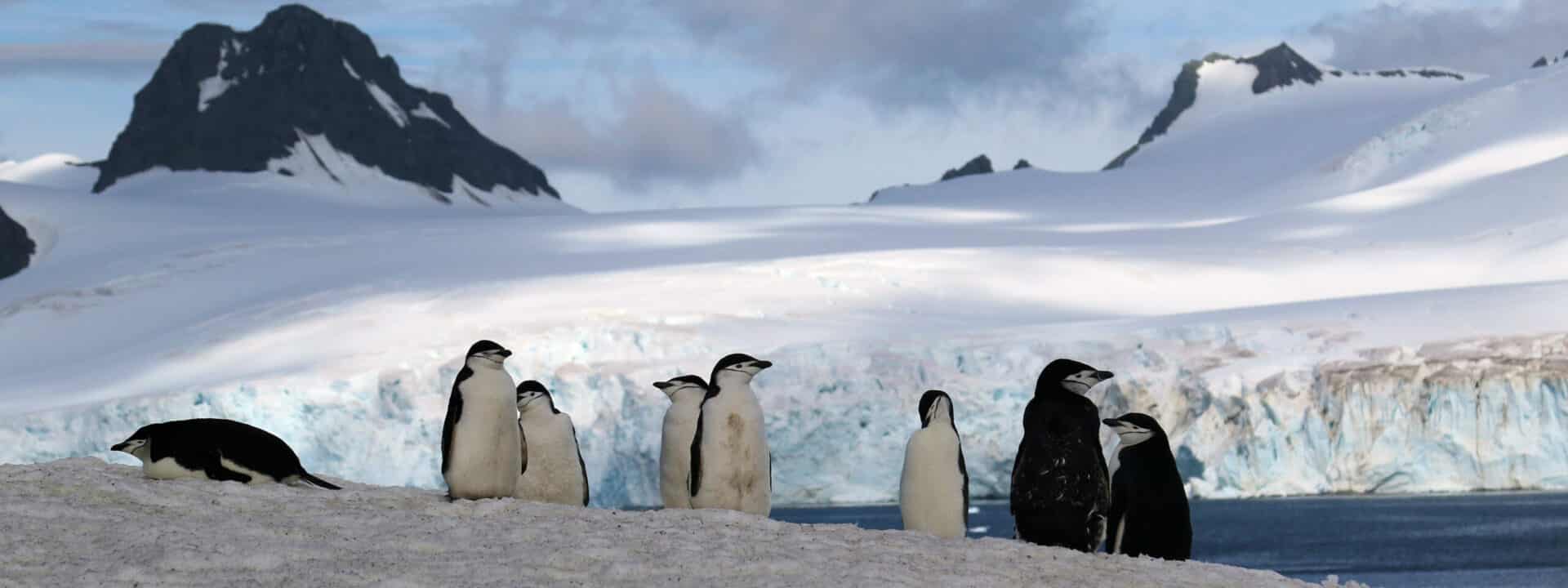
Our weather luck seemed to be holding, another glorious blue sky morning greeted us in berg choked Wilhelmina Bay in which we went for another Zodiac cruise amongst the ice. A pair of Snow Petrels were flying around a small berg as we just tried to take in the awe inspiring scenery once again. We had seen a few Humpbacks and fairly distant Antarctic Minke Whales early on and after returning to the ship enjoyed a bar-b-q lunch in the sunshine on the back deck. As we started steaming south I returned to the bridge for more watching. Just before we entered the Gerlache Straits again quite a number of Antarctic Minkes could be seen feeding ahead of us. A shout had the few of us running to the starboard side for a very close animal, again clearly visible in the pristine waters. Even though I stood next to Kees taking photos together, he got the shots, I didn’t. C’est la vie with cetacean photography. The Gerlache was pretty windy however with a lot of whitecaps and some us got nervous that we may not get ashore today. Andrew’s experience down here though came to the fore again and we were soon embarking the Zodiacs for another cruise and possible landing at Orne Harbour. We boarded the Zodiacs and went exploring below the cliff edges, upon which was a small colony of Chinstrap Penguins and Antarctic Shags. Some of the skuas here seemed to be classic pale-phase South Polars, rather than the much commoner Southerns (Brown). We finally got onshore on some rocks, just below the penguin’s walkway up the hill. We couldn’t get any closer to them however as a group of fur seals blocked our way. We still enjoyed great views of the Chinstraps marching up and down the icy slope whilst a few Gentoos were also nesting here.

We returned to our ship, realising, all of a sudden, tomorrow was our last day in the ice.


20th February

AM Landing and Zodiac cruise, Neko Harbour. PM Landing and Zodiac cruise, Culverville Island. Late PM at sea, heading north.

We sailed the short distance from our anchorage for our morning landing at a Gentoo colony at Neko Harbour. The addition of a pair of Adelie Penguins with them went down very well too. Another spectacular location with the cliffs above us capped with glacial ice. As we sailed in some of the ice had taken on the pink hues of the rising sun. We went exploring the berg choked bay in the Zodiacs for an hour or so, with group concern rising at the lack of Leopard Seal sightings so far, it was after all, our last chance.  Most people got great looks at a hauled out Weddell Seal at least. We sailed on towards our last landing, the large Gentoo colony at Culverville Island, yet another superb setting. Our last Zodiac landing was yet again enjoyed in sunshine, we really had been very lucky with weather. The colony was packed and with lots of well fed chicks. Another Adelie lay resting on the beach. As the last Zodiacs headed back to the ship, bingo! A last second Leopard Seal hauled out on an ice floe. Very impressively, passengers already back on the ship were brought back to see it to. We finally re-embarked the vessel and spent the rest of the afternoon and evening sailing towards the open ocean again. Most of us spent this time on deck, basking in the scenery with a final flurry of Humpbacks to wish us goodbye.


21st February

At sea, Drake Passage, flat calm and foggy.

Up on the bridge early for what I hoped was going to be a great day. The infamous Drake Passage  was certainly the Drake ‘Lake’ today, much to the joy of most of the passengers. As the day wore on visibility became poor due to fog. Over 12 hours of sea-watching produced about the same number of birds! It was deadly and without doubt, the only disappointing day of the trip, even the convergence was quiet. I spoke to two of my regular Antarctic tour leaders post-voyage and they both confirmed they have had similar days. The unpredictable nature of the ocean but still, no complaints after everything else we had seen.


22nd February

At sea, 1200 off Cape Horn, PM cruise into eastern end of Beagle Channel.

Our last full day, and all at sea. It was clear within an hour of starting watching it was going to be better than yesterday. We had slowed down and were heading for Cape Horn, due to arrive offshore around lunchtime. Lots of Black-browed Albatross again, a few Wanderers and another Northern Royal. A small pod of Orcas crossed the bows and quickly disappeared heading south. The other regular seabirds were also seen, Sooty Shearwaters, White-chinned Petrels, Wilson’s Storm-Petrels and two Cape Petrels plus two Common Diving-Petrels.  The captain got us pretty close to Cape Horn and everyone came back up to the bridge, you could even see the recently erected albatross statue, dedicated to all the mariners who have perished in these waters over the years. As we started moving off again a lone passerine was spotted heading for the ship, probably a Blackish Cinclodes. We finally slowly headed north to the Beagle Channel’s entrance, the wind and waves picking up as the afternoon wore on. Another group of Peale’s Dolphins were seen mid-afternoon. By the time dark fell, the Southern Ocean was roaring but we were already safely in the shelter of the channel.


23rd February

Disembark 0830 Ushuaia.

As we woke at dawn, our good ship was tying up back in Ushuaia, our fantastic voyage finally over. I don’t consider myself religious but there certainly is a heaven, it just happens to be frozen.


Species List


(Emperor Penguin 1 adult seen the following week in the Antarctic Sound by Simon Cook – we planned to go there but it was totally blocked by ice)

King Penguin

Gentoo Penguin

Adelie Penguin

Chinstrap Penguin

Rockhopper Penguin

Macaroni Penguin

Magellanic Penguin

Great Grebe

‘Snowy’ Wandering Albatross

Northern Royal Albatross

Southern Royal Albatross

Black-browed Albatross

Grey-headed Albatross

Light-mantled Sooty Albatross

Northern Giant Petrel

Southern Giant Petrel incl white phase

Southern Fulmar

Antarctic Petrel

Cape Petrel

Lesser Snow Petrel

Great-winged Petrel

Kerguelan Petrel

Soft-plumaged Petrel

Blue Petrel

Antarctic Prion

Slender-billed Prion

Grey Petrel

White-chinned Petrel

Great Shearwater

Sooty Shearwater

Wilson’s Storm-Petrel

Grey-backed Storm-Petrel

Black-bellied Storm-Petrel

Common Diving Petrel

Georgian Diving-Petrel

Neotropic Cormorant

Rock Shag

Blue-eyed Shag

South Georgia Shag

Antarctic Shag

Black-crowned Night Heron

Coscoroba Swan

Ruddy-headed Goose

Upland Goose

Kelp Goose

Crested Duck

Flightless Steamer-Duck

Falklands Flightless Steamer-Duck

Flying Steamer-Duck

South Georgia Pintail

Turkey Vulture

Red-backed Hawk

Cinereous Harrier (Rio Gallegos airport)

Chimango Caracara

Striated Caracara

Crested Caracara

Peregrine

Chilean Hawk

Magellanic Oystercatcher

Blackish Oystercatcher

Southern Lapwing

Double-banded Plover

Rufous-chested Dotterel

Baird’s Sandpiper

White-rumped Sandpiper

South American Snipe

Snowy Sheathbill

Chilean Skua

Brown Skua

Sub-Antarctic Skua

South Polar Skua

Dolphin Gull

Kelp Gull

South American Tern

Antarctic Tern

Arctic Tern

Austral Parakeet

Blackish Cinclodes

Dark-bellied Cinclodes

Bar-winged Cinclodes

Dark-faced Ground Tyrant

Austral Negrito

Chilean Swallow

Austral Thrush

Correndera Pipit

Long-tailed Meadowlark

Black-throated Finch

Black-chinned Siskin


Antarctic Fur Seal

Crabeater Seal

Leopard Seal

Weddell Seal

Southern Elephant Seal

Peale’s Dolphin

Hourglass Dolphin

Commerson’s Dolphins

Orca

Antarctic Minke Whale

Blue Whale

Sei Whale

Fin Whale

Humpback Whale

Southern Bottlenose Whale

(Possible Arnoux’s Beaked Whale)


Snow algae – red, green & yellow.


Many thanks to Andrew Prossin and his fantastic expedition team aboard our vessel, not forgetting Captain Poskoniy and his officers and crew. Thanks also to Simon Boyes & Markus Lilje for their birding company onboard. Special thanks to Ira Meyer, the ship’s photographer for showing me new ways to look at skies and ice.


Antarctica the Falkands
and S. Georgia
The Atlantic Odyssey
The Sub-Antarctic Islands of NZ
Antarctica for the Independent traveller
Antarctic Peninsula
Antarctic Peninsula & The Polar Circle
Antarctic Peninsula & The Weddell Sea
Antarctica, The Falklands & S. Georgia
Antarctic Icebreakers
Emperor Penguins
Welcome
Travel Agency
BirdWatching Introduction
BirdWatching Calendar
WIldOceans Introduction
Trinidad & Tobago Introduction
Mammal tours
Wildlife Cruises
Wild Insights
DeepOcean Expeditions
Space Adventures
Tour Reports