Adobe

Antarctica, the Falklands and South Georgia  2007

 Tour report by Dick Filby , Tour Leader

Go to Antarctica, Falklands and S. Georgia
Trip Reports

WILDWINGS LINKS

Welcome
Travel Agency
BirdWatching Introduction
BirdWatching Calendar
Predatours
WildOceans Introduction
Wild Insights
DeepOcean Expeditions
Space Adventures


Antarctica, The Falklands and South Georgia 2007

Tour Report by Dick Filby, Tour Leader.

Pre-tour Extension:

Feb 2nd 

We all met up in Buenos Aires airport in the morning but scarcely had time to sample the summer heat before it was time to head south on the flight to Ushuaia, once a security official had been found to open the security gate.  The ensuing security check was a nonsense, but never-the-less we boarded and set off.  The flight made an intermediate stop at El Calafate before we arrived at Ushuaia early afternoon.  Our transfer guide was awaiting us and we were soon at the hotel. After settling in and freshening up, those who wished took a pre-dinner stroll along the waterfront.  We soon saw several birds including Kelp and Dolphin Gulls, Crested Duck, South American Tern, Rufous Collared Sparrow, Bar-winged Cinclodes and some Flightless Steamer Ducks.

We headed for dinner, accompanied by Marcelo our guide for the next three days.  We enjoyed some excellent seafood and steaks, before retiring for the night, eager to sample the delights of Tierra del Fuego.

Feb 3rd 

After breakfast at the hotel we set off for the hills, driving up nearly as far as the tree line. Pausing enroute we enjoyed some Black-faced Ibis and some Southern Lapwings and at a subsequent stop our first Dark-faced Ground Tyrants and several delightful Thorn-tailed Rayaditos.

Heading up a seemingly invisible trail, Marcelo guided us expertly through the trees and up above the tree line in search of our main quarry – the White-breasted Seedsnipe.  Enroute we saw Black-chinned Siskins, White-crested Elaenias and more Thorn-tailed Rayaditos.  Approaching the tree line the fog closed in for a while but undeterred and aided by Marcelo’s GPS he took us to where he had seen the species recently.  Initially it seemed we were not gong to be lucky, so we spread out and it was not long before Martin, Marcelo and I saw two birds.  However they were able to elude the rest of the party, so it was only when Marcelo took us to a second part of the mountain where he had seen some only a few days earlier that we all managed to see them. Here we found an adult and a juvenile feeding on the bare hillside and we all had excellent views of these cryptically plumaged birds with the scopes.  Terry and I had both carried our scopes up and it was absolutely worth every ounce of the effort. The views were now to be savoured, sweetened of course with our seedsnipe success, and the walk back down was broken with pauses to photograph plants and the stream.

Back at the bus we headed towards town, diverting to see White-throated Caracaras, along with their commoner relatives, Southern Caracaras and the by now very familiar Chimango Caracaras.

After dinner we headed for bed rather than go owling, as the weather was not calm enough

Feb 4th

Setting off after breakfast we headed north towards Rio Grande.  We had not gone far before our first roadside stop, for an Andean Condor on a roadside cliff, plus several forest birds including Thorn-tailed Ryaditos, White-crested Elaenias and a White-throated Treerunner.  The road north was then punctuated with several more roadside stops, with birds seen including several more Andean Condors (seven in all) and some magnificent scenery.  Rio Grande itself isn’t much of a town, but we were there to find the endemic Magellanic Plover – and after a concerted effort during which we saw a wonderful group of five Least Seedsnipes, we finally had excellent views of one Magellanic Plover at a lakeside. The shore nearby had plenty of other waders, including Magellanic Oystercatchers, Two-banded Plovers, Hudsonian Godwits, Red Knot, Sanderling and White-rumped Sandpipers. We made a few roadside stops on the way home, before heading out to dinner. Other good birds of the day included Coscoroba and Black-necked Swans, Ashy-headed Geese, Red Shoveler, a couple of Baird’s Sandpipers, Austral Parakeets, Common Miner, Fire-eyed Diucon, Austral Negrito, Austral Blackbird, Grey-hooded Sierra-Finch, as well as a fox species and lots of Guanacos.

After dinner those who wished went owling and we had great views of two Rufous-legged Owls in a tree overhead.  It had been a long day – and a memorable one.

Main tour

Feb 5th

We headed to the Tierra del Fuego National Park, where the lush Southern Beech forest was a treat, filled with birds.  We made our way into the park, making various roadside stops, with some excellent successes. Four Austral Pygmy Owls, sitting just over our heads, followed by a Magellanic Horned Owl, calling as is sat astride a large bough, were amongst the best. We saw a single Andean Condor and a Black-chested Buzzard Eagle too, and several smaller birds, best of which were the tiny Magellanic Tapaculo that fed around our feet, the White-throated Tree-runner, whilst three Spectacled Ducks were quite a treat.  By mid afternoon it was time to head back to town and board the ship.  We had had an excellent and very successful time in Tierra del Fuego and now it was time to start the voyage at sea.

Having been greeted and shown our cabins we explored the ship, becoming familiar with the layout and the facilities.  We cast off from the dock and sailed down the Beagle Channel as the dusk gathered, seeing Black-browed Albatrosses, Magellanic Penguins, Magellanic Flightless Steamer Ducks and Southern Giant Petrels.  Lifeboat drill, dinner, logcall and bed.

Feb 6th

We awoke at sea with a fair following breeze that meant we enjoyed plenty of seabird action.  Albatrosses, petrels and shearwaters were the order of the day: Two Wandering Albatrosses, a Southern Royal, plus a Royal albatross sp, two Grey-headeds and scores of Black-broweds, plus Northern and Southern Giant Petrels, hundreds of Slender-billed Prions, some White-chinned Petrels, Great and Sooty Shearwaters, hundreds of Wilson’s Storm-Petrels, five Grey-backed and a single Black-bellied Storm Petrel.  A single Magellanic Diving Petrel early morning was one of only two on the trip.  A surprise came in the form of a White-crested Elaenia that flew around the ship several times before disappearing – hopefully it made it to land.  Mammals were represented by several South American Fur Seals and three Peale’s Dolphins that rode the bow wave for several minutes.


Presentations included being briefed by Dutch on IAATO, the organization devoted to responsible and sustainable tourism in the Antarctic regions, Flipper talked about the Zodiac and life jacket routines in preparation for our first planned landing tomorrow,  Peter talked about the proper use and care of binoculars and Lynn told us all about seabirds in the Southern Oceans.


To properly prepare us for our first dinner at sea, Callum and Jim offered a wine-tasting and after dinner we did the WildWings log and Jim gave a brief bar story.


Feb 7th


A bright and sunny dawn found us approaching East Falkland, surrounded by Sooty Shearwaters.  Before long we were in sight of Port Stanley, the red and blue roofs strung out along the shore.  In the harbour Rock Shags and Imperial Cormorants fished alongside Magellanic Penguins, Kelp and Dolphin Gulls patrolled and Falkland Flightless Steamer Ducks skittered away on our approach.


Once cleared by the officials we headed to shore and took a bus out towards Gypsy Cove.  Between squalls the birding was great, with Ruddy-headed Geese as well as the much more numerous Upland Geese, Dark-faced Ground Tyrants, Long-tailed Meadowlarks, Black-throated Finches, Black-chinned Siskins and a Correndera Pipit.  On the beach we found plenty of Magellanic Penguins along with two King Penguins.  The beach was out-of-bounds due to mines left over from the 1982 conflict, but we enjoyed its bleak splendour and the wildlife obviously thrives in the tranquillity. Some of the Magellanic Penguins were around their burrows amongst the tussac grass, allowing close approach.  Also in the grass were some Sedge Wrens.  Turkey Vultures lingered around the cliffs, where Rock Shags fed nearly fledged young and overhead a Red-backed Hawk flew over.  We walked back to the first beach now that the tide had dropped and several Rufous-chested Dotterels were now feeding alongside small groups of White-rumped Sandpipers. We hopped onto our bus and headed back to town and had a free afternoon, most of us enjoying some time in the small but interesting and packed museum, wandering the waterfront to photograph Kelp Geese, Falkland Flightless Steamer Ducks and other birds, pop into the shops for a postcard or souvenir, or some even dropped into one of the pubs to have a pint!


We headed back to the ship, and a lucky few were treated to bow-riding Commerson’s Dolphins. We sailed overnight for Bleaker Island.


Feb 8th


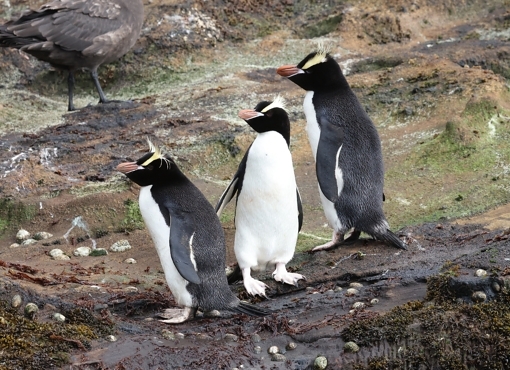
We were offered an early landing at 6.30 which most of the group took in order to spend longer on the island, whilst others made a later start after a leisurely breakfast.  Onshore we headed through the farm buildings, past ludicrously tame Blackish Cinclodes and across the pasture to the cliffs where we found Rockhopper Penguins beyond a large, spectacular Imperial Cormorant colony.  Early on many penguins were still on the clifftop, but as the day grew older, most of the birds hopped and bounced down the cliff to enter the turbulent sea.  It was great to watch, photograph and film.  Alongside there were Rock Shags on the ledges, giving excellent views and our first Snowy Sheathbills scavenged for scraps.  The more energetic of us abandoned the cliffs and strode off across “the camp” past large flocks of Two-banded Plovers and White-rumped Sandpipers to reach a group of Gentoo Penguins which posed nicely at the top of the far beach.  On a small lagoon were a few Silvery Grebes, and back near the jetty a couple of folk saw a Striated Caracara.  The ride back to the ship was wet and blustery – an adventurous conclusion to a great landing.  Some great sea-watching followed in the evening, Black-browed Albatrosses were all around, there were lots of Sooty Shearwaters, a single Great, scores of Wilson’s Storm Petrels and at least 60 Grey-backed Storm-Petrels, an exceptional showing of the latter, and our first Soft-plumaged Petrels.  Our Falklands visit had been excellent.


Feb 9th


With The Falklands behind us we were heading east toward South Georgia with a gentle following sea and fine weather. The sea-watching was excellent, with highlights including six Grey Petrels (the only ones of the voyage), lots of Soft-plumaged Petrels, many giving excellent views, a single White-headed Petrel, 10 or more Wandering Albatrosses and a single Southern Royal Albatross plus few Grey-headed and Black-browed Albatrosses. Everyone who has ever seen on will remember their very first Cape Petrel – and today we saw the first one of this voyage – a precursor of the flocks to come. There was also a single Black-bellied Storm-Petrel.


Indoors Peter explained Alfred Wagener’s theory of continental drift, Lynn talked about whales in the morning and in the afternoon about seals, whilst John began his history of the British Antarctic Survey. Meanwhile Jim attempted to persuade us that the Irish were the first to discover America.


Feb 10th


Another great sea day. On the birding side the action was dominated by albatrosses, with several Wandering, many Black-broweds, at least 20 Grey-headed and six Light-mantled Sooties (our first of the trip).  Other highlights included our first Snow Petrels, many Antarctic Prions, lots of Soft –plumaged Petrels and at least 200 Black-bellied Storm Petrels.  Four King Penguins were a long way out to sea!  On the mammal side we saw our first Antarctic Fur Seals, had two sightings of Hourglass Dolphins (one, then three), a possible Sperm Whale, at least 20 Fin Whales, three Humpbacks, and at least 15 more unidentified whales. 


There was also a full programme of lectures inside. Callum did the early history of Antarctic exploration, John explained why Antarctic scientific research is important for the world as a whole. Lynn talked about penguins including some things we were afraid to ask, and Dutch gave us an introduction to South Georgia.


All the while falling sea and air temperatures gave evidence that we were entering the area of the Antarctic Convergence, where two great oceans meet but do not mingle!  A kind of moving boundary.  Tomorrow - South Georgia.


Feb 11th


We approached South Georgia with great expectations and were soon seeing Macaroni Penguins in the water! Soon after breakfast we were onshore at one of the best sites - the vast King Penguin rookery of Salisbury Plain.  Perhaps a quarter of a million King Penguins were there to greet us!  As each Zodiac got ashore in the big surf, they came to greet us, small committees shuffling forward, curious to inspect us.  We repaid the attention, transfixed by the scenes surrounding us, barely capable of taking it all in.  We walked a few yards at a time, stopping to take more pictures or just to stare. We clambered a few feet up a tussocky slope to get an overview, and watched tiny chicks being fed, other adults incubating, whilst others still ran the gauntlet of the beaks as they tried to get back to their partner or down to the beach. We saws our first South Georgia Pintail but they paled into near insignificance compared to the King Penguin rookery. All too soon it was turn to head for the ship, lunch and the afternoon’s activities.

Big seas precluded visiting Prion Island so we headed along the coast to the shelter of Possession Bay, the site of Captain Cook’s first landfall at South Georgia.  Here, at King Olav Harbour where despite winds gusting to 40 knots, we were able to do a Zodiac cruise. South Georgia Shags were present in good numbers, and it was fascinating to see the ruins of the whaling station, now taken over by Fur Seals, Elephant Seals and a few King Penguins.  The Zodiac ride was bracing and we certainly felt hat we had earned our dinner.


Feb 12th


There was an early rise for some, at 4:30, as we prepared to disembark to follow in Shackleton’s footsteps from Fortuna Bay to Stromness. Alas, the weather conspired against us, with 50 knot winds, whitehorses and snow squalls, so we headed instead for a “big ship tour” of Leith and Stromness whaling stations. The Captain brought us within two hundred metres of the shoreline so that we had a perfect view of these ruined stations. From the ship we could see hundreds of fur seals, elephant seals and reindeer.

In the afternoon we went ashore at Grytviken, the first whaling station to be established in South Georgia in 1904.  Now it has been made safe for visitors, with the dangerous outer structures of most buildings removed, and a small museum and gift shop.  We started our landing with a toast to Sir Ernest Shackleton “The Boss” at his grave, before setting off on what I expected to be a mainly scenic walk. That said the walk started with terrific views of Elephant and Fur Seals, King Penguins and a South Georgia Shag, before encountering some nesting Antarctic Terns. We also passed the ruins of an Argentine Helicopter, destroyed in the 1982 conflict.  On arrival at the overlook that was our destination we enjoyed the view before realising that we could hear Light-mantled Sooty Albattrosses calling from the cliffs beneath us. Sure enough with a little extra searching we found several chicks and accompanying adults esconced on the cliffs.  Terrific scope views, great pics (Michael we must see your video!) were the result.  We made our way back to see the whaling station, visit the museum and shop, before getting back on board for an evening barbecue.

Fittingly, to wrap up the evening, Ben offered the movie “The Endurance”, tracing Shackleton’s epic journey from the Weddell Sea to Elephant Island and thence to South Georgia.


Feb 13th


We awoke off St Andrews Bay in 30 knot winds and fog, but headed into the bay just in case there was a weather window – and there was! What a magic morning we were rewarded with!  Welcomed ashore by a solitary Chinstrap penguin, along with a couple of hundred thousand or more King Penguins as well, and some aromatic Elephant Seals, words failed us.  The scene was absolutely filled  with wildlife:  as we stared across the bay at penguins, seals, fur seals, and in the distance a herd of South Georgia Reindeer it was again hard to take it all in.  A few Gentoos and a single Macaroni Penguin, it was seemingly all here. Even the clouds cleared to reveal the jagged peaks surrounding the bay, and the sun appeared to round it all off.  It was bliss indeed.

During lunch the ship repositioned to Royal Bay where another treat awaited. Against the now familiar spectacular backdrop of South Georgia, we loaded into the Zodiacs to enjoy a cruise to a colony of Macaroni Penguins, on a steep tussac-covered shore. We had terrific views on the offshore rocks, watching as they lunged into the seething surf, bouncing apparently unharmed against the rocks before heading to sea. Others, returning, reversed the process appearing as if by magic from the surf, to scramble onto dry land. The wind picked up as we headed back to the ship - Antarctica, here we come!

Feb 14th


Throughout the morning, the stormy Scotia Sea provided the quintessential southern ocean experience. Black-browed Albatrosses cruised by with ease, accompanied at times by Wandering, Gey-headed or Light-mantled Sooty Albatrosses. Thousands of Antarctic Prions, accompanied by just a couple of Blue Petrels kept us on our toes, and three Southern Right Whales were a treat indeed. Icebergs in ever varying forms slid past the ship, and shortly before lunch the Captain provided a superb close view of a massive iceberg which he circled with the ship. The sculpted beauty and remarkable depth and range of blues within the ice meant the camera shutters were clicking wildly.


Throughout the afternoon, we continued our way southwest, again with much wildlife seen.  As if from nowhere a mother and calf Southern Right Whale appeared right off the bow of the ship, giving the dedicated members of the group some magnificent views.  A little later we passed close by two Fin Whales. The day’s total of Snow Petrels rose to four, and we also had a single Soft-plumaged Petrel.


During the day a full slate of presentations was given. John talked about the “ownership” of Antarctica whilst Lynn provided a comparison of the polar regions. In the afternoon, Dutch outlined the proposed itinerary for the rest of the voyage, while Callum talked of the Shackleton expeditions. By evening the winds had risen once more, and we were sailing in the grips of a Force 9 gale, again demonstrating the rapidity with which conditions change in these southern latitudes. A slowly sinking sun, however, backlit the steady procession of icebergs, creating a glowing panorama. It was a fitting conclusion for a memorable day on the Scotia Sea.  We were glad to be on such a sturdy and comfortable ship, which enabled us to enjoy the conditions with ease.


Feb 15th


Having crossed the 60th parallel, we awoke to “Antarctica”. A noticeable drop in temperature greeted us and we found ourselves in fog threading our way through icebergs to left and right.  There were still a few Black-browed Albatrosses, Grey-headed and Light-mantled Sooties and even a lone Wanderer – he was a bit far south. We saw our first Southern Fulmars, a lone Blue Petrel, and our first Antarctic Shags.


We had a special talk after breakfast when Jean gave us a talk on the Scottish National Antarctic Expedition of 1902-1905, led by William Spiers Bruce, on which her grandfather Captain Robertson was skipper of the expedition ship Scotia.  It was especially poignant, because we were shortly to see Laurie Island, South Orkney, where the expedition overwintered.  As we approached we were treated to an iceberg spectacle as the Captain weaved the ship through the myriad of grounded bergs that mark the shoals south of the islands.

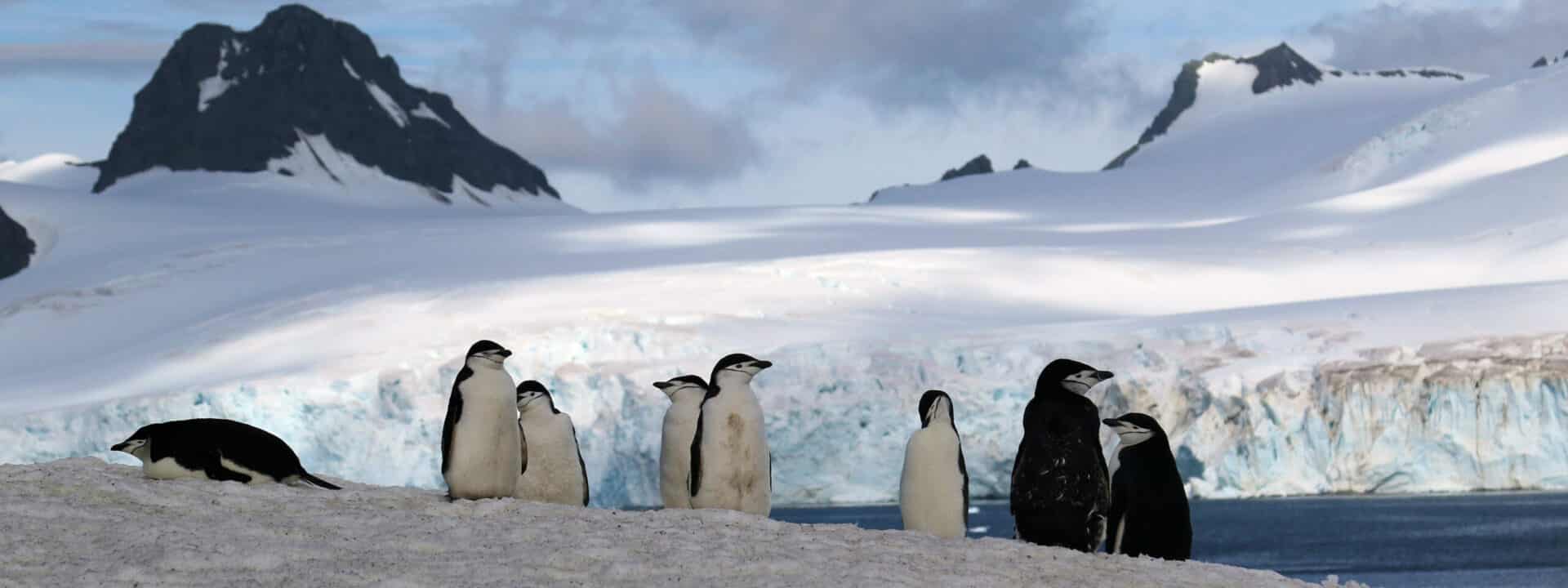
After lunch the afternoon saw us heading into Scotia Bay on Laurie Island.  Some headed off to Orcadas Station for a visit, the Argentinean station personnel ashore welcoming their visitors generously with guided tours, a small museum, hot coffee and a shop.  We had our hearts set on another mission - Chinstrap Penguins.  We took the zodiacs along the edge of the bay and landed at a Chinstrap colony where we got the full experience!  Lots of chicks, noisy adults, and plenty of smell!   Other highlights of the afternoon included several Elephant Seals, many Antarctic Fur Seals and a couple of Weddell Seals.  High above Cape Petrels wheeled around their nesting cliffs, occasionally accompanied by a Snow Petrel. 

Feb 16th


Still heading southwest, a light snow covering the decks greeted us early morning. The seas were smooth and a grey dawn soon gave way to sunny skies. It was not long before Martin reported a pod of eight Orcas, the first of two pods today (the second group had five animals). People tumbled onto the outer decks, several still in night attire to see these superb mammals.


During the day we saw at least 25 Kerguelen Petrels – a real treat!  Also our first Adelie Penguins, as well as several Chinstraps, surprising yet another Wandering Albatross as well as several Black-browed, at least two Grey-headed and at least five Light-mantled Sooties.  The mammal highlight for some was close views from the bridge of a Southern Bottlenose Whale, which we even managed a couple of pictures of.  Again it was a reward for those who put in the time on watch – as it was only seen for a few moments like beaked whales so often are.  Throughout the day an endless procession of icebergs of every shape and hue, including many deep blue ones, provided an ongoing display.


Presentations were given throughout the day. In the morning John spoke on Antarctic governance, Lynn gave an overview of Antarctica’s penguins. During the afternoon Callum spoke of four famous Antarctic expeditions while Peter unravelled some of the mysteries of ice and icebergs.


During dinner more whales appeared, bringing the day’s total of individuals past sixty, of five species! Orca, Southern Bottlenose, Southern Right, Fin and Antarctic Minke. Once more the WildWings group led the emptying of the dining room as folks streamed onto the decks.


As we went to bed we knew that we were in reach of the Antarctic Peninsula for an anticipated arrival tomorrow morning!


Feb 17th


We awoke to our landfall on the Antarctic Peninsula – the Danger Islands!  With the weather overcast but calm and visibility extensive, we were delighted by the magnificence of the rank on rank of tabular bergs intermixed with fantastical blocks of ice of every shape and form.

South Polar Skuas, Adelie and Chinstrap Penguins, Cape and Snow Petrels were often to be seen as we approached Paulet Island.  The sun appeared highlighting the mountains of Joinville and Dundee Islands (so named by Jean’s grandfather Captain Robertson), while the ship weaved her way through a field of bergy bits and floes. 

After breakfast we landed on Paulet Island - named in 1843 by James Clark Ross for Lord George Paulet of the Royal Navy.  Although most of the Adelie penguins had departed, some remained, and their smell definitely had not!  There were also many Antarctic Shags, nesting in a small colony near the beach, as well as a pair of Snowy Sheathbills and a few Weddell Seals lounging on the beach.  We also saw the remains of Captain Larsen’s hut and the grave of Øle Wennersgaard, the only member of the Swedish Antarctic Expedition to die during their 1902-04 ordeal in the ice.  Cruising the ice floes and bergy bits on the way back to the ship was a rewarding experience.

In the afternoon we sailed into Erebus and Terror Gulf, to the southeast of the Tabarin Peninsula, and into another spectacular seascape of bergs and floes, including one tabular berg 2.7 miles long, estimated by some to weigh more than a billion tons!  We headed southwest through a glassy calm sea until we reached the edge of a large expanse of fast ice.  Several Crabeater and Antarctic Fur Seals rested on the expanse.  The Captain couldn’t resist nosing the bow into the ice, just a little, until it cracked, and then took us back out past the leviathan tabular bergs towards Antarctic Sound, with the setting sun turning the ice deeper and deeper shades of pink.  Scones and hot chocolate were served on the bow.  By the end of the day we had counted 29 Weddell Seals, six Leopard and six Crabeater Seals, as well as at least 100 Antarctic Fur Seals.

Feb 18th


We awoke on another fine morning in an iceberg dotted Antarctic Sound heading for our morning landing at Brown Bluff where we landed after breakfast.  Adelie and Chinstrap Penguins could be seen on the bergy bits and floes, and as we approached we saw the first of several Antarctic Minke Whales (a total of eight seen today) The magnificent volcanic bluff stands 745 metres above a black cobble beach. To either side, glaciers reach the sea slowly transporting snow and ice from the smooth dome of the ice cap above. Bands of ochre, grey and yellow strata tell of past eruptions, while boulders littering the beach bear witness to the intensity of the eruptions. and subsequent frost shattering of the bluff.

As we headed to shore at least one Antarctic Minke Whale appeared close to hand, a Leopard Seal lounged on an ice floe, and nearby there are Antarctic Fur Seals and Crabeater Seals. As we land we see Adelie and Gentoo Penguins lined up close to the water, whilst above, Cape (Pintado) and Snow Petrels wheeled across the face of the bluff, where they nest. Several Leopard Seals were on the ice just offshore.  It was a fantastic morning.

Back on board for lunch we proceed to sail westwards through the Antarctic Sound and into the Bransfield Strait.  The scenery is stunning, punctuated with close encounters with Humpbacks, more seals on floes, as well as Cape and Snow Petrels and Southern Giant Petrels.  Inside there was a panel discussion of issues concerning Antarctica.  At 5:30pm a few hardy souls took the challenge of entering Antarctic waters by taking a plunge into the ship’s pool. For spectator and participant alike it was memorable!

Feb 19th


We have progressed much further south overnight and awake off Trinity Island.  A large flock of Cape Petrels flys laps around the ship, swooping and diving in a “pigeon-like” manner.  It was a grey dawn, but soon the sun was shining giving us a glorious introduction to the mountains and glaciers of the north west Antarctic Peninsula.  An abundance of whales was the major highlight of the day and we started early with both Orcas (somewhat distantly) and Humpbacks too. By the day’s end we had recorded at least 17 Orcas (in two pods), at least four Antarctic Minke Whales, and 17 Humpbacks.  We headed into Mikkelsen Harbour where we zodiac cruised with an adult Humpback and calf that gave us a most wonderful experience.  Then there was an even closer encounter with a Leopard Seal weaving very close to our zodiacs and giving us some very close up and personal views. 


We landed on the small (un-named) island, where there were masses of whale bones – a legacy of the early whaling endeavours from the turn of the last century. Nesting Gentoos were in abundance, offering plenty of photo opportunities, whilst Kelp Gulls and Antarctic Terns cruised overhead.  At the end of the landing a few hardy souls took up the challenge of joining the Antarctic swimming club, including one in a penguin costume!


Then, time to head back to the ship for a late but very welcome lunch whilst the ship repositioned to Curtis Bay for yet more fabulous cruising and kayaking!  Splendid views of Leopard Seals were very much the order of the day – we wound up seeing at least 20.  The day was very much one for the mammals and the splendid scenery and experiences of being here. 


Feb 20th


05.30 and Dutch’s voice gave a wake up call for our planned pre-breakfast zodiac cruise in Cierva Bay. As we rose to look out the portholes, snow was gently falling, coating the decks, and settling on the sea too!  Indeed the sea was covered with brash ice – a soup of ice bits, varying in size from tiny to significant chunks of up to one metre or more in width. This would be an exciting run: moving away from the gangway ice crowded the pontoons and crackled as it passed astern. Large icebergs were in shades of blue against a deep dove-grey sky. Several Gentoos stood sentinel on the ice. Leopard Seals made clandestine appearances as they stole through the brash in search of penguins. Several minkes were spotted in open leads, one made passes quite close to our Zodiacs. The kayakers, not to be outdone by cruising Zodiacs, headed out for a unique paddle through this frozen sea. Returning to the ship, everyone dug into a hearty breakfast. We set course away from the Antarctic Peninsula, heading across the Bransfield Straight for Deception Island on the South Shetlands.  For those not on watch, Peter gave a presentation on adaptations of seabirds. 


From the comfort of the bridge we kept watch and by the day’s end had seen a Light-mantled Sooty Albatross, a few Black-broweds, three Grey-headed, as well as the by now customary Cape Petrels, Southern Fulmars and Wilson’s Storm Petrels plus at least four Antarctic Minke Whales, three Fin Whales, and half a dozen Humpbacks.


As the afternoon progressed, the pressure dropped dramatically, the seas kicked up and we were into gale force winds. Once again a reminder of how quickly conditions can change in Antarctica. The planned visit to Deception was called off due to the conditions and instead there was the option to explore the unseen depths and recesses of the Ioffe on guided ship tours.  For those of us outside it was time to bid a fond adieu to Antarctica and the ice.


Feb 21st


We awoke to a seemingly “empty” sea – no ice or icebergs anywhere. We had in effect left Antarctica behind us as we headed north into Drake’s Passage this morning, although technically we were still in Antarctica until we crossed the 60th parallel early afternoon.  A few Chinstrap Penguins reminded us the continent was not far behind.  As is usual this day was fairly quiet for sightings, but we still managed a single Wandering Albatross, another large albatross, possibly a Southern Royal, 20+Grey-headed Albatrosses and four Light-mantled Sooties.  Most notable birds perhaps were 20+Soft-plumaged Petrels, as well as 10 more Blue Petrels, a single Sooty Shearwater and several Wilson’s and Black-bellied Storm Petrels.   On the cetacean front we saw at least 15 Fin Whales, with perhaps another 50 or so large rorquals – possibly all this species also, as well as two Humpback Whales – the last of the trip..  As the day progressed the pressure rose and the wind eased, making for an ever more comfortable crossing.


In the morning John regaled us with life as a winterer in Antarctica 40 years ago – one shower a week and only five gallons of water for it!  Meanwhile Lynn talked about how we are trying to conserve Antarctic Wildlife.  After lunch Callum introduced us to the amazing lives of the Indians of Tierra del Fuego, now sadly long passed into history, and Peter weaved us a planetary tapestry, comparing the Amazon with Antarctica. The day wrapped up with a fancy-dress dinner, with some truly creative works of costuming along the wide open themes of Explorers, Film Stars and Favourite Animals, followed by Duncan’s “favourite questions” in the bar, and the final episodes of Life in the Freezer.


Feb 22nd


The day dawned with us only 60 miles south east of Cape Horn, rolling along on a big swell from the northwest, with a 30-40 knot wind from the southwest producing a confused sea state and some great waves over the bow.  Photographers loved it!  After lunch we were in the shelter of the land and heading towards the Pilot Station.  Birding was good today, with Wanderering, Northern Royal, a possible Southern Royal, Grey-headed and plenty of Black-browed Albatross, as well as a single Cape Petrel still with us, plus another 15 or so Soft-plumaged Petrels, a single Magellanic Diving Petrel, Chilean Skua and many Imperial Cormorants too.  We saw three different small parties of Peale’s Dolphins, consisting of a group of three, four+ and another group of three.


For those not on watch there was the movie “Rounding The Horn”, a silent movie shot in the 1920s by an amateur photographer/crew member on one of the last of the wooden clipper ships, and narrated by him sixty years later.  Around 1 p.m., Cape Horn hove into view between squalls, moving rapidly with 50 knot (Force 10!) winds.  After rounding the famous landmark, where thousands of sailors have lost their lives in even worse storms since it was first navigated by Schouten and LeMaire in 1616, we put our back to the wind and sailed more serenely round to the mouth of the Beagle Channel.  En route, we were entertained by Dutch, with his trip recap and a showing of the ‘best of’ photos. Some of us dressed up for the last dinner on board, as we lay at anchor off the pilot station.  The Captain joined us and made an elegant speech.


Feb 23rd  Ushuaia


We came alongside early morning and thus concluded our excellent trip.  The WildWings group all took the opportunity to book a trip out to the National Park with Marcelo and avoid waiting around in town.  The hardest part was leaving the park to return to the airport to begin the long journey home.


It was another excellent trip – thank-you to all the group for booking and making it extra special.

Dick Filby


www.wildwings.co.uk


| home | introduction | news | late availability | media resources | brochure request | booking form & conditions | contact us |
WildWings, 577 Fishponds Road, Fishponds, Bristol. BS16 3AF.UK
| Tel: 0117 9658 333 | Fax: 0117 9375681 | Email: wildinfo@wildwings.co.uk |